Spinning Through Space: Why Celestial Bodies Rotate

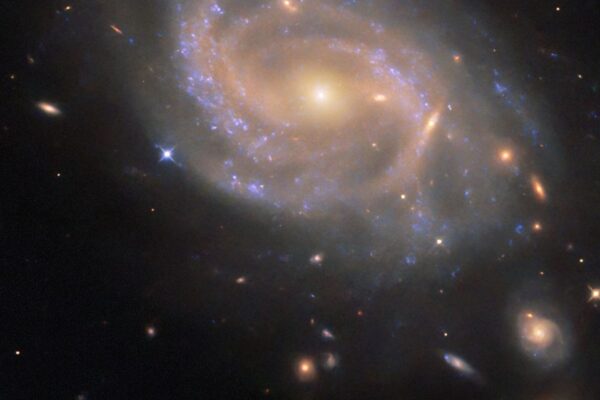
Why does everything in the universe spin?Rotational motion plays a fundamental role in shaping the cosmos-from planets and stars to galaxies and black holes. This paper explores the physics behind rotational motion, including the principles of angular momentum conservation and the influence of collisions and cosmic explosions in generating spin. Drawing from personal experiences in…

Read More

Black Holes, Wormholes & Time Loops: A Journey Through Spacetime

The mysteries of space have fascinated scientists and dreamers alike. Among the most mind-bending phenomena in the cosmos are black holes, wormholes, and the concept of time loops. These aren’t just science fiction—they are rooted in the mathematics of Einstein’s relativity and the latest frontiers of astrophysics. Let’s explore how these cosmic concepts may shape…

Read More

Curiosity’s New Adventure: Entering the Uyuni Quad (Sols 4573–4574)

Over the weekend, Curiosity successfully wrapped up its science activities at the “Altadena” drill site and resumed driving. After completing a 48-meter (157-foot) drive, the rover entered a new exploration zone—informally called a mapping “quad.” To give some context: Curiosity’s team divides the exploration area into square regions, each 1.5 kilometers wide. The team names…

Read More

🌌 Interstellar – Where Science Fiction Meets Real Astrophysics

At AstroDrive.fun, we explore the universe — not only through telescopes and satellites, but also through ideas that stretch our imagination. That’s why today we’re diving into Christopher Nolan’s masterpiece, Interstellar — a film that isn’t just fiction, but a cinematic journey rooted deeply in real astrophysics. While movies often bend science for storytelling, Interstellar…

Read More

☀️ When the Sun Becomes a Red Giant: What About the Outer Planets & Moons?

1. What’s a Red Giant? 2.Outer Planets: Farther, But Warmer As the Sun loses mass and expands, the gravitational grip on the outer planets will weaken, allowing orbits of planets like Jupiter and Neptune to drift outward. Despite this distance, these outer worlds will receive more solar energy than they do today. 🌐 NASA Exoplanet…

Read More

🔭 What’s New in the Sky – June–July 2025

1. June 10–11: Strawberry Moon The “Strawberry Moon” rises low on the horizon, appearing unusually large and tinted orange-red due to atmospheric scattering. Best viewed just after moonrise near midnight.Source: NASA, Space.com 2. June 16–17: Mars–Regulus Conjunction Mars and Regulus (the brightest star in Leo) will appear only about 0.5° apart—close enough to see together…

Read More