
A Rare Sky Show Is Coming — April 18 Will Be Special!
Hello again, sky explorer!
If you thought the April 18 planetary alignment was just a simple sky event… there’s actually a much deeper and more fascinating story behind it.
A Cosmic Scene Unfolds
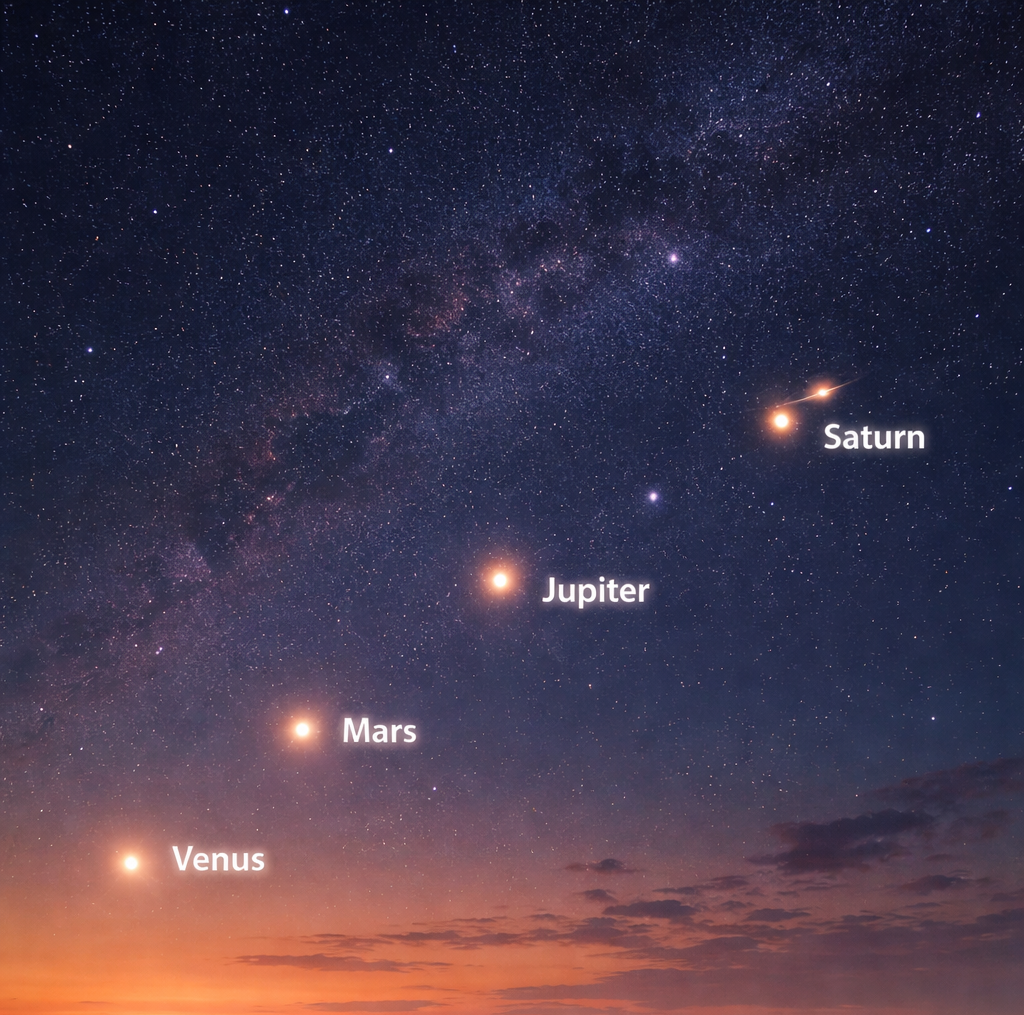
As twilight fades over Chattogram, the sky slowly transforms into a stage. First, a bright light appears… then another… and then more.
But these aren’t just distant stars.
They are entire planets—massive worlds—revealing themselves one by one.
For a brief window of time, four planets—spread across hundreds of millions of kilometers—will appear together, as if they’ve gathered for a silent cosmic meeting.
The Deeper Story of Each Planet
Venus — The Dazzling Twin
Venus is often called Earth’s “sister planet” because of its similar size.
But don’t be fooled—its surface is a burning hell, hot enough to melt metal.
Yet from Earth, it looks peaceful… the brightest object in the night sky after the Moon.
Mars — The Dream of Humanity
Mars has captured human imagination for centuries.
It’s the planet where scientists are actively searching for signs of past life—and maybe one day, humans will walk there.
When you see that faint red glow, you’re looking at a world we may one day call a second home.
Jupiter — The Protector
Jupiter is not just big—it’s massive beyond imagination.
Its gravity acts like a shield, pulling in comets and asteroids that might otherwise threaten Earth.
In a way, this giant planet has quietly helped protect life on our world.
Saturn — The Beauty of the Solar System
Saturn is famous for its rings—made of ice and rock, stretching thousands of kilometers.
Even though you can’t see the rings with your eyes alone, just knowing they’re there adds a sense of wonder to that tiny point of light.
Why This Event Feels Special
Planetary alignments happen from time to time—but seeing four bright planets together is always exciting.
Larger alignments (with 5, 6, or even 7 planets) are much rarer, making this event a perfect chance for casual skywatchers to experience something memorable.
What Makes This Alignment Scientifically Interesting?
This event is a result of orbital mechanics—the precise and predictable motion of planets around the Sun.
Each planet moves at a different speed:
- Mercury completes an orbit in just 88 days
- Earth takes 365 days
- Saturn takes nearly 30 years
Because of these different speeds, alignments like this are temporary—a fleeting arrangement in a constantly changing system.
Simple Explanation: Why Do They “Align”?
Here’s the fascinating truth:
All planets orbit the Sun in a flattened path called the ecliptic plane. Think of it like lanes on a cosmic highway.
Sometimes, from Earth’s point of view, several planets appear along this same path at once.
They don’t actually form a perfect straight line in space—but they appear aligned in the sky.
It’s a trick of perspective… but a stunning one.
Timing Details You Should Know
To truly enjoy this event:
- Evening Viewers:
Look just after sunset—Venus and Jupiter will likely stand out first - Early Morning Viewers:
Before sunrise, you may spot Mars and Saturn - Best Conditions:
- Clear horizon
- Minimal clouds
- Away from bright city lights
A Rare but Gentle Reminder
No explosions. No dramatic changes in gravity.
Just a quiet, elegant alignment.
But sometimes, the most powerful experiences are the simplest—
just looking up and realizing how vast everything is.
A Human Connection to the Cosmos
Think about this:
Every civilization in history—from ancient astronomers to modern scientists—has looked at these same planets.
The difference?
Today, we understand what they are.
We’ve sent spacecraft to Mars, flown past Jupiter, and studied the rings of Saturn up close.
Yet, the feeling of wonder… remains exactly the same.
So when the night comes, don’t rush.
Pause. Look up. Stay a little longer.Because in that moment, under the aligned planets,you’re not just watching the universe…
You’re part of it.