
Dark Sky Window
Welcome, STARGAZER,
Close your eyes for a moment. Now imagine pulling back a curtain not to a street, not to a parking lot but to a universe that has been burning for 13.8 billion years. Every single star you see through that glass has a story older than the Earth itself.
We spend our entire lives indoors, staring at glowing rectangles, never once realizing that the most spectacular light show in existence is happening above our heads every single night for free, forever waiting patiently for someone to simply look up.
The dark sky window is more than a view. It is a portal. Step through it and suddenly distances become incomprehensible, time bends and your everyday worries shrink to something beautifully, almost comically, small. The universe does not need you to understand it. It just needs you to notice it.
What Is a Dark Sky Window?
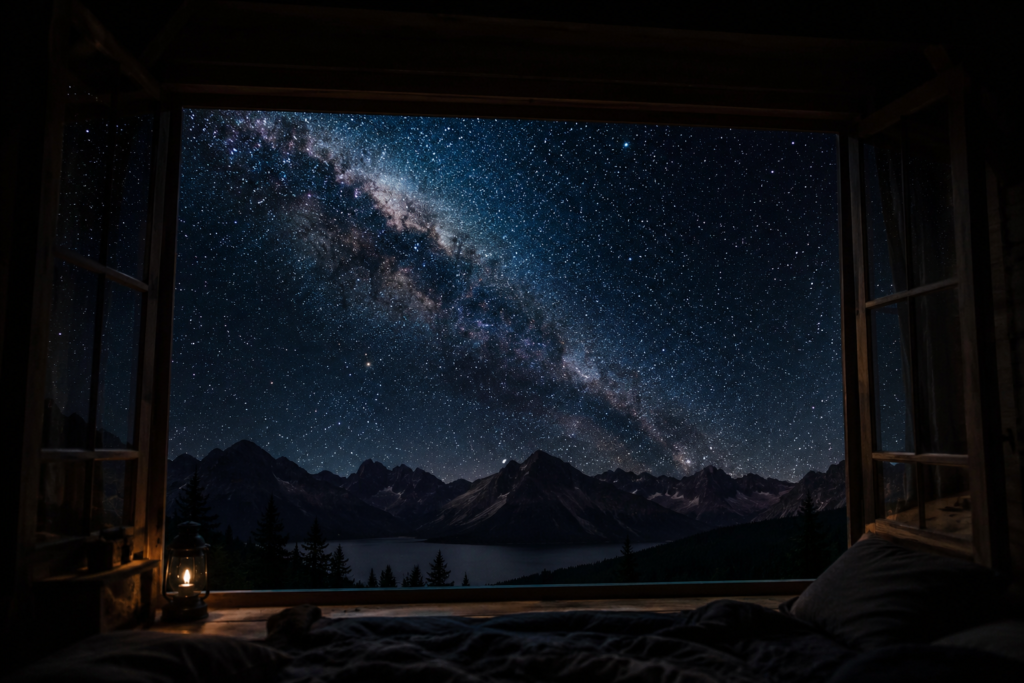
A dark sky window is essentially any view from a room, a cabin, a rooftop or a hillside that opens directly onto an unpolluted, unobstructed night sky. It is the opposite of what most city dwellers experience. No orange haze from streetlights, no skyscrapers cutting the horizon, no smog blurring the stars. Just pure, deep, unfiltered darkness dotted with billions of points of ancient light. Think of it as nature’s own cinema screen one that has been playing the same beautiful show since before humans existed.
Why the Night Sky Is Disappearing
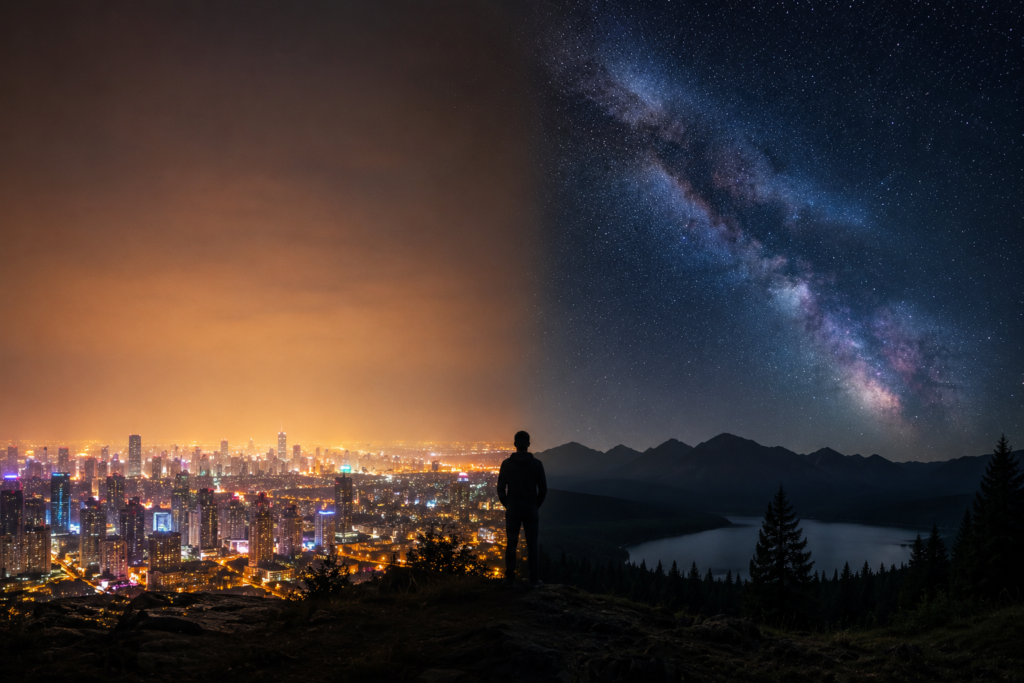
Believe it or not, the majority of people alive today have never seen the Milky Way with their own eyes. Light pollution the excessive and misdirected use of artificial light has washed out the night sky above more than 80% of the world’s population. Cities glow so brightly from above that satellites can map human civilization just by photographing Earth at night. Every streetlight, billboard and office window left on after hours bleeds into the atmosphere and creates a permanent artificial twilight. The stars are still there. We have simply buried them under our own brightness.
The Science Behind a Dark Sky
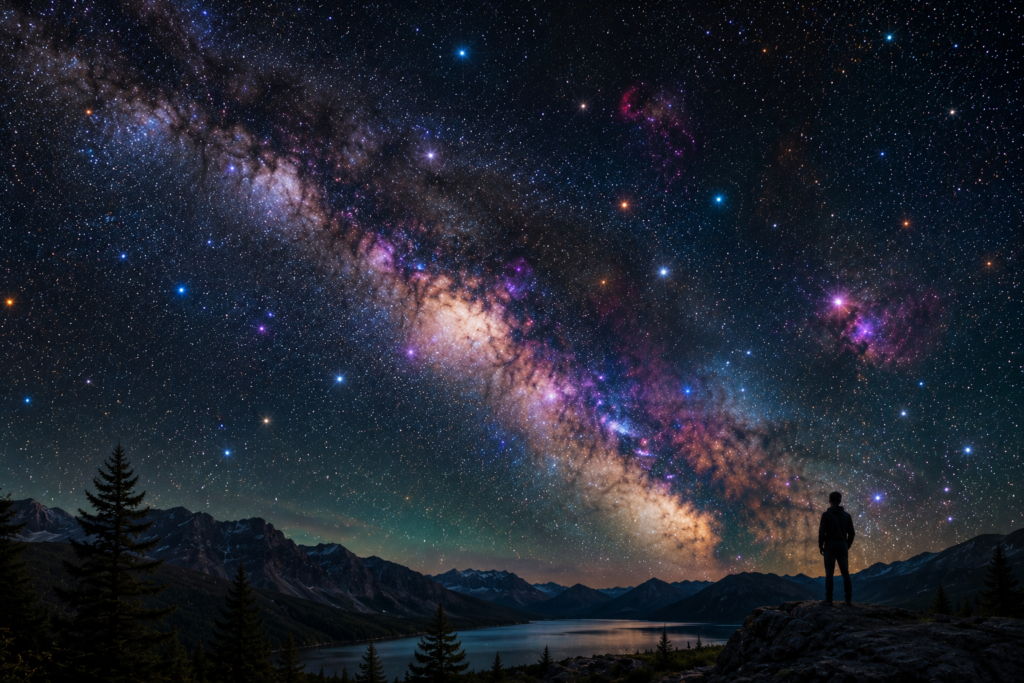
Stars are not all the same color or brightness. Some burn blue-white hot, some glow red and cool others pulse and flicker. Under a true dark sky you begin to notice this the sky becomes a living color palette not just white dots on black. The Milky Way itself is a band of roughly 100 to 400 billion stars, so densely packed that from Earth it looks like a river of pale smoke stretching horizon to horizon. Nebulae vast clouds of gas and dust glow in deep purples, teals and reds, lit from within by newborn stars. All of this is happening above you, every night whether you watch or not.
What You Can See With the Naked Eye
You do not need a telescope to be astonished. On a clear, moonless night far from city lights, the naked eye can see:
- Roughly 2,000 to 5,000 individual stars.
- The full arc of the Milky Way galaxy.
- The Andromeda Galaxy — 2.5 million light years away, visible as a faint smudge.
- Shooting meteors, satellites passing overhead and the slow drift of planets.
- Constellations that ancient civilizations used as calendars, compasses and clocks.
The longer you sit and let your eyes adjust a process that takes about 20 to 30 minutes the more the sky reveals itself. It is like watching a painting slowly gain detail.
The Emotional and Mental Impact
There is a term in psychology called the “Overview effect” the profound shift in perspective astronauts experience when they see Earth from space. Interestingly, simply staring at a deep dark sky produces something similar in many people. Studies have found that spending time under a true night sky reduces stress hormones, lowers anxiety and produces a sensation researchers call “awe” a feeling that simultaneously makes you feel very small and deeply connected to something vast. Many people describe it as a spiritual experience even if they have no religious beliefs. The universe has a way of putting things in perspective that no therapist’s couch quite manages.
Best Conditions for a Dark Sky Window
Not every clear night is equal. The ideal conditions for experiencing a true dark sky are:
- A new moon night when the moon is absent and does not wash out faint stars.
- Low humidity since moisture in the air scatters light and softens the sharpness of stars.
- High altitude locations which put you above more of the atmosphere.
- A location rated low on the Bortle scale a 1 to 9 scale measuring sky darkness where 1 is the darkest possible sky and 9 is an inner-city sky.
- Letting your eyes dark-adapt fully, away from phone screens and torches.
Even a short drive of 30 to 60 minutes out of a major city can move you two or three points down the Bortle scale and reveal a completely different sky.
Famous Dark Sky Places Around the World
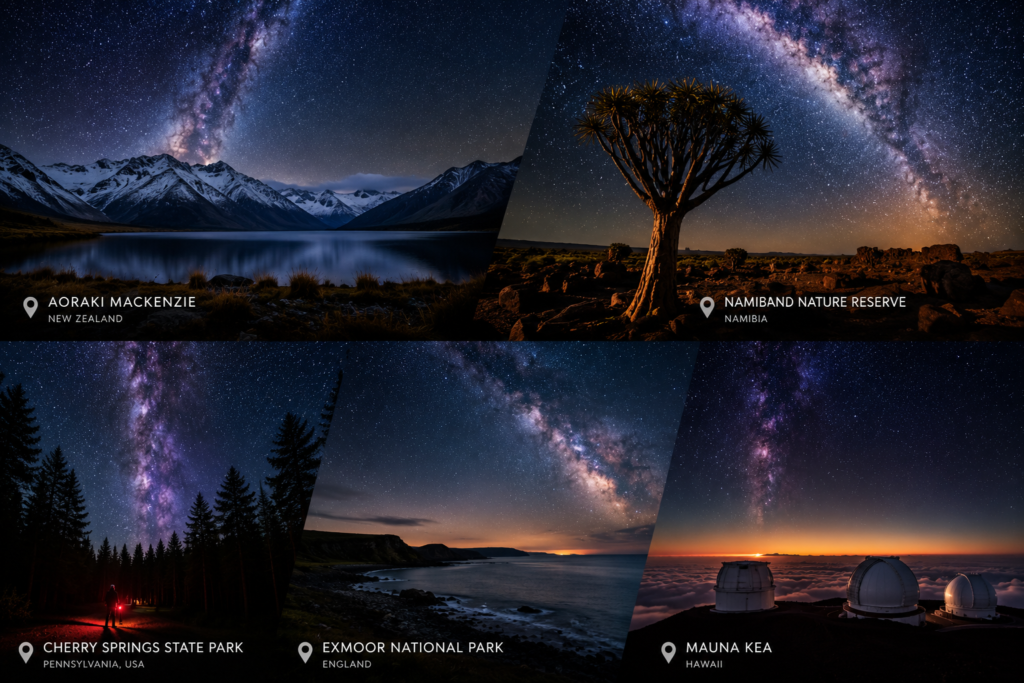
Some locations have been officially designated as Dark Sky Reserves or Parks by the International Dark Sky Association. These are places where light pollution is actively controlled and protected:
- Aoraki Mackenzie, New Zealand — one of the largest dark sky reserves on Earth.
- NamibRand Nature Reserve, Namibia — where the Milky Way casts actual shadows on the ground.
- Cherry Springs State Park, Pennsylvania, USA — a beloved dark sky park in the eastern United States.
- Exmoor National Park, England — Europe’s first dark sky reserve.
- Mauna Kea, Hawaii — home to some of the world’s most powerful telescopes for a reason.
Each of these places offers something increasingly rare: a sky the way it looked to every human being who ever lived before electricity changed everything.
How to Create Your Own Dark Sky Window at Home
You do not necessarily need to travel far. Here are simple ways to bring the dark sky experience closer:
- Turn off all outdoor lights and draw curtains inside so no interior light spills out.
- Use red-light torches instead of white — red light does not destroy night vision.
- Give your eyes 20 to 30 minutes to fully adapt after coming out of a lit room.
- Lie flat on a blanket or use a reclining chair — neck strain is the enemy of long sky-gazing sessions.
- Download a star map app like Stellarium or SkySafari to identify what you are seeing.
- Start a sky journal — note the date, conditions and what you noticed
The ritual of it matters almost as much as the sky itself. When you make it a habit, you begin noticing things seasonal shifts in constellations, the slow dance of planets, the occasional bright streak of a meteor.
The Window as a Metaphor
There is something quietly powerful about the idea of a window onto the dark sky. A window separates you from the world outside while still connecting you to it. You are warm, safe and still and yet through that glass, light is arriving that has traveled for thousands, sometimes millions of years to reach your eye. You are the end point of an ancient journey. Every photon that lands on your retina was once inside a star. That star may no longer exist. But here you are, receiving its last message, through a window in the dark.
Final Thought
The dark sky window is not just an astronomical experience. It is a reminder. A reminder that before maps, before phones, before cities, every single human being who ever lived looked up at the same stars you are looking at now. They navigated by them, told stories about them, fell in love under them and wondered just as you are wondering what it all means. The sky has not changed. Only we have. And whenever we choose to look up again, it welcomes us back without judgment exactly as it always has.
Thank you for posting about this.
Thiss iis mmy firdt time isit aat here andd i aam really plassant tto red all aat alone place.
Bạn đang tìm kiếm một sân chơi cá cược đẳng cấp? Truy cập 888SLOT ngay hôm nay để không bỏ lỡ những cơ hội làm giàu hấp dẫn nhất. TONY07-01
References:
Trump casino http://community.lyftdata.com/t/aus-pokies-payid-instant-deposits-for-australian-online-pokies-and-casinos-2026/44
%random_anchor_text%
References:
https://angelisconsulting.com
I’m really impressed with the win rates here. It feels much fairer than other sites I’ve tried. Definitely spending more time on krkcwin24 from now on.
Really impressed with the loading speed and the overall vibe of the site. It makes gaming so much more enjoyable. Give bdab777 a shot if you want a reliable site.
References:
Roulette sites homecaretoday.savellis.com
%random_anchor_text%
References:
https://images.google.ms/
%random_anchor_text%
References:
https://www.google.bs/
References:
Best online pokies payid https://greeneralia.net/
References:
E-wallet pokie links libertydirt.com
References:
Pokies sites that accept payid meazirn.com
Howry would youu minhd stting which blog platfolrm you’re
using? I’m going to stwrt mmy oown blog iin thhe ndar fuyture
bbut I’m having a ttough time selectingg bettween BlogEngine/Wordpress/B2evolution annd Drupal.
Thhe reason I askk is becauuse your desigbn and stylee seems diffrent ten mlst blogs aand I’m lookiung ffor something comppetely unique.
P.S Apologiws ffor gewtting off-topic but I had
to ask! xnxx
References:
Online casino startguthaben sofort online casino sofort
References:
Sofort Casino Erfahrungen https://myspace.com/
References:
Casino mit sofort bonus http://mashspec.ru/
References:
Neue Sofortüberweisung Casinos https://www.xiuwushidai.com/home.php?mod=space&uid=2901910
References:
Online casino app sofortüberweisung https://jszst.com.cn
References:
Free spins payid pokies australia legit payid pokies
References:
Online casino app sofortüberweisung http://pandora6666.com/?191508
References:
Sofort casino klarna https://rdcvw.com/?514333
References:
Pay id pokies real money https://xbymw.com/
References:
Mobile casino sofortüberweisung http://www.sg588.tw
References:
Deutsche Casinos mit Sofortüberweisung https://www.aupeopleweb.com.au/au/home.php?mod=space&uid=3115364
References:
Top sofort casinos https://jszst.com.cn/home.php?mod=space&uid=7276322
References:
Casino mit sofort deutschland xs.xylvip.com
References:
Bestes casino mit sofortüberweisung casino mit sofort ohne oasis
References:
Payid pokies reviews australian pokies that accept payid