
What Makes Earth Different from Mars and Venu
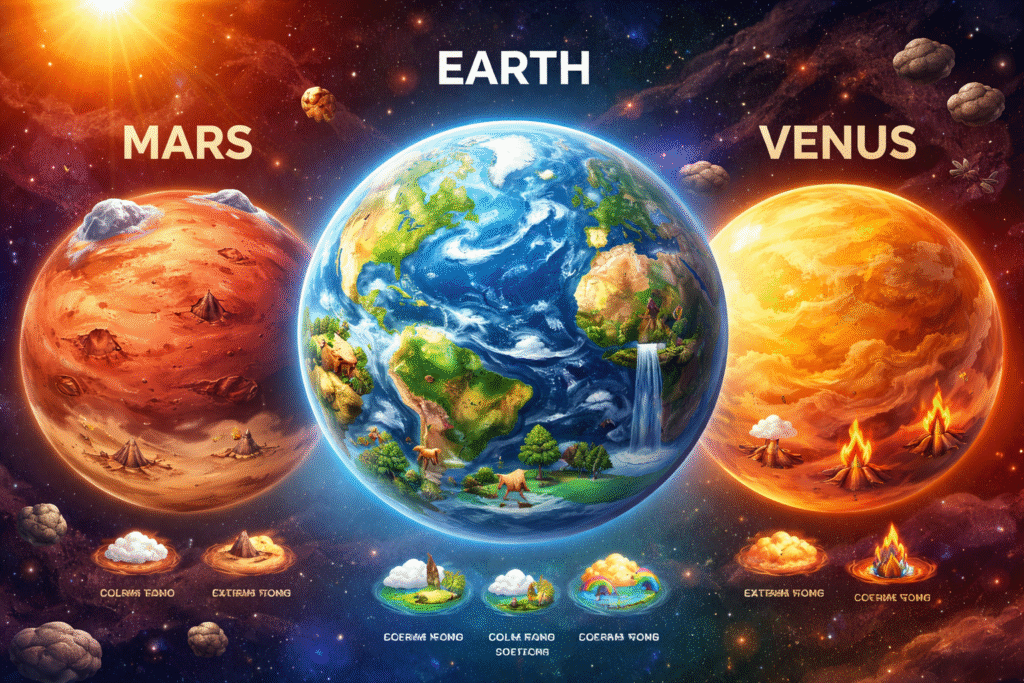
Earth is special because it sits in a comfortable zone around the Sun where temperatures allow liquid water to remain stable on the surface. Vast oceans regulate climate, plate tectonics recycle nutrients and a magnetic field shields the atmosphere from harmful radiation. The air is rich in nitrogen and oxygen, making it possible for complex organisms to breathe and thrive. These systems interact like parts of a living engine, maintaining balance over immense stretches of time.
Mars, smaller and farther from the Sun, lost much of its internal heat early in its history. With a weak magnetic field, the solar wind stripped away most of its atmosphere, leaving the surface cold and dry. Water that once flowed now survives mainly as ice or possibly salty brines underground. The thin air, frequent dust storms and large temperature swings make survival difficult for life as we know it, though robotic explorers continue to search for signs of ancient microbes.
Venus followed a very different path. Although similar in size to Earth, its dense carbon-dioxide atmosphere created an extreme greenhouse effect. Heat became trapped, surface temperatures soared high enough to melt lead and crushing air pressure built up beneath thick clouds of sulfuric acid. Instead of oceans moderating the climate, runaway warming reshaped the planet into one of the most hostile environments in the solar system.
Looking at these three neighbors together reveals how small differences in distance from the Sun, atmospheric composition and internal dynamics can steer worlds toward radically different destinies. One became a blue haven filled with life, another a frozen desert preserving memories of water and the third a furnace wrapped in clouds. Understanding these contrasts helps guide the search for habitable planets beyond our solar system and reminds us how precious our own home is.