
The Lunar Ice Discovery: NASA Locates Frozen Water in Dark Craters
Why Scientists Never Expected Water on the Moon
For most of the 20th century, scientists believed the Moon was:
- Completely dry
- Airless (no atmosphere to trap moisture)
- Exposed to extreme heat during daytime (over 120°C)
Because of this:
- Any water should have evaporated into space
- The Moon was considered a dead, bone-dry world
Even during the Apollo missions (1969–1972):
- Astronauts brought back rocks thought to contain zero water
- Any detected hydrogen was assumed to be contamination from Earth
This belief stayed unchanged until advanced space instruments became available.
The Key Discovery: Permanently Shadowed Craters
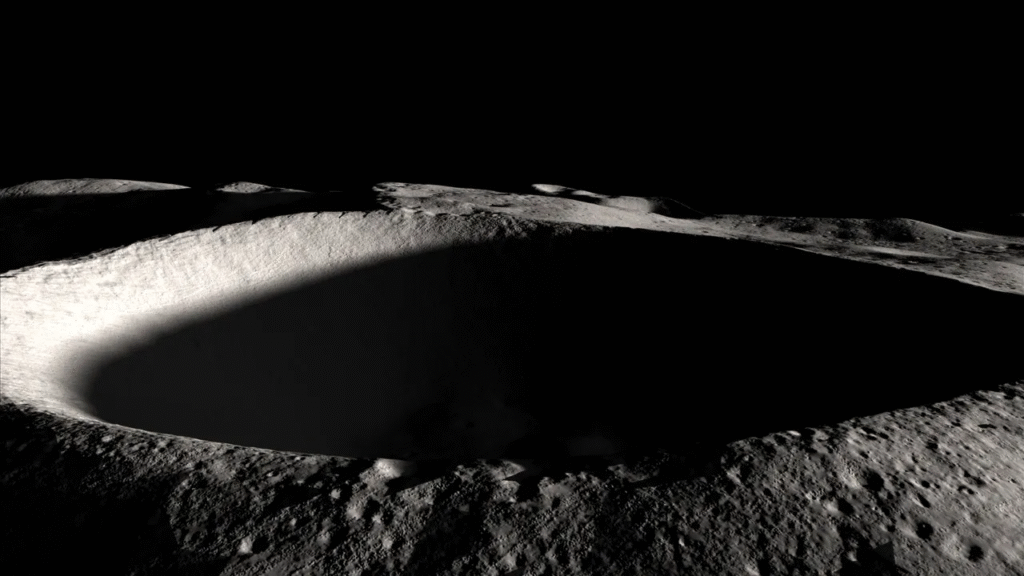
At the Moon’s north and south poles, there are deep craters that:
- Never receive sunlight
- Have remained dark for billions of years
- Have temperatures as low as –173°C (–280°F)
These are called:
1. Permanently Shadowed Regions (PSRs)
2.The coldest natural places in the entire Solar System
Scientists realized:
If water ever reached these areas, it could freeze and stay preserved forever
The First Strong Evidence (1998–2009 Missions)
Lunar Prospector (1998)
- Detected hydrogen signals at the Moon’s poles
- Hydrogen usually means:
- Water (H₂O)
- Or hydroxyl (OH)
This was the first major indirect hint.
Chandrayaan-1 (India, 2008)
NASA placed a powerful NASA instrument called:
Moon Mineralogy Mapper (M³)
It detected:
- Clear absorption signatures of:
- Water molecules (H₂O)
- Hydroxyl (OH)
This discovery shocked the scientific world.
LCROSS Mission (2009): Direct Proof
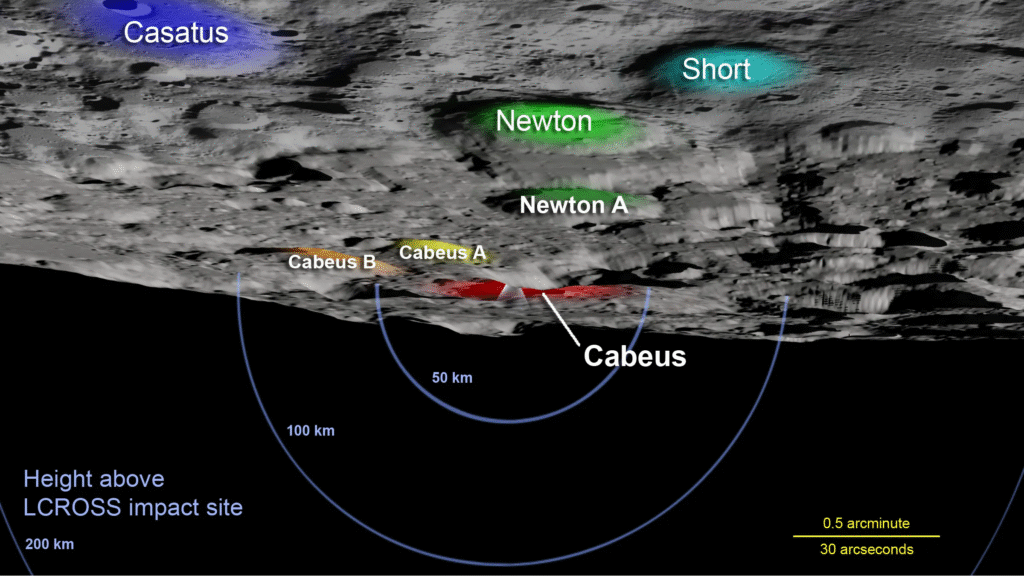
NASA crashed a spacecraft into a permanently dark crater:
Cabeus Crater (South Pole)
What happened:
- The impact created a massive dust plume
- A following probe analyzed the debris
The plume contained:
- Water vapor
- Ice particles
- Hydrocarbons
- Ammonia
- Carbon dioxide
Final result:
- About 5–10% of the crater material was pure water ice
This was the first direct confirmation of ice on the Moon.
How Much Water Is on the Moon
Using multiple missions (LCROSS, LRO, Chandrayaan-1):
Scientists now estimate:
- Hundreds of billions of tons of ice
- Trapped inside:
- South Pole craters
- North Pole craters
- Some craters may contain:
- Ice mixed with soil
- Sheets of nearly pure ice
The largest confirmed ice reserves are at:
- Shackleton Crater
- Cabeus Crater
- Haworth Crater
How Did Water Get There?
There are four main sources:
1. Comets & Asteroids
- Icy objects smashed into the Moon billions of years ago
- Their water froze inside cold craters
2. Solar Wind Reaction
- Hydrogen from the Sun hits oxygen in Moon rocks
- Forms temporary water molecules
3. Volcanic Outgassing (Ancient Moon)
- The Moon was once geologically active
- Water vapor escaped from inside the Moon long ago
4. Meteorite Impacts
- Constant micrometeorites deliver small water amounts over time
How NASA Confirms Ice Today
NASA uses multiple instruments on the Lunar Reconnaissance Orbiter (LRO):
- LEND (neutron detector) → Finds hydrogen
- LOL A (laser altimeter) → Maps crater depth + shadow
- Mini-RF Radar → Detects ice reflectivity
Ice is confirmed when:
- Hydrogen is high
- Radar reflection matches frozen material
- Sunlight never reaches the area
Why This Discovery Is Extremely Important
Drinking Water for Astronauts
No need to bring huge water tanks from Earth.
Rocket Fuel Production
Water (H₂O) can be split into:
- Hydrogen → Fuel
- Oxygen → Breathing + Oxidizer
This enables:
- Moon fuel stations
- Cheaper missions to Mars
Permanent Moon Bases
Ice allows:
- Long-term human settlements
- Farming experiments
- Industrial activity
Deep Space Gateway
Moon becomes:
- A launch platform for Mars and asteroids
- A supply depot for interplanetary travel
Artemis Missions & the Future
NASA’s Artemis Program plans:
- Artemis III → First humans at the South Pole
- Ice-mining experiments
- Long-term lunar habitats
- Power stations near polar craters
- Water-to-fuel refineries
Final Summary (Short & Powerful)
- The Moon was once thought to be completely dry.
- Permanently shadowed craters at the poles stay colder than Pluto.
- NASA confirmed real water ice using:
- Lunar Prospector
- Chandrayaan-1
- LCROSS
- LRO
- The ice came from:
- Comets
- Solar wind reactions
- Ancient volcanic activity
- This water can:
- Support astronauts
- Create rocket fuel
- Enable Moon bases
- Open the path to Mars
Dark it is
Gave 777perya a try. Pretty straightforward. Some of the games looked familiar, felt comfortable using it. Nothing to write home about, but definitely worth checking to see if you have fun!
Yo, heard about PlayKaro365 from a buddy. Checked it out – pretty decent! Simple interface, easy to navigate. Could use a few more game options IMO, but overall solid. Check it out: playkaro365
MinesGameVN. Addicting little game. Be careful you don’t spend all day on it! Play if you dare minesgamevn.
Phlove1, what’s that about? Hope it’s not some weird dating site LOL. Checking it out to see what the deal is! Let’s unveil what lies within phlove1