
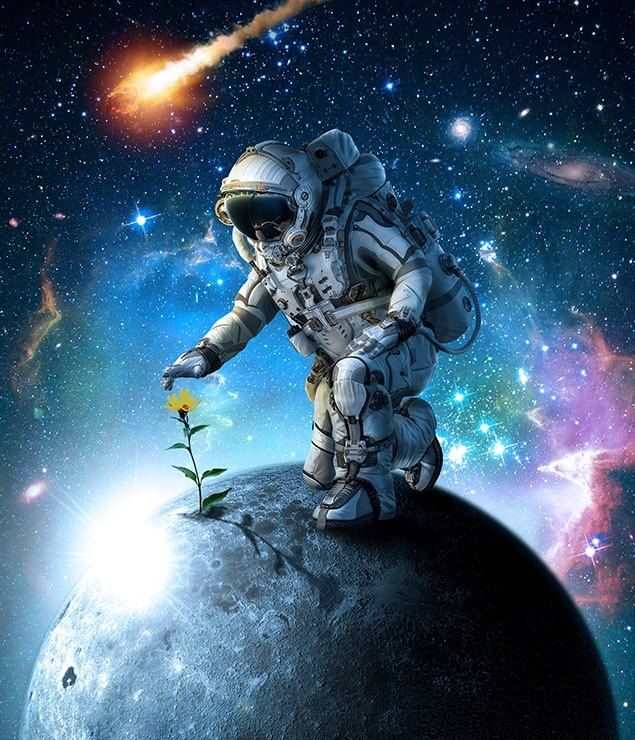
Time Dilation Confirmed: Einstein’s Legacy Proves Time is Relative in Space
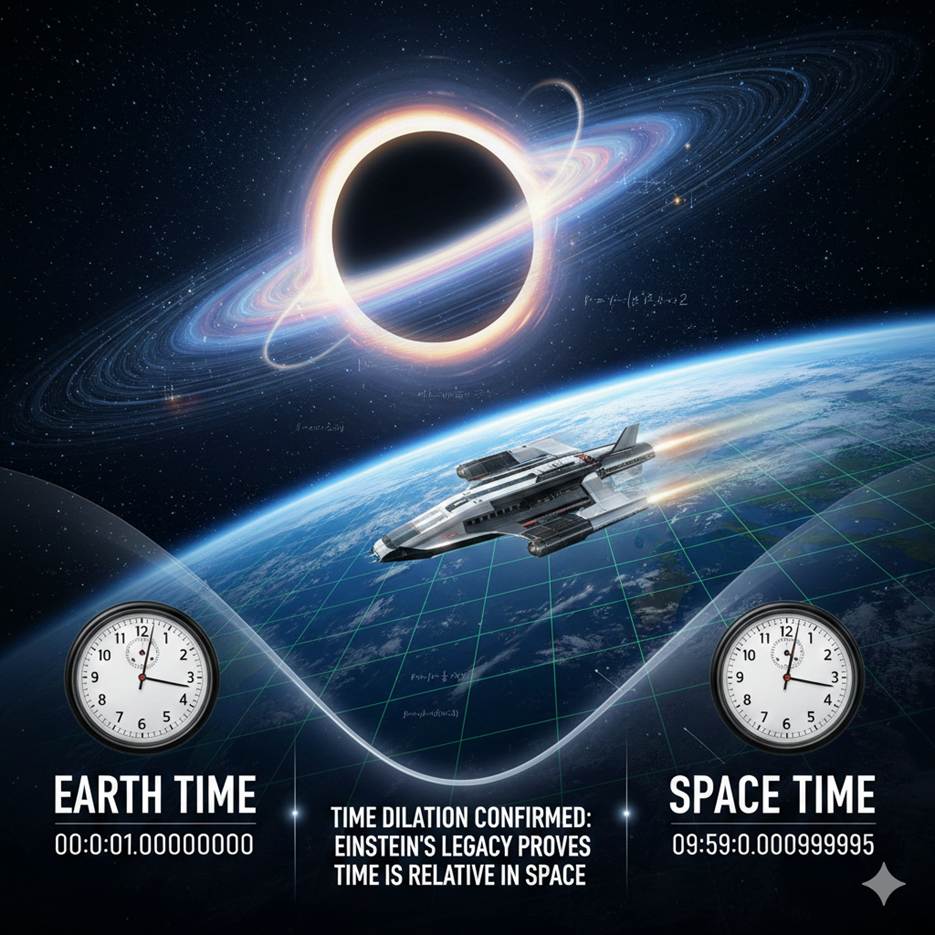
Time Dilation: Why Time Moves Slower in Space
The idea that “Time Moves Slower in Space” is not science fiction; it is a validated consequence of Albert Einstein’s theories of Relativity. This phenomenon is called Time Dilation, and it means that time is not absolute—it passes differently for observers depending on their relative speed and their location within a gravitational field.
Time dilation is caused by two distinct but related effects predicted by Einstein:
1. Velocity Time Dilation (Special Relativity)
Albert Einstein’s Special Theory of Relativity (1905) established that the laws of physics are the same for all non-accelerating observers and that the speed of light in a vacuum ($c$) is constant for everyone.
- The Principle: Because the speed of light must remain constant, time itself must adjust for objects moving at different velocities.
- The Effect in Space: An observer who is moving at a very high velocity relative to a stationary observer will experience time more slowly. The faster you travel, the greater this time-slowing effect becomes.
- Practical Examples:
- Astronauts in Orbit: The International Space Station (ISS) orbits Earth at about 7,700 meters per second. Due to this high speed, an astronaut on the ISS ages slightly less than a person on Earth. Over a six-month mission, the astronaut is younger by about 0.005 seconds compared to their Earth-bound twin.
- Subatomic Particles: Muons, which are subatomic particles created when cosmic rays hit the atmosphere, have an extremely short natural lifespan (about 2.2 microseconds). However, because they are traveling at nearly the speed of light, their time is dilated, allowing many of them to survive long enough to reach the Earth’s surface—much farther than they should based on their “at rest” lifespan.
2. Gravitational Time Dilation (General Relativity)
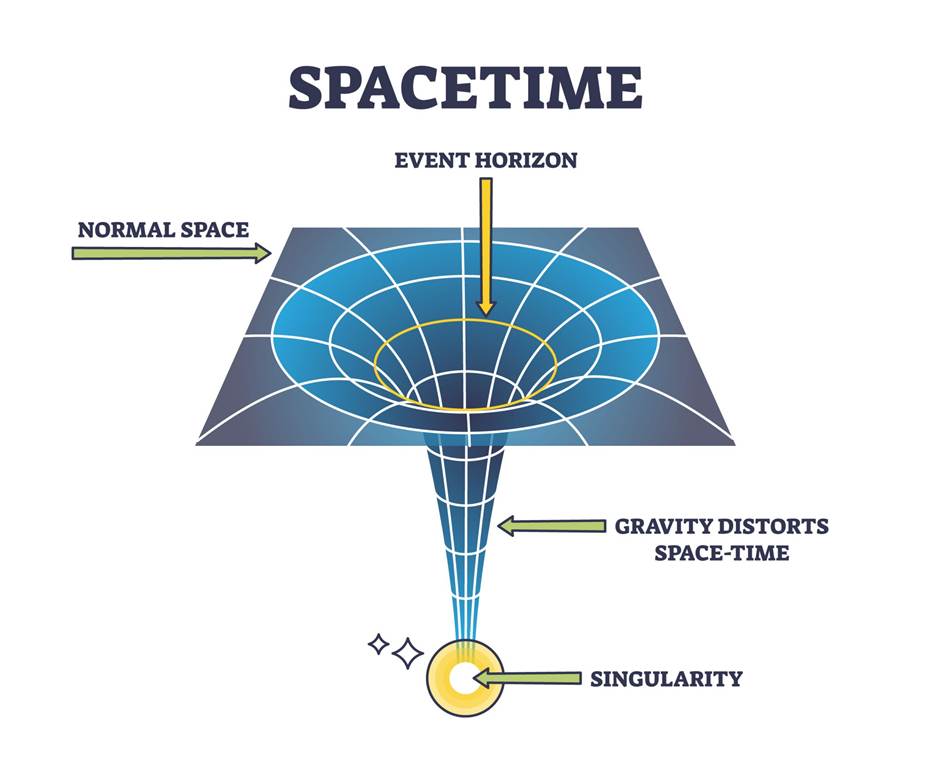
Einstein’s General Theory of Relativity (1915) explains that gravity is not a force, but a curvature of spacetime caused by mass.
- The Principle: The closer an object is to a massive body (like a planet or star), the stronger the gravity, and the slower time passes. The further away you are from a source of gravity, the faster time runs.
- The Effect in Space: While astronauts in low Earth orbit are moving fast (causing time to slow down—Velocity Dilation), they are also slightly farther away from Earth’s center of gravity (causing time to speed up—Gravitational Dilation). The overall effect for the ISS is that velocity dilation is stronger, leading to a net slowing of time compared to Earth.
- Extreme Examples: The time dilation effect near objects with immense gravity, like black holes, is extreme. Close to a black hole’s event horizon, time for an outside observer would appear to slow almost to a stop.
Recent News and Real-World Impact
Time dilation is not just a theoretical concept; it is a measurable reality essential for modern technology:
- Global Positioning System (GPS): GPS satellites orbit the Earth at a high altitude and speed. Engineers must account for both types of time dilation:
- Velocity Dilation (Slowing): Due to their speed, the satellites’ clocks run slightly slower than Earth clocks.
- Gravitational Dilation (Speeding Up): Due to their altitude (weaker gravity), their clocks run significantly faster than Earth clocks.
- The combined effect means the clocks on GPS satellites run ahead by about 38 microseconds (millionths of a second) every day. Without continuous, precise correction, the system would quickly fail.
- Time on Mars Runs Faster: Recent studies have calculated that time on Mars ticks slightly quicker than on Earth—by about 477 microseconds per Martian day. This is primarily due to Mars’ significantly weaker gravitational pull. This tiny difference must be factored into future interplanetary communication and navigation systems.
- Ancient Universe Slow-Motion: Astronomers have recently confirmed that in the early universe, just a billion years after the Big Bang, time appeared to move about five times slower than it does now. This cosmological time dilation is a direct consequence of the universe’s expansion, proving Einstein’s predictions correct on a cosmic scale.
In summary, the statement “Time Moves Slower in Space” is accurate. The perceived flow of time is fundamentally relative, and it is governed by an observer’s motion through space and their proximity to a source of gravity, a concept that continues to be proven by experiments from orbiting laboratories to the farthest reaches of the cosmos.
Conclusion: Time is Relative, Not Absolute
The reality that time moves slower in space—a phenomenon proven through numerous real-world tests—is the most profound confirmation of Albert Einstein’s theories of relativity. It forces us to abandon the intuitive, classical view of time as a universal, unchanging constant.
- Time is a Dimension: Time and the three spatial dimensions are interwoven into a single fabric called spacetime. The flow of time is relative and depends entirely on the observer’s motion and position within a gravitational field.
- Dual Effects: Time dilation is a composite effect:
- Velocity Dilation (Special Relativity): The faster you move through space, the slower you move through time, relative to a stationary observer.
- Gravitational Dilation (General Relativity): The stronger the gravitational pull (i.e., the closer you are to a massive object), the slower time passes.
- Technological Necessity: These effects are not merely academic curiosities. They are critical factors for modern technology. Without calculating and compensating for time dilation, systems like the Global Positioning System (GPS) would fail within minutes, demonstrating that relativity is a non-negotiable part of our daily lives.
From the infinitesimally small lag on an astronaut’s clock to the colossal stretch of time near a black hole, the universe operates on a principle of relative time. As we venture further into space, understanding and utilizing time dilation will be crucial for the success of long-duration space travel and the exploration of the cosmos.
Looking for some fun? Trying vipphfun.com. Looks like there are a lot of options. Hope the fun never ends! Start the fun: vipphfun
Anh em nào đam mê đá gà thì chắc biết sv388agent rồi nhỉ. Chỗ này uy tín đó, chơi lâu rồi chưa thấy phốt gì cả. Check them out: sv388agent
Ready to play some Rummy! Just logged into RummyJungle. Let’s see if I can beat my friends and stack up some chips. Login at rummyjungleelogin.