

The Starless Frontier: Journey of a Rogue Planet
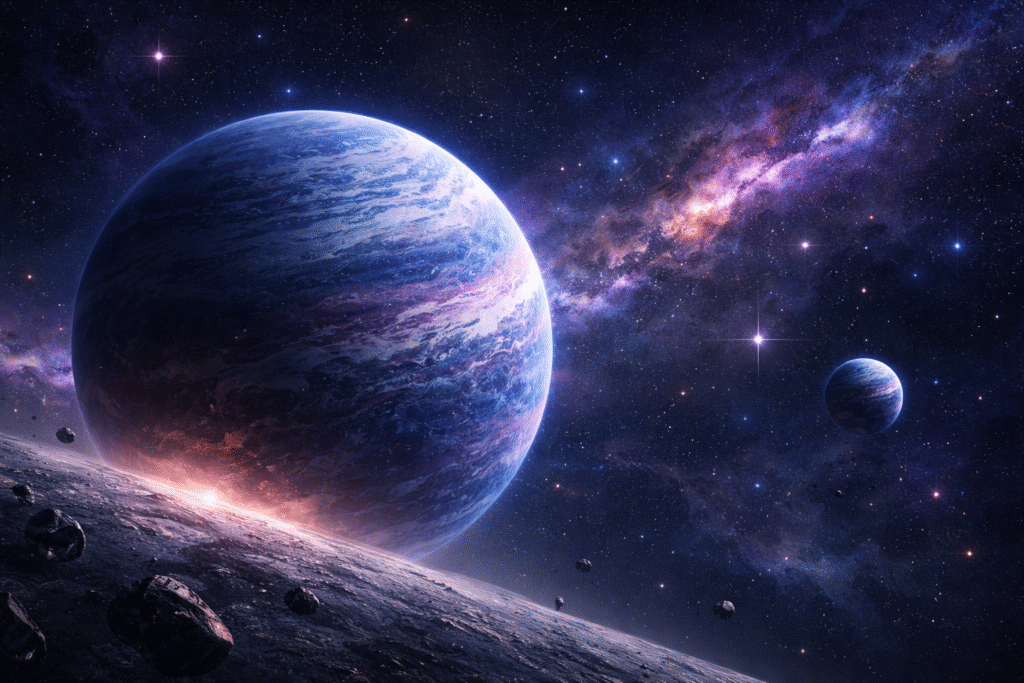
In the vast darkness between the stars, astronomers have confirmed the existence of mysterious worlds known as rogue planets — planetary bodies that travel through space without orbiting any star. Once thought to be rare cosmic accidents, these wandering planets are now believed to be incredibly common throughout the Milky Way, possibly numbering in the trillions.
What Exactly Is a Rogue Planet?
A rogue planet — also called a free-floating or interstellar planet — is a planetary-mass object that is not gravitationally bound to any star. Unlike Earth, Jupiter, or other planets in our solar system, rogue planets drift alone through the cold emptiness of interstellar space.
They are not moons, not stars, and not asteroids. They are full planetary bodies — some as small as Earth, others as massive as Jupiter — but without a parent star.
How Do Rogue Planets Form?
Scientists have identified two main formation pathways:
1. Violent Ejection from Young Solar Systems
In the early stages of planetary system formation, massive planets often shift or migrate. Their powerful gravity can create chaotic interactions:
- Large gas giants may sling smaller planets outward.
- Close planetary encounters can destabilize orbits.
- Nearby passing stars can gravitationally disrupt young systems.
When this happens, a planet can gain enough speed to escape its star’s gravity permanently, becoming a cosmic wanderer.
Many researchers believe this ejection process is extremely common, especially in crowded star-forming regions.
2. Direct Formation from Gas Clouds
Some rogue planets may form similarly to stars. If a small cloud of gas and dust collapses under gravity but does not gather enough mass to trigger nuclear fusion, it can form a planet-sized object instead of a star.
These objects blur the line between large planets and small brown dwarfs.
How Are Rogue Planets Detected?
Because rogue planets do not orbit stars, they do not reflect starlight in the usual way. Detecting them is extremely difficult. Astronomers rely on two major techniques:
Gravitational Microlensing
When a rogue planet passes in front of a distant star, its gravity bends and magnifies the star’s light. This brief brightening can reveal:
- The planet’s mass
- Its approximate distance
- Whether it is alone or part of a hidden system
Microlensing events are rare and short-lived, sometimes lasting only hours or days.
Infrared Observation
Young rogue planets still glow faintly from leftover heat after formation. Powerful observatories such as the James Webb Space Telescope have detected several massive free-floating planetary objects in nearby star-forming regions using infrared imaging.
How Many Rogue Planets Exist?
Recent surveys and simulations suggest astonishing numbers:
- There may be billions to trillions of rogue planets in our galaxy.
- Some estimates propose there could be more rogue planets than stars.
- For every star, there may be multiple free-floating planets.
Future missions from NASA, including the upcoming Nancy Grace Roman Space Telescope, are expected to discover thousands more — including Earth-mass rogue planets.
What Are Conditions Like on Rogue Planets?
Without a star, rogue planets are incredibly cold. Surface temperatures could drop below −200°C or colder.
However, scientists believe some may still retain heat through:
- Radioactive decay inside their cores
- Residual heat from formation
- Thick hydrogen atmospheres that trap warmth
Some theoretical models suggest that subsurface oceans could exist beneath thick ice layers — similar to icy moons like Europa, but without sunlight.
Could Rogue Planets Support Life?
While surface life seems unlikely due to the lack of sunlight, subsurface microbial life is not impossible.
If internal heating maintains liquid water below an icy crust, life could theoretically survive in complete darkness — relying on chemical energy instead of sunlight.
This possibility has expanded the scientific definition of habitable environments beyond traditional “Goldilocks zones.”
Why Rogue Planets Matter
Studying rogue planets helps answer fundamental questions:
- How violent are young planetary systems?
- How often are planets ejected?
- What is the true diversity of planetary types in the galaxy?
- How much hidden mass exists in interstellar space?
Their abundance also reshapes our understanding of galactic structure and planetary formation.
A Universe Filled With Wandering Worlds
Rogue planets represent a hidden population of cosmic nomads — silent, dark, and drifting endlessly between stars. Once considered rare oddities, they are now believed to be one of the most common types of planetary objects in the galaxy.
As new telescopes come online in the coming decade, astronomers expect a surge of discoveries that may finally reveal how many lonely worlds are traveling through the vast interstellar darkness
online pharmacy store
canadian pharmacy meds
canadian pharmacies mail order
mexican pharmacies online cheap
canadian pharmacies online
order prescriptions
aarp approved canadian online pharmacies
canadian pharmacies
reputable canadian mail order pharmacy