
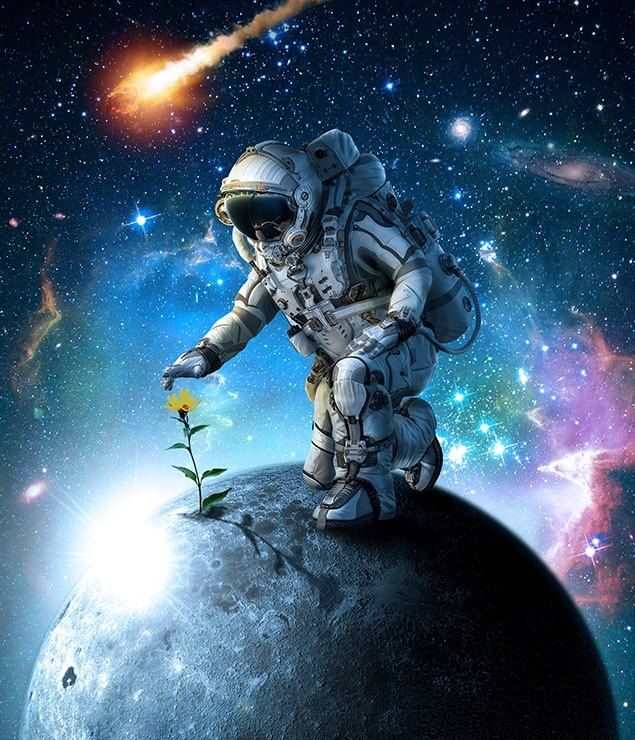
The Scientific Narrative: From Big Bang to Cosmic Web
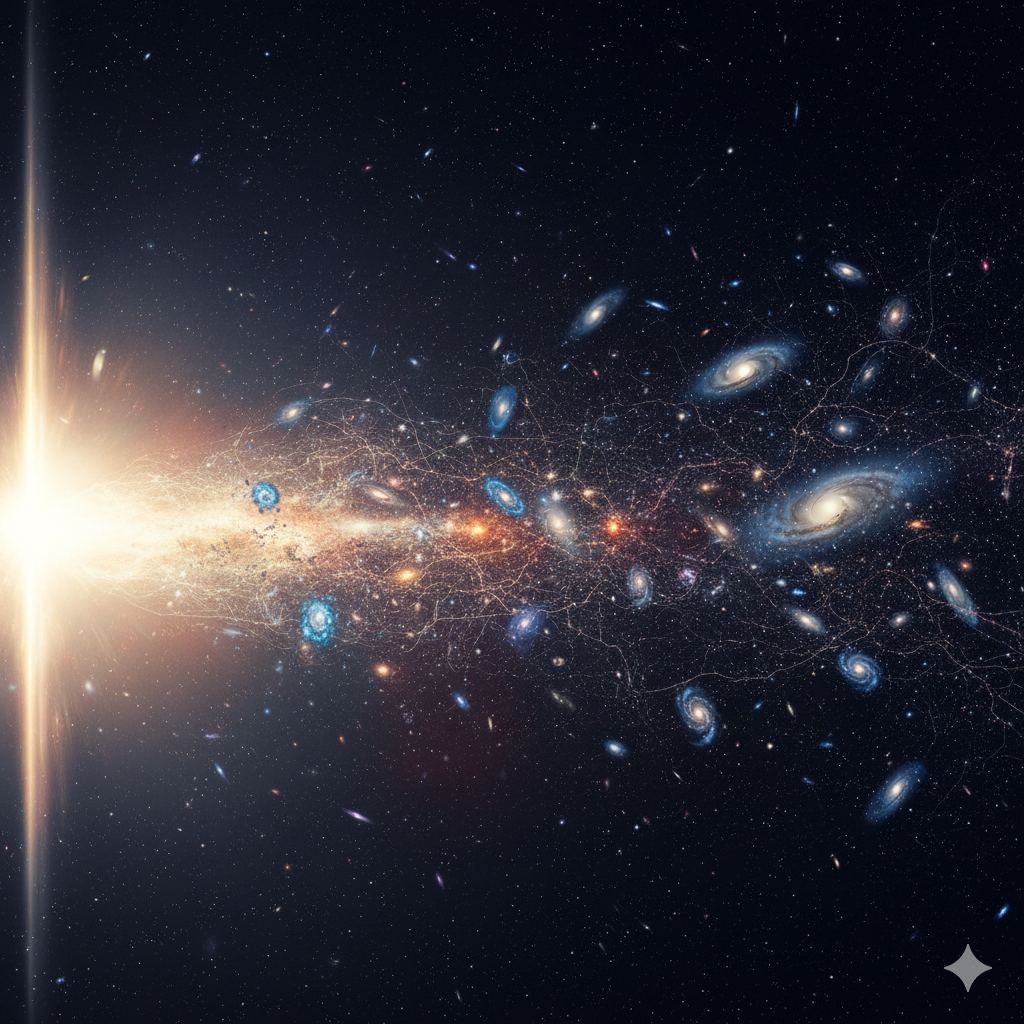
Modern cosmology paints a majestic picture of universal creation, primarily centered around the Big Bang Theory.
- The Beginning (The Singularity): Science postulates that the universe began approximately 13.8 billion years ago from an infinitesimally small, extremely hot, and incredibly dense state known as a singularity. What existed “before” this moment, or caused it, remains one of science’s greatest unanswered questions.
- Inflation: Immediately after the Big Bang, the universe underwent a period of incredibly rapid expansion called inflation, stretching space faster than the speed of light, smoothing out irregularities, and setting the stage for the large-scale structure we see today.
- Fundamental Forces and Particles: As the universe expanded and cooled, the fundamental forces of nature (gravity, electromagnetism, strong nuclear, weak nuclear) separated, and elementary particles (quarks, leptons) began to form.
- Nucleosynthesis: Within the first few minutes, protons and neutrons fused to form the nuclei of the lightest elements: hydrogen, helium, and a trace of lithium.
- Cosmic Microwave Background (CMB): About 380,000 years after the Big Bang, the universe cooled enough for electrons to combine with nuclei, forming stable atoms. This made the universe transparent, and the light from that era, redshifted to microwaves, is what we observe as the CMB—the faint afterglow of the Big Bang, a crucial piece of evidence supporting the theory.
- Galaxy Formation: Over billions of years, gravity pulled together matter, forming stars, galaxies, and the vast cosmic web of structures we observe today.
Stephen Hawking’s Contributions: No Boundaries, No Beginning?
The brilliant mind of Stephen Hawking profoundly impacted our understanding of the universe’s origin, particularly concerning singularities.
- Singularity Theorems: Hawking, along with Roger Penrose, developed singularity theorems which demonstrated that under general conditions consistent with Einstein’s theory of General Relativity, the universe must have originated from a singularity (a point of infinite density and spacetime curvature). This strongly supported the Big Bang as a point of origin.
- “No Boundary Proposal”: Later, Hawking (with James Hartle) proposed the “no boundary proposal,” a quantum theory of cosmology. This revolutionary idea suggests that at the very earliest moments, the universe had no “boundary” in spacetime, meaning it didn’t necessarily begin at a specific point in time or space in the way we usually conceive it.
- Hawking’s famous quote summarizes this idea: “The universe would be entirely self-contained and not be affected by anything outside itself. It would neither be created nor destroyed. It would just BE.”
- This proposal aimed to remove the need for an external cause or “creator” for the universe, suggesting that its quantum nature at the very beginning precluded a sharp boundary or a “first moment.”
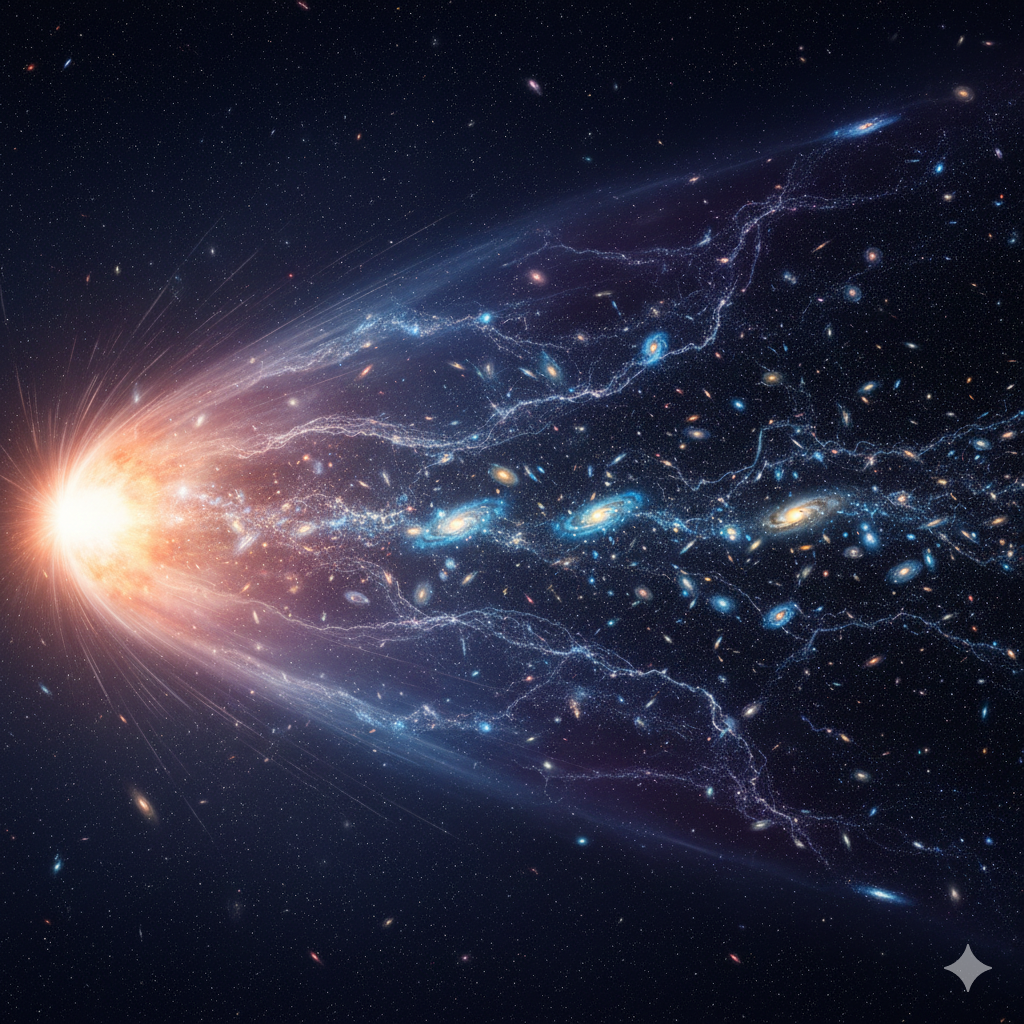
Ancient Vedic Cosmology: Cycles of Creation and Dissolution
Ancient Vedic texts, dating back thousands of years, offer a cosmological view that is both cyclical and incredibly vast in its timescales.
- Cyclical Universe (Kalpas and Yugas): Unlike a single Big Bang event, Vedic cosmology describes an eternal, cyclical universe, undergoing repeated phases of creation, preservation, and dissolution (Pralaya). Each cycle is immense, spanning billions of human years.
- Brahma’s Day (Kalpa): A single “Day of Brahma” (Kalpa) is equivalent to 4.32 billion human years, during which the universe is manifested. This is followed by a “Night of Brahma” (Pralaya) of equal duration, where the universe is unmanifested or absorbed back into the cosmic source. This resonates with the idea of a universe with no absolute beginning or end.
- The Unmanifest (Brahman): The ultimate reality, Brahman, is seen as the unmanifest source from which the entire cosmos emerges. It is both the material and efficient cause of creation.
- Vedic Verses (Example from Rig Veda): The Nasadiya Sukta (Hymn of Creation) from Rig Veda (Mandala 10, Hymn 129) eloquently captures the mystery of creation, even questioning whether the gods themselves knew the origin:
- Rig Veda 10.129.6:“Who verily knows and who can here declare it, whence it was born and whence came this creation? The Gods are later than this world’s production. Who knows then whence it first came into being?”
The Quranic Perspective: Creation by Divine Command
The Quran, the holy book of Islam, presents a cosmology rooted in the omnipotence and singular will of Allah (God). It describes creation as a deliberate act, emphasizing order, purpose, and signs for humanity to reflect upon.
- Creation from Nothing (Ex Nihilo): The Quran clearly states that Allah created the heavens and the Earth from nothingness, by His command.
- Quran 2:117:“The Originator of the heavens and the earth. When He decrees a matter, He only says to it, ‘Be,’ and it is.” This verse emphasizes creation as an immediate, powerful act by divine will.
- Creation in Six Days (or Periods): The Quran repeatedly mentions creation in “six days” (or “periods,” as the Arabic word yawm can mean a long duration, not necessarily 24-hour days), followed by God establishing Himself over the Throne.
- Quran 7:54:“Indeed, your Lord is Allah, who created the heavens and the earth in six days and then established Himself above the Throne.” This period is often interpreted by modern Islamic scholars as epochs or phases, allowing for consistency with scientific timelines for universal development.
- The Expanding Universe: Strikingly, the Quran also contains verses interpreted by many as alluding to the expansion of the universe, a concept only discovered by modern astronomy in the 20th century.
- Quran 51:47:“And the heaven We constructed with strength, and indeed, We are [its] expander.” This verse is seen by many as a powerful testament to the Quran’s foresight regarding cosmic phenomena.
Harmonizing Perspectives: Seeking Meaning in the Grand Narrative
While science, philosophy, and faith often approach the question of origin from different angles—how, why, and by whom—they each contribute invaluable pieces to humanity’s grand understanding.
- Science offers the verifiable mechanisms and sequences of events.
- Hawking’s work pushes the boundaries of our conceptualization of “beginning.”
- Vedic traditions provide a cyclical, timeless framework, emphasizing the eternal nature of the cosmic dance.
- The Quran instills purpose and divine agency, encouraging reflection on the signs of creation.
The universe’s creation remains a profound mystery, inviting continuous inquiry, awe, and contemplation from every facet of human thought. What piece of this cosmic tapestry resonates most with you?
Having trouble logging into 678game? Me too! That’s why I used 678gamelogin. Got me straight in. Now, where’s that winning streak at, eh?
Bigdaddygamebet? Yeah, I’ve put some bets down there. The odds are pretty competitive, and they’ve got a decent selection of games. Had a couple of wins, no complaints so far. Give it a shot if you’re feeling lucky. Find them here: bigdaddygamebet
Okay, so 789livebet kinda caught me off guard. I was expecting a run-of-the-mill betting site, but the mobile app is actually pretty slick. Makes placing bets super easy on the go. Give it a whirl if you’re mobile-first!
Wow
Yo, seen anyone playing around on aagame777bet? Looks like they’ve got some interesting games. Thinking about throwing down a few bucks. Any tips or tricks from you seasoned players? Let me know! Give it a look: aagame777bet
Been playing 33vin for a while now and I’m pretty impressed with the variety of games they offer. There’s always something new to try! Site is secure, too, which is a big plus in my book. Check it out: 33vin
Win777slots? Dude, the name alone is worth a try. Hoping for some lucky spins over there! I’m ready at win777slots.
Okay, Jiliwincomapp… Seems like a lot of folks are playing here. Gave it a shot. Graphics are slick, and the gameplay is pretty smooth. Good for killing time if you’re bored. Give it a try: jiliwincomapp
Thinking of checking out 007betgame tonight. Any tips or tricks for a first-timer? Heard the slots are where it’s at. 007betgame
Alright, 345vip isn’t bad. Could use a few improvements on the interface, but overall it does the job. If you’re looking for another option, take a look: 345vip
Tried 797bet for the first time last night. Variety of games is great, and I actually won a few bucks! Will definitely be back to try my luck again. Visit them here: 797bet