
The Moon’s Shifting Smile: Sunlight Makes It Happen
1. What the “Shifting Smile” Means
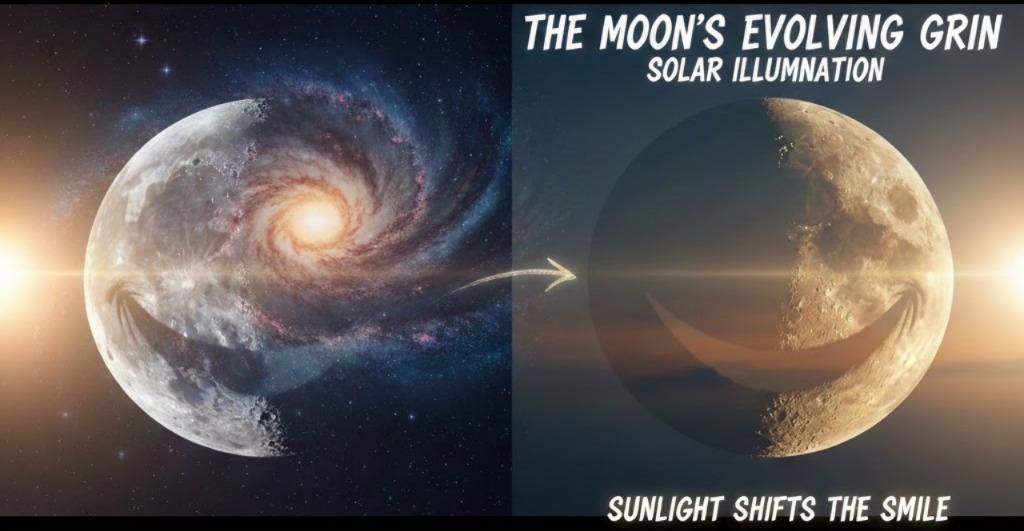
The “Shifting Smile” refers to the changing shape of the Moon that we see from Earth — the phases of the Moon. Sometimes it looks like a thin crescent, sometimes a half-circle and sometimes full. This smile is not because the Moon changes shape but because the sunlight hitting it changes angle relative to Earth.
- When people say “smile,” they usually mean the crescent Moon.
- The Moon can appear to “smile” upward, downward or sideways depending on your location and the Moon’s position in the sky.
2. Why the Moon Changes Shape
The Moon does not produce its own light, it reflects sunlight. The phases happen due to the positions of the Earth, Moon and Sun:
- New Moon – The Moon is between Earth and the Sun, so the side facing Earth is dark.
- Waxing Crescent – A thin sliver of sunlight appears on the right side.
- First Quarter – Half of the Moon is lit on the right side.
- Waxing Gibbous – More than half is lit, approaching full.
- Full Moon – Entire side facing Earth is lit.
- Waning Gibbous – Light begins to decrease, left side lit.
- Last Quarter – Left half lit.
- Waning Crescent – Thin sliver on the left before becoming new again
3. The Role of Sunlight
- Sunlight hits the Moon from one direction.
- Depending on where the Moon is in its orbit, different portions are illuminated.
- This changing illumination is what creates the crescent or “smiling” shape.
Think of it like shining a flashlight on a ball in a dark room. If you move the ball, different parts of the ball light up, creating crescents or half-shapes.
4. Orientation of the Smile
- The Moon’s “smile” appears upright, tilted, or sideways depending on:
- Latitude of the observer – Near the equator, the crescent can appear like a “smile”; Near the poles, it may appear more vertical.
- Time of year – The angle of sunlight shifts with Earth’s tilt, affecting the crescent’s orientation.
- This is why people in different parts of the world may describe the crescent differently.
5. The Moon’s Orbit
- The Moon’s orbit around Earth is elliptical and slightly tilted (~5°) relative to Earth’s orbit around the Sun.
- This tilt and the orbit cause small variations in the Moon’s appearance each night.
- The “smile” moves across the sky as the Moon rises and sets.
6. Fun Fact
- The thin crescent is called a “Horned Moon” in some cultures.
- In the Northern Hemisphere, the “smile” often points to the right in the waxing phase and left in the waning phase.
- Observers can predict the next phase of the Moon by looking at the crescent.
7. Why It Matters
- Ancient cultures used the Moon’s phases for calendars, farming, and navigation.
- Today, understanding the Moon’s phases helps in astronomy, space missions, and stargazing.
- The “shifting smile” reminds us of the dynamic dance between Sun, Earth, and Moon.
8. Summary in Simple Terms
- The Moon’s “smile” is the crescent phase, created by sunlight reflecting off the Moon.
- Its orientation changes due to your location on Earth and Earth-Sun-Moon geometry.
- Each night, the Moon appears slightly different as it moves along its orbit.
Having a look at 29Betlogin. The betting options seen pretty broad. It seems they take their sports betting serious. Very interesting. 29betlogin
Thanks for sharing the knowledge😍😍. Cool!
brt365, eh? Never heard of you before. Show me what you’ve got! Competition’s tough, so you better be good! Explore Now: brt365
Signed up for bonos777club because of the perks. I have to say its worth a peek. You’ll find awesome content: bonos777club
Acesuperapp? Man, that’s my go-to! Smooth as butter and keeps me entertained for hours. Check it out acesuperapp
chơi bài 66b – Nơi biến những giấc mơ triệu phú thành hiện thực. Click ngay vào link chính thức để bắt đầu hành trình của bạn. TONY02-11O