

The Moon’s Secret Anatomy
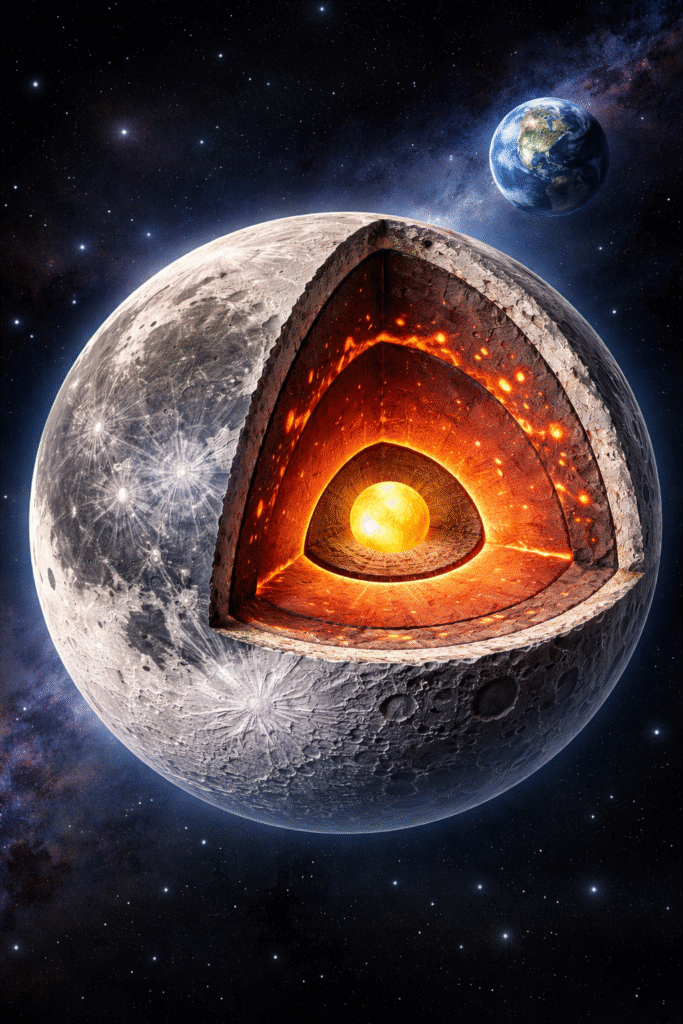
Although the Moon appears calm and simple from Earth, its interior hides a complex and fascinating structure shaped by ancient cosmic events. Scientists have uncovered the Moon’s internal layers using seismic data from Apollo missions, lunar rock samples, gravity measurements and modern spacecraft observations. The Moon’s anatomy reveals clues about its violent origin, thermal history and ongoing evolution.
1. Lunar Crust — The Scarred Outer Shell
The Moon’s crust is its outermost layer, averaging 30–50 km thick but it varies greatly. The far side crust is significantly thicker than the near side explaining why the near side has vast dark plains called lunar maria while the far side is heavily cratered.
- Composed mainly of anorthosite a light-colored rock rich in calcium and aluminum
- Formed over 4 billion years ago as the Moon’s surface cooled
- Heavily bombarded by asteroids preserving an ancient record of the early Solar System
- Contains regolith a fine dust layer created by billions of years of impacts
Secret clue: The crust’s uneven thickness supports the theory that internal heat and early tidal forces shaped the Moon differently on each side.
2. Lunar Mantle — The Silent Interior Engine
Beneath the crust lies the mantle extending roughly 1,300 km deep. This layer once contained partially molten rock that fueled ancient volcanic eruptions.
- Made of dense silicate minerals like olivine and pyroxene
- Source of basaltic lava that flooded impact basins and formed maria
- Evidence suggests parts of the mantle were molten billions of years ago
- Today, it is mostly solid and geologically quiet
Hidden past: The mantle was once active, driving volcanism long after the Moon formed far longer than scientists once believed.
3. Lunar Core — Small but Surprising
At the Moon’s center lies a small metallic core surprisingly complex for such a small body.
- Radius of about 350 km
- Consists of iron, nickel, and sulfur
- Divided into:
- Solid inner core
- Liquid outer core
- A partially molten boundary layer
Although the Moon lacks a global magnetic field today, ancient rocks show it once had one evidence that the core was once active possibly powered by early rotation and cooling.
4. Temperature & Heat Flow — A Cooling World
The Moon is slowly losing heat.
- Interior temperatures reach 1,600–1,700°C near the core
- Heat escapes extremely slowly due to lack of tectonic activity
- No plate tectonics like Earth
- Small, shallow moonquakes still occur mostly due to tidal forces from Earth
Ongoing change: The Moon is shrinking slightly as it cools, causing surface fractures called lobate scarps.
5. What the Moon’s Anatomy Reveals About Its Origin
The Moon’s internal structure strongly supports the Giant Impact Hypothesis:
- A Mars-sized body (Theia) collided with early Earth
- Debris formed the Moon
- Explains:
- Small iron core
- Similar isotopic composition to Earth
- Early global magma ocean
The layered anatomy is a fossil record of this catastrophic birth.
6. Why the Moon’s Anatomy Still Matters Today
Understanding the Moon’s interior helps scientists:
- Predict moonquakes for future lunar bases
- Locate subsurface resources
- Understand how rocky planets form
- Prepare for long-term human habitation
Upcoming missions like Artemis will deploy advanced seismometers to further probe the Moon’s hidden depths.
Just checked out xvipvn, and gotta say, not bad! The interface is pretty smooth and easy to navigate. Feels like a solid platform. Definitely worth a look if you’re in the market. Check it out here: xvipvn
Billionaire777vn… sounds like a plan! Gotta get those wins up! Hoping this website can deliver. I’m feeling lucky today, let’s do this guys! billionaire777vn
Majicjili is pretty much my go-to lately. Easy to use, and the variety of games keeps things interesting. Could use a few more promos, but overall, it’s solid. Give it a whirl at: majicjili
https://t.me/s/PortablE_1WIN
https://t.me/ut_1xbet/942
Vn123win, Another online gaming site? I like the look, but I’m not too familiar with this stuff. Worth a try if you are looking for fun! Go for the win vn123win!
8clb89, I spent some time messing around on the site and I was impress by the interface, it feels modern an snappy! Check it out if you are looking to wind down and play something 8clb89!
Keobong88com, so you are looking for football odds? I can’t promise you any wins here, but at least the site looks trustworthy and the information provided is correct. Get your bets on keobong88com!