
The Moon’s Role in Protecting Earth from Extreme Axial Tilt
What Is Axial Tilt and Why It Matters
Axial tilt refers to the angle between a planet’s rotational axis and the perpendicular to its orbital plane. Earth’s axial tilt is about 23.5 degrees which is responsible for the changing seasons, balanced climate zones and predictable solar energy distribution. If this tilt were to change dramatically, Earth would experience extreme seasonal variations, making large regions either permanently frozen or excessively hot threatening life as we know it.
Earth Without the Moon: A Chaotic Scenario
Without the Moon, Earth’s axial tilt would be unstable and highly chaotic. Gravitational influences from the Sun and other planets especially Jupiter would cause Earth’s axis to wobble unpredictably over millions of years. Scientific models suggest Earth’s tilt could vary anywhere from 0 to over 60 degrees leading to extreme climate shifts similar to what is observed on Mars today.
The Moon as a Gravitational Stabilizer
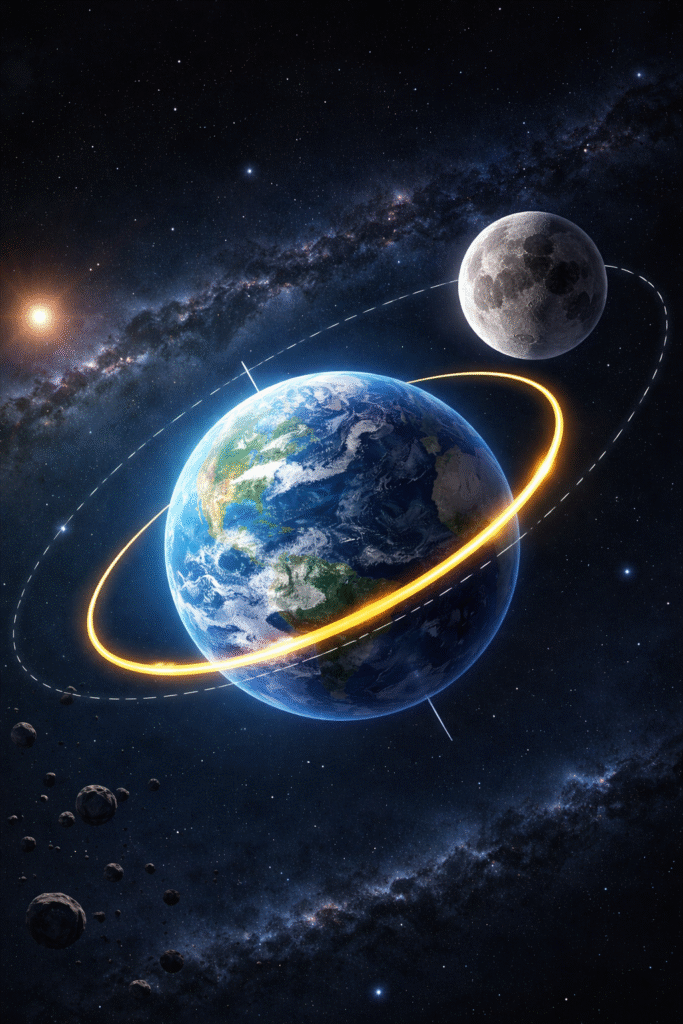
The Moon acts as a stabilizing force by exerting a strong gravitational pull on Earth’s equatorial bulge. This interaction dampens large oscillations in Earth’s axial tilt and keeps it within a narrow, life-friendly range. Because the Moon is relatively large compared to Earth, its stabilizing effect is unusually strong compared to other planet moon systems in the solar system.
Prevention of Extreme Climate Swings
By stabilizing Earth’s axial tilt, the Moon prevents sudden and severe climate changes. This stability ensures that seasons remain predictable over geological timescales allowing ecosystems to evolve gradually rather than being repeatedly disrupted. Long-term climate consistency is essential for the development of complex life and biodiversity.
Comparison with Mars
Mars lacks a large moon and experiences dramatic axial tilt variations, ranging from about 10 to 60 degrees over millions of years. These shifts cause massive climate changes including ice caps migrating toward the equator and atmosphere loss. Mars serves as a natural example of what Earth might look like without the Moon’s stabilizing presence.
Long-Term Habitability of Earth
The Moon’s role in maintaining Earth’s axial stability has contributed significantly to the planet’s long term habitability. Stable climates over billions of years allowed oceans to persist, life to diversify and intelligent species to evolve. This makes the Earth – Moon system unique and highlights the Moon’s hidden but critical role in sustaining life.
A Rare and Fortunate Cosmic Arrangement
Large moons like Earth’s are rare in the universe. The Moon likely formed from a massive collision early in Earth’s history a rare event that turned out to be highly beneficial. This fortunate cosmic arrangement suggests that stable life-supporting planets may be less common than previously thought.
Found phcity22 after my friend told me about it. It’s pretty good so far, easy to use and the games are fun. You should take a look at phcity22.