
The Changing Sky: Earth and Moon Over Billions of Years
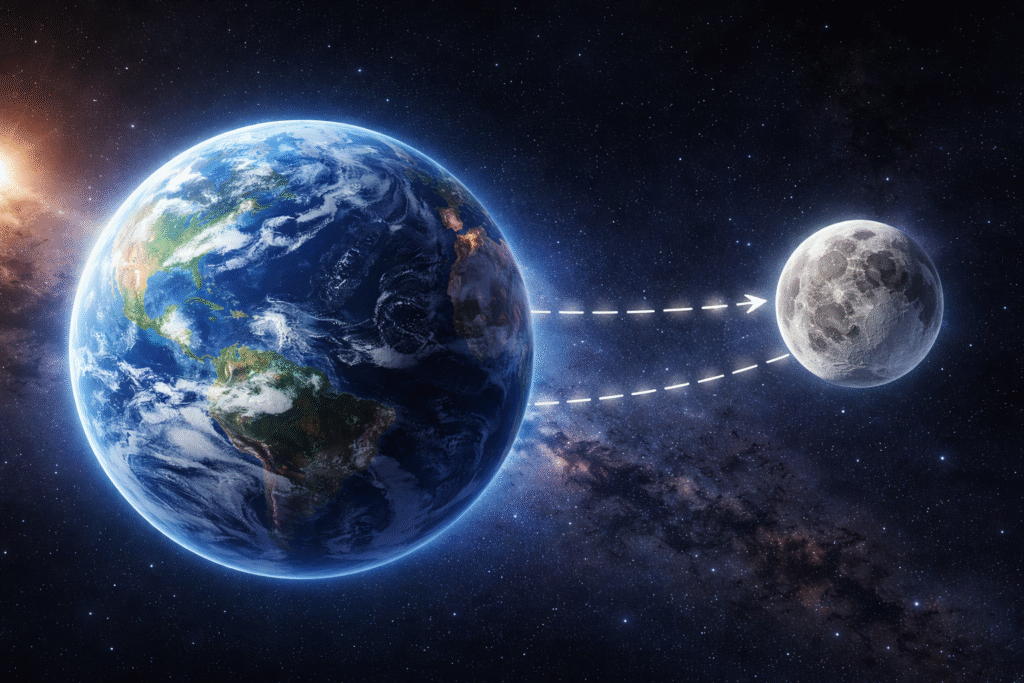
Astronomers and space scientists confirm that Earth’s only natural satellite, the Moon, is **very slowly moving farther away from our planet — by about 3.8 centimetres (1.5 inches) every year. This subtle retreat has been measured with high precision using laser experiments that bounce beams off reflective panels placed on the lunar surface during NASA’s Apollo missions.
How Do We Know the Moon Is Moving Away?
Since 1969, scientists have used powerful lasers from Earth to bounce light off retroreflectors (mirrors) left on the Moon by Apollo astronauts and later lunar missions. By precisely timing how long that light takes to return, researchers can measure the Earth–Moon distance with milli metre-level accuracy — and they have found it increasing steadily by about 3.8 cm per year
Why Is the Moon Drifting Outward?
The reason lies in a gravitational phenomenon known as tidal interaction:
- The Moon’s gravity pulls on Earth’s oceans, creating tides.
- Because Earth rotates faster than the Moon orbits, these tidal bulges get pulled slightly ahead of the Moon.
- The gravitational pull between the tidal bulges and the Moon transfers rotational energy from Earth to the Moon.
- As a result:
- Earth’s rotation slows down very gradually, lengthening the day over millions of years.
- The Moon gains orbital energy and moves into a slightly higher orbit — hence it recedes.
This process is governed by the conservation of angular momentum — a fundamental law of physics that keeps the total rotational energy of the Earth–Moon system constant.
What Does 3.8 cm Per Year Really Mean?
At first glance, 3.8 cm — about the same as the length your fingernails grow in a year — might seem small. But over geological timescales, it becomes significant. Extrapolated backward, this recession suggests that billions of years ago the Moon was much closer to Earth than it is now.
However, scientists caution that the current rate is not constant over Earth’s entire history and likely varied in the distant past.
Long-Term Implications
- Days on Earth are getting longer: As the Moon steals rotational energy, Earth’s spin slows — in fact, hundreds of millions of years ago a day was only about 22 hours long.
- The Moon will look smaller: Far into the distant future (hundreds of millions of years), the Moon will appear smaller in the sky, because it will be farther away — eventually affecting solar eclipse visibility.
- Tidal interactions will continue: Eventually, trillions of years from now, the Earth and Moon could become tidally locked to each other — meaning the same face of Earth would always face the Moon — but that outcome lies far beyond human timeframes and well after the Sun’s evolution alters the solar system.
A Window Into Planetary Evolution
Scientists study this slow recession not just to understand the Earth–Moon relationship, but also to gain insights into planetary dynamics and evolution in other star systems.
In a slow but measurable cosmic dance, the Moon is gradually moving farther from the Earth at a rate of approximately 3.8 centimeters per year. While the change is imperceptible to human senses, scientists confirm that the shift is real, continuous, and deeply significant for our planet’s long-term future.
Precision Measurements From Space Science
The discovery is not speculation — it is backed by decades of direct measurement. During the late 1960s and early 1970s, astronauts placed special reflective mirrors on the Moon’s surface as part of missions conducted by NASA.
Scientists on Earth still fire laser beams at those reflectors today. By timing how long the laser light takes to return, researchers can measure the Earth–Moon distance with millimeter accuracy. These experiments show the gap is increasing year after year.
The current average distance between Earth and the Moon is about 384,400 kilometers, and it is slowly growing.
The Science Behind the Drift: Tidal Forces at Work
The reason for the Moon’s retreat lies in tidal interaction.
- The Moon’s gravity pulls on Earth’s oceans, creating tidal bulges.
- Earth rotates on its axis faster than the Moon orbits Earth.
- Because of this, the tidal bulges are slightly ahead of the Moon.
- The gravitational pull between the bulges and the Moon transfers energy.
This energy transfer causes:
- Earth’s rotation to slow down
- The Moon to gain orbital energy and move outward
This process follows the law of conservation of angular momentum, meaning energy isn’t lost — it’s redistributed.
Earth’s Days Are Getting Longer
Hundreds of millions of years ago, a day on Earth lasted about 22 hours instead of 24. Fossil evidence from ancient coral growth patterns supports this finding.
As the Moon continues to recede:
- Earth’s rotation will keep slowing.
- Days will become slightly longer over vast timescales.
- Leap seconds are occasionally added to our clocks to account for this gradual slowdown.
What About Solar Eclipses?
Because the Moon appears almost the same size as the Sun in our sky, we experience total solar eclipses.
However, as the Moon moves farther away:
- It will appear slightly smaller.
- In the distant future, total solar eclipses may no longer occur.
- Only annular eclipses (where a ring of sunlight remains visible) would be possible.
This change will take hundreds of millions of years, so there is no immediate concern.
Looking Back in Time
Scientists estimate that about 4.5 billion years ago, when the Moon first formed, it was much closer to Earth — possibly only 20,000–30,000 kilometers away.
At that time:
- Tides would have been dramatically stronger.
- The Moon would have appeared much larger in the sky.
- Earth’s rotation was much faster.
However, the recession rate has not always been exactly 3.8 cm per year — it likely varied depending on ocean depth, continental positions, and climate conditions throughout Earth’s history.
The Very Distant Future
If the process continued for billions of years:
- Earth and the Moon could eventually become mutually tidally locked.
- One side of Earth would always face the Moon.
- The Moon would always show the same side to Earth (which it already does).
But scientists note this scenario would occur far beyond the current lifespan of our Sun, making it largely theoretical.
A Quiet but Powerful Cosmic Process
Though 3.8 centimeters per year seems tiny — roughly the width of two fingers — over millions and billions of years it reshapes planetary dynamics.
The Moon’s slow retreat is a reminder that:
- Planetary systems are not static.
- Even stable celestial relationships evolve.
- Time operates on scales far beyond human perception.
In the vast rhythm of the universe, the Earth–Moon system is still changing — quietly, steadily, and predictably.