
Sunspots: Dark Windows into Solar Magnetism
Sunspots and Their Appearance
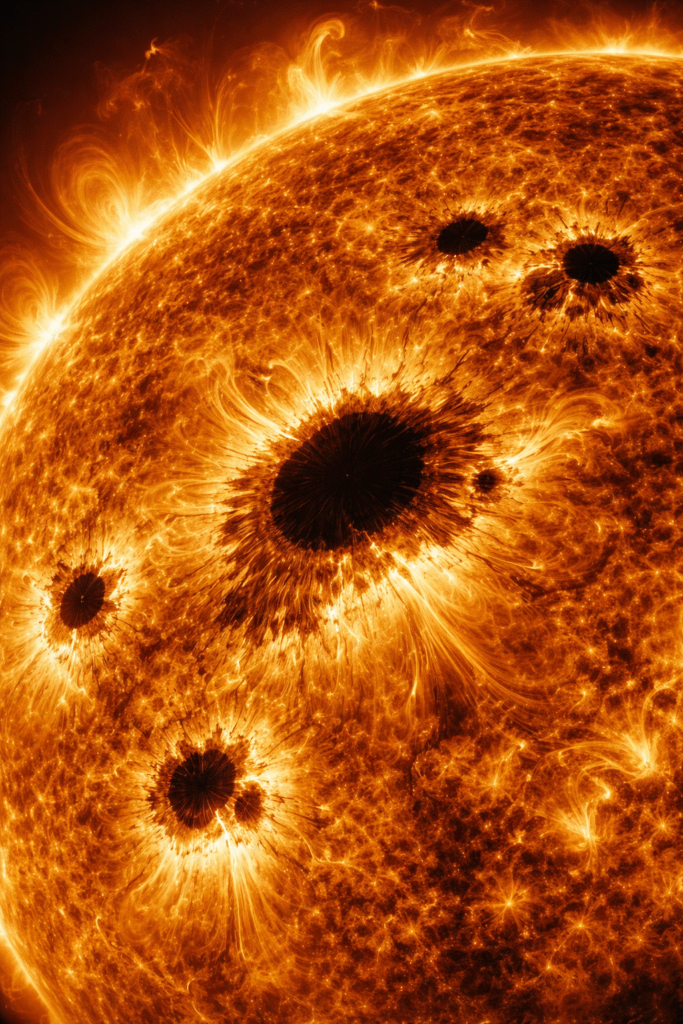
Sunspots are dark, cooler regions that appear on the surface of the Sun specifically on the photosphere. They look dark only in contrast to the surrounding areas which are much hotter and brighter. A typical sunspot has a central dark region called the umbra surrounded by a lighter, filament-like area known as the penumbra. Sunspots can range from smaller than Earth to several times larger and they often appear in groups rather than alone.
Magnetic Origin of Sunspots
The primary cause of sunspots is intense magnetic activity inside the Sun. Powerful magnetic fields rise from the solar interior and pierce the photosphere, suppressing the normal convective flow of hot plasma. When convection is reduced, less heat reaches the surface in that region causing the temperature to drop and the area to appear darker. These magnetic fields are thousands of times stronger than Earth’s magnetic field.
Sunspot Life Cycle
Sunspots are not permanent features. They follow a life cycle that can last from a few days to several weeks. They form when magnetic field lines become twisted and concentrated grow as magnetic complexity increases and eventually decay as the magnetic fields weaken and disperse. Large, complex sunspots tend to last longer than smaller, simpler ones.
Sunspot Cycles
Sunspots follow a well-known approximately 11-year cycle called the solar cycle. During solar maximum, sunspots are numerous and solar activity is high. During solar minimum, sunspots may be rare or even absent for long periods. This cycle is linked to the periodic reversal of the Sun’s global magnetic field and plays a major role in overall solar behavior.
Connection to Solar Activity
Sunspots are closely associated with energetic solar events such as solar flares and coronal mass ejections (CMEs). When magnetic field lines around sunspots suddenly realign or snap enormous amounts of energy can be released. These events can send bursts of radiation and charged particles into space, sometimes toward Earth.
Effects on Earth
Although sunspots themselves do not directly harm Earth, the solar activity linked to them can have significant effects. Strong solar storms can disrupt satellite operations, GPS systems, radio communications and even power grids. On the positive side, they can also intensify auroras, producing vivid northern and southern lights visible at lower latitudes than usual.
Scientific Importance of Sunspots
Sunspots serve as visible indicators of the Sun’s magnetic behavior and internal dynamics. By studying them, scientists gain insight into solar magnetism, plasma physics and stellar behavior in general. Observations of sunspots over centuries have helped build our understanding of how the Sun evolves, how it influences the solar system and how similar processes may occur in other stars.
Sevengame is my go-to for a quick fix of gaming fun. Got some cool games I haven’t seen anywhere else. Worth a look see what thrills you! sevengame
Lucky67 is pretty cool! Good way to spend some downtime. I’ve had some good experiences so far! Give it a shot at: lucky67
X03bet is a new experience, and what I’ve seen so far has been pretty good. If you want to try it, you can find it here: x03bet