

Solar Wind Dynamics and the Creation of the Heliospheric Bubble
1. What Is the Solar Wind?
The solar wind is a continuous stream of charged particles (mostly electrons + protons) that flow outward from the Sun in all directions.
Key facts:
- Speed: 300–800 km/s
- Temperature: 1–2 million Kelvin
- Composition: ~95% protons, ~4% alpha particles, ~1% electrons & heavier ions
- Originates from the Sun’s corona, the outermost layer
The Sun’s intense heat gives particles enough energy to escape the Sun’s gravity → causing a constant outward “wind”.
2. Why Does the Solar Wind Exist?
The corona is extremely hot and produces:
- High thermal pressure
- Strong magnetic forces
- Electromagnetic acceleration
These forces push particles outward until they break free from the Sun’s magnetic field loops.
This escaping plasma becomes the solar wind.
3. Solar Wind Types
1. Fast Solar Wind
- ~750–800 km/s
- Comes from coronal holes
- Stable and steady
2. Slow Solar Wind
- ~300–400 km/s
- Comes from streamer belts near the solar equator
- More chaotic and variable
4. How the Solar Wind Creates the Heliosphere
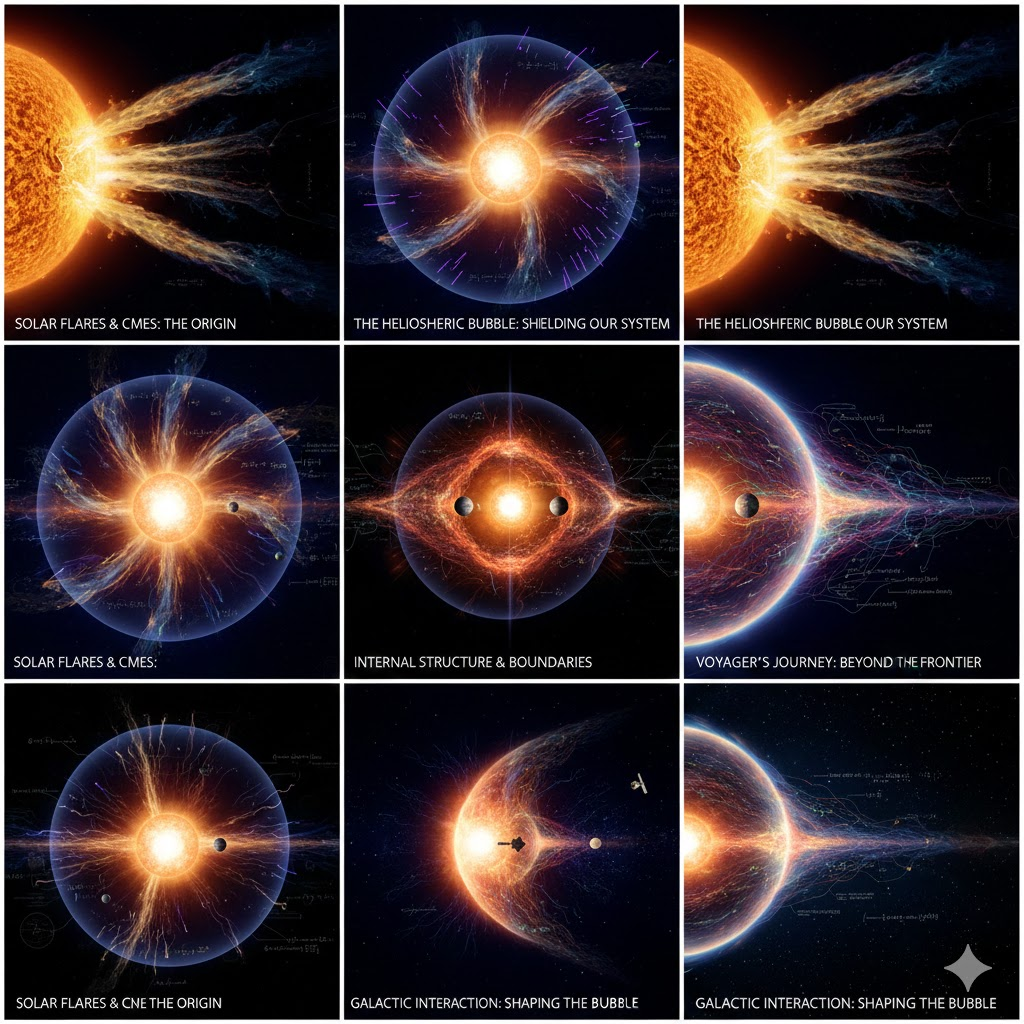
The heliosphere is a giant “bubble” around the solar system, formed by the pressure of the solar wind pushing back interstellar gas.
Think of the Sun blowing a bubble inside space.
4.1 Formation Steps
- Solar wind flows outward from the Sun → Filling space with charged particles.
- It expands in all directions, carrying the Sun’s magnetic field (IMF) → Creates a magnetic “bubble”.
- The solar wind pushes against the interstellar medium (ISM) → ISM contains neutral gas, cosmic rays, dust.
- Where solar wind pressure = ISM pressure, a boundary forms → This is the outer edge of the heliosphere.
5. The Structure of the Heliosphere (4 Layers)
1) Termination Shock
Solar wind slows down from supersonic to subsonic due to pressure from interstellar gas.
Speed drops from ~400 km/s → <100 km/s.
Voyager 1 crossed it in 2004, Voyager 2 in 2007.
2) Heliosheath
A turbulent region where slowed solar wind mixes with interstellar material.
3) Heliopause (Outer Boundary)
- Final border of the heliosphere
- Solar wind pressure = ISM pressure
- Beyond this point → true interstellar space
Voyager 1 crossed it in 2012, Voyager 2 in 2018.
4) Bow Shock / Bow Wave (Debated)
Like a ship moving through water, the Sun may create a wave in front of it in the interstellar medium.
New data suggests it may be a bow wave instead of a shock.
6. Why Is the Heliosphere Important?
1. Shields Earth from cosmic rays
It blocks 70–90% of deadly galactic cosmic rays.
2. Protects the atmosphere
Without it, high-energy radiation would strip away gases (like on Mars).
3. Determines space weather
Solar wind interactions create:
- Aurora (Northern & Southern Lights)
- Geomagnetic storms
- Satellite damage
- Radio blackouts
- Power grid disturbances
7. Solar Cycle Influence
Every 11 years, solar activity rises and falls.
High activity (Solar Maximum):
- More solar wind
- Larger, stronger heliosphere
- More CMEs, solar flares
Low activity (Solar Minimum):
- Weaker solar wind
- Smaller heliosphere
- More cosmic rays enter the solar system
8. Parker Spiral – Solar Wind Twisting the Magnetic Field
Because the Sun rotates, the magnetic field carried by the solar wind becomes a spiral shape in space called the Parker Spiral.
This affects:
- Planetary magnetospheres
- Cosmic ray paths
- Spacecraft navigation
9. Interaction With Planets
Planets with magnetic fields (Earth, Jupiter, Saturn) create magnetospheres that deflect the solar wind.
Planets without magnetic fields (Mars, Venus) face:
- Direct solar wind erosion
- Loss of atmospheric particles
10. Importance to Human Space Exploration
Astronaut safety depends on understanding solar wind and heliospheric boundaries.
The solar wind causes:
- Radiation exposure
- Toxic particle impacts
- Communications interference
NASA monitors solar wind through missions like:
- Parker Solar Probe
- Solar Orbiter
- Voyager spacecraft
- ACE & SOHO
Final Word
- The solar wind is a fast stream of charged particles from the Sun.
- It expands outward and forms a giant bubble called the heliosphere.
- The heliosphere protects our solar system from harmful cosmic rays.
- It has 4 parts: termination shock, heliosheath, heliopause, bow wave.
- Solar activity regulates how big and strong this bubble is.
jljl88com, eh? Gave it a shot the other day. Seems legit, navigation is pretty smooth and I like what I saw. Could use a bit more polish, but honestly, not bad! Worth a peek: jljl88com
Tried logging into 7kbetlogin the other day, smooth as butter! Simple and did what it needed to do. If you’re looking for easy access, this is it. Get in there: 7kbetlogin
Alright, 55666 bong88 is the real deal. I’ve had some decent wins on this site. The interface is clean and easy to navigate, which is a major plus. Give it a shot! 55666 bong88
The Onexbet app is a lifesaver. Betting on the go has never been easier. Seriously, download it and you will be happy onexbet app.
Bookmarked the 72betcomlogin page for easy access. No fuss, no muss. Just gets me straight to my account. Makes things much easier! Here’s the link: 72betcomlogin
Goo99…I not so sure, cause no deposit yet. When I deposit and win money then I will tell you if this is legit. You can see at goo99.
Alright, so I checked out 66winapp. It’s pretty decent, especially if you’re looking for a quick and easy betting experience. Nothing mind-blowing but it works! Gotta say, I’m somewhat impressed. Check it out yourself at 66winapp.
[url=https://vyezdnoj-shinomontazh-77.ru]шиномонтаж на выезд москва[/url]
шумоизоляция арок авто https://shumoizolyaciya-arok-avto-77.ru
шумоизоляция авто https://vikar-auto.ru
Здравствуйте дорогие друзья! Сегодня затронем тему — сколько стоит ПВХ крыша. Дело в том, что: дорого на старте — но окупается. Нужна смета — могу рекомендовать: [url=https://montazh-membrannoj-krovli-spb.ru]установка мембранной кровли[/url]. Какие результаты можно достичь: мембрана стоит дороже рубероида, зато без ремонтов. Например рубероид меняешь 5 раз — то есть мембрана выгоднее. Общие рекомендации: считай на перспективу. Что в итоге: это отличные параметры — экономия в долгосрочной перспективе.
Здравствуйте дорогие друзья! В этой статье я расскажу — ремонт кровли многоквартирного дома. Здесь такой момент: управляющая компания тянет — пора звать специалистов. Могу рекомендовать: [url=https://montazh-membrannoj-krovli-spb.ru]установка мембранной кровли[/url]. На практике крыши многоэтажек — давно требуют замены. Например латать бесполезно — значит нужна полная замена. Основные этапы: провести собрание. Что в итоге: удаётся достигать классных результатов — жители довольны.
[url=https://vikar-auto.ru]шумоизоляция авто[/url]
шумоизоляция торпеды https://shumoizolyaciya-torpedy-77.ru
шумоизоляция дверей авто https://shumoizolyaciya-dverej-avto.ru
[url=https://nakrutka-podpischikov-telegram-1.ru]накрутка подписчиков в Телеграм[/url]
Вы можете выбрать игры различных жанров и форматов.
[url=https://7v4.casino/]Пинко Казино[/url]
Служба поддержки работает оперативно и профессионально.
https://www.medvediza.ru/bitrix/redirect.php?event1=&event2=&event3=&goto=https://www.salesforce.com/trailblazer/pq1xkbbqsa5pd50lvc
https://zookompleks.ru