
Scientists Uncover 45 Earth-Like Planets in the Habitable Zone — A Major Breakthrough
Hello again, space explorer!
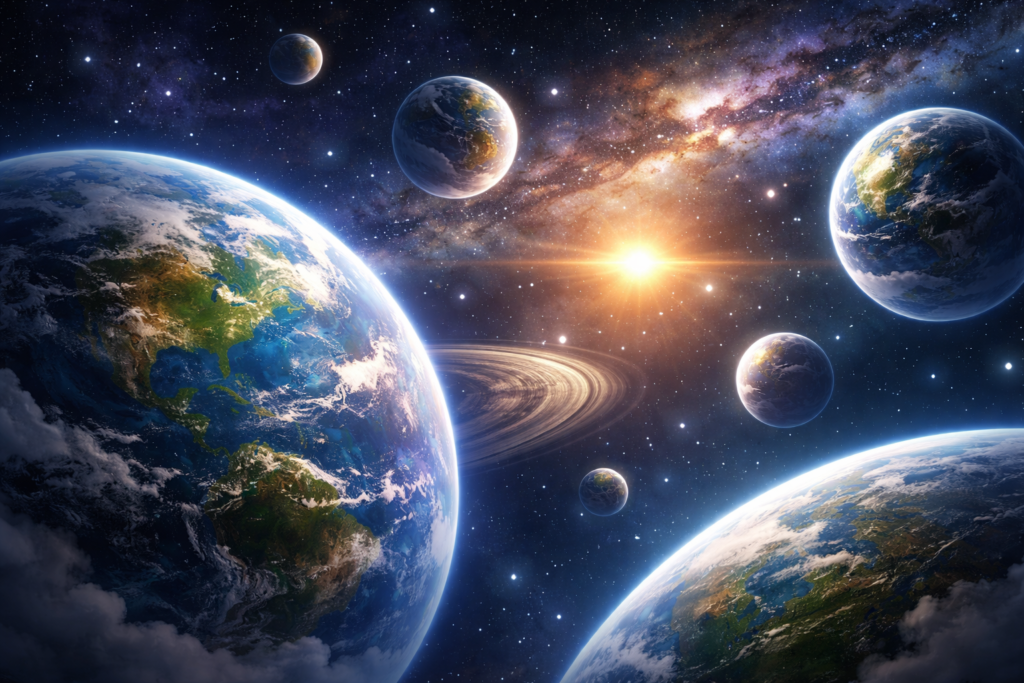
Let’s go further. Much further. Because this discovery isn’t just exciting it’s revolutionary. Those 45 Earth-like planets aren’t just numbers… they are real worlds, each with its own story, orbiting distant stars, possibly holding oceans, clouds, and maybe even life.
Where Are These Planets Hiding?
These planets are scattered across our cosmic neighborhood inside the vast Milky Way Galaxy. Most lie hundreds to thousands of light-years away, meaning the light we see from them today actually began its journey long before modern human civilization.
Many of them orbit small, cooler stars known as red dwarfs. These stars are dimmer than our Sun, but incredibly common making them prime targets in the hunt for habitable worlds.
Not All “Earth-Like” Means Earth 2.0
Here’s something important and fascinating.
Even though these planets are called “Earth-like,” they can be very different from our home:
- Some may have thicker atmospheres, trapping more heat
- Others might be covered entirely in oceans so-called “water worlds”
- A few could be tidally locked, meaning one side always faces the star (eternal day) while the other remains in darkness
Despite these differences, conditions might still allow life just not necessarily life as we know it.
The Science of Habitability
Scientists don’t just guess they use detailed models to evaluate whether a planet could support life.
They analyze:
- Stellar radiation (how much energy the star provides)
- Orbital stability (does the planet stay in the habitable zone?)
- Atmospheric retention (can it hold gases like oxygen or carbon dioxide?)
Planets too close to their stars may lose their atmospheres. Too far, and they freeze. But in the middle there’s a narrow, precious zone where life might thrive.
The Technology Behind the Discovery
This breakthrough is powered by incredible instruments like NASA’s Kepler Space Telescope and TESS (Transiting Exoplanet Survey Satellite).
But now, a new era has begun with the James Webb Space Telescope.
Unlike earlier telescopes, Webb can actually analyze the atmospheres of distant planets. It looks for:
- Water vapor
- Methane
- Oxygen
These are called biosignatures chemical clues that could hint at life.
Imagine detecting oxygen on a distant planet. On Earth, oxygen exists largely because of life. Finding it elsewhere would be a huge moment in human history.
A Few Standout Candidates
Among the 45 planets, scientists have highlighted several especially promising ones:
- Planets with Earth-like gravity
- Worlds orbiting quiet, stable stars
- Systems where multiple planets exist suggesting long-term stability
Some may even have conditions suitable for liquid oceans and weather systems, just like Earth.
Think clouds drifting… rain falling… maybe even seasons changing.
The Human Effort Behind It All
This discovery is the result of decades of global collaboration. Scientists from around the world—working through agencies like NASA have spent years anallyzing tiny signals buried in massive datasets.
It’s not glamorous work. It’s slow, precise, and often frustrating.
But every once in a while… the data reveals something extraordinary.
And this is one of those moments.
Are We Close to Finding Life?
Here’s the honest truth:
We haven’t found life yet.
But we are closer than ever before.
These 45 planets are not random they are targets. In the coming years, scientists will focus on them, studying their atmospheres, temperatures, and chemical compositions in detail.
Future telescopes may even be able to:
- Detect cloud patterns
- Map surface temperatures
- Identify seasonal changes
And one day… maybe even detect signs of biological activity
Let this sink in:
If 45 potentially habitable planets can be found with our current technology… then there could be millions more across the galaxy.
Each one a possibility.
Each one a mystery.
Each one a chance that we are not alone.
Tonight, when the sky turns dark over your city, take a moment.
Look up.
Somewhere out there, orbiting a distant star, one of those 45 worlds might have its own sky… its own oceans… maybe even someone else looking back at the stars, wondering the same thing:
“Are we alone?”
And maybe just maybe the answer is waiting among those distant lights.