
Painted by the Sun: The Violent Space Weather Behind Auroras
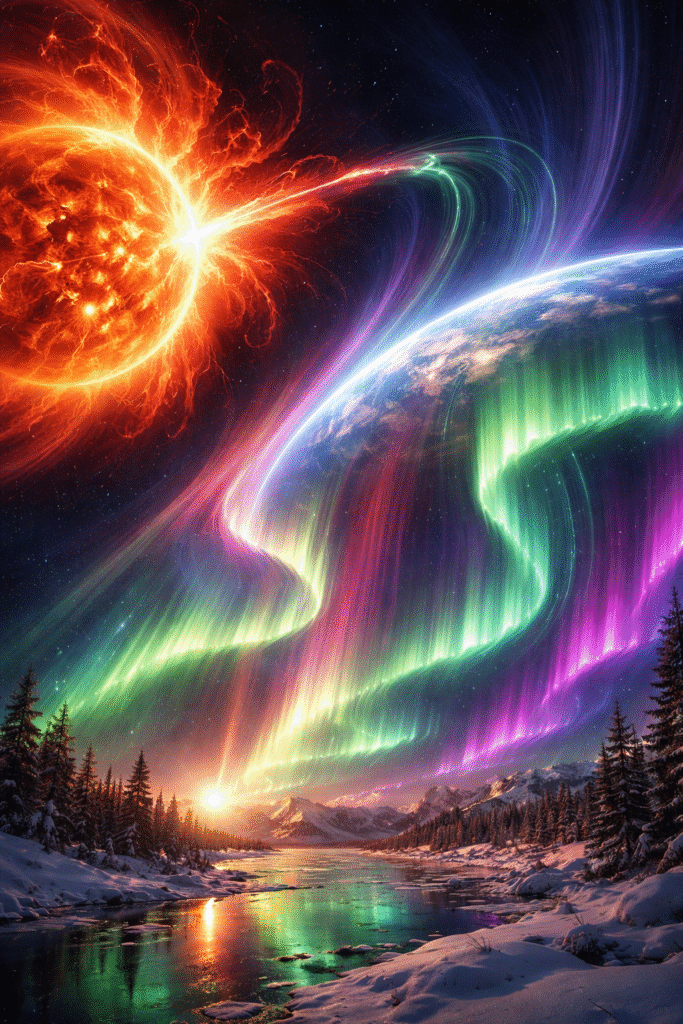
Auroras—often called the Northern and Southern Lights—are among the most breathtaking natural displays on Earth. Shimmering curtains of green, red, purple, and blue light ripple across polar skies, appearing calm and magical. But behind this beauty lies a story of solar violence, charged particles, and powerful space weather driven by the Sun.
The Sun: A Restless Star
The Sun is not a quiet ball of light. It is a massive, boiling sphere of plasma threaded with intense magnetic fields. These magnetic fields constantly twist, snap, and reconnect, releasing enormous amounts of energy in events known as solar flares and coronal mass ejections (CMEs). When this happens, billions of tons of electrically charged particles mainly electrons and protons are hurled into space at speeds reaching millions of kilometers per hour.
Solar Wind and Space Storms
Even during calm periods, the Sun continuously emits a stream of charged particles called the solar wind. During solar storms, this wind becomes faster and denser carrying strong magnetic fields toward Earth. If a CME is aimed at our planet, it can collide with Earth’s magnetic shield within one to three days, triggering geomagnetic storms.
Earth’s Magnetic Shield: Gatekeeper of Auroras
Earth is protected by a magnetic field known as the magnetosphere which deflects most harmful solar particles. However, this shield is weakest near the North and South Poles. During strong solar storms, charged particles funnel down magnetic field lines into the upper atmosphere, setting the stage for auroras.
The Atmospheric Collision That Creates Light
When high-energy solar particles slam into Earth’s atmosphere, they collide with gases like oxygen and nitrogen at altitudes of 80–500 kilometers. These collisions excite atmospheric atoms, pushing their electrons into higher energy states. When the electrons fall back to normal levels, they release energy as light creating auroras.
Different gases and altitudes produce different colors:
- Green (most common): Oxygen at ~100–300 km
- Red: High-altitude oxygen above 300 km
- Blue & Purple: Nitrogen molecules
- Pink & Yellow: Blends of oxygen and nitrogen emissions
Why Auroras Move Like Curtains
Auroras are rarely still. They wave, pulse, spiral, and stretch across the sky. This motion is caused by fluctuating magnetic fields and electric currents flowing through the upper atmosphere, especially the auroral electrojet a powerful ring of electric current encircling the polar regions.
Auroras and Solar Cycles
Auroral activity follows the Sun’s 11-year solar cycle which alternates between solar minimum and solar maximum. During solar maximum, sunspots, flares, and CMEs increase dramatically, making auroras brighter, more frequent and visible much farther from the poles even at mid-latitudes.
Beauty with a Dangerous Side
While auroras themselves are harmless to people on the ground, the solar storms that cause them can be dangerous. Strong geomagnetic storms can:
- Disrupt satellite operations
- Damage power grids
- Interfere with GPS and radio communications
- Increase radiation exposure for astronauts and high-altitude flights
Thus, auroras are not just light shows they are visible warnings of powerful space weather events.
A Cosmic Reminder
Every aurora is a reminder that Earth is not isolated. Our planet lives inside the Sun’s vast magnetic influence, constantly interacting with energy from a star 150 million kilometers away. What appears as gentle, glowing ribbons in the night sky is actually the final act of a cosmic battle between solar fury and Earth’s magnetic defense.
Alright lads, just tried out 88gobet8. Not bad, not bad at all. Had a decent punt and almost won big. Give it a go, might be your lucky day!88gobet8
Yo, anyone know where to find ‘gà chọi c1.com’ streams? Hoping this site does the trick lets see some action! Here it is: gà chọi c1.com.
Xibetlogo is pretty legit, no doubt. The games keep me hooked for hours. Nice vibes all around, I say give it a shot. xibetlogo
I gotta say, 6789fccom has a lot going for it. Good offers, the games are very varied, and you can just keep playing forever! The world’s your oyster! Check it out, you won’t regret doing the same: 6789fccom
I’ve been using 7ffbet for a while now, and it’s always a good time. Reliable platform and great promotions. Check it out: 7ffbet
9bet99br has a great community feel. It makes it more fun when you can see what others are up to. Enjoy!: 9bet99br
Hey, has anyone used 98winbet01 before? Trying to find a new place to put down a few bets and this one looks promising. What’s the deal? Check out 98winbet01 if you are interested.
Hey, I’ve been looking at 20bets. Anyone here played there? If you have please give me some advice. I am trying to evaluate if it is fun. Check out 20bets maybe?
Just signed up on billionaire777vn! Seems like a lot of options to play. Wish me luck, gonna try and become a billionaire myself LOL! Here’s the link: billionaire777vn