

One Teaspoon of a Neutron Star Would Weigh a Billion Tons, Scientists Say
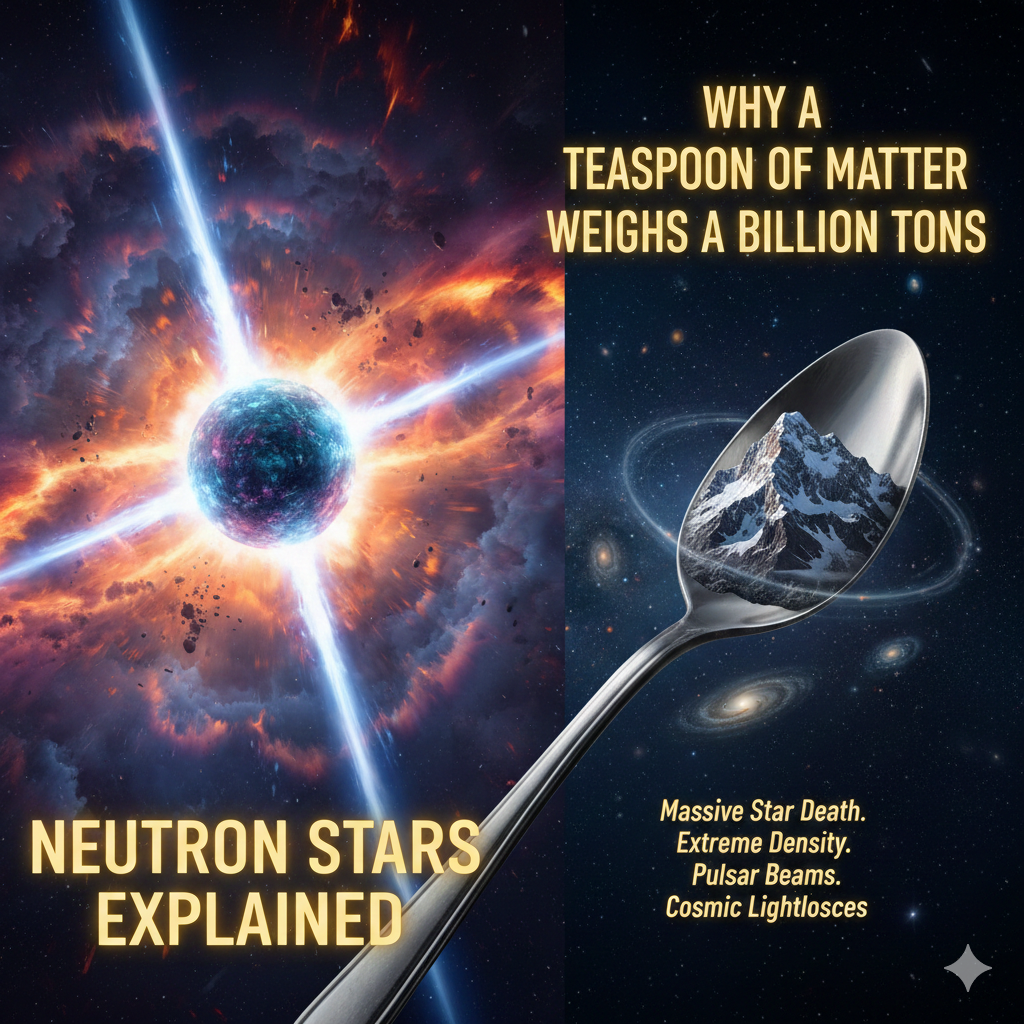
Neutron stars are among the most mysterious and extreme objects ever discovered in the universe. Born from the violent deaths of massive stars, these cosmic remnants challenge our understanding of matter, gravity, and the fundamental laws of physics. One of the most astonishing facts about neutron stars is their density: a single teaspoon of neutron star material would weigh about one billion tons on Earth.
How Neutron Stars Are Formed
Neutron stars form when a star much larger than the Sun exhausts its nuclear fuel. Without the outward pressure from nuclear fusion, gravity causes the star’s core to collapse in a fraction of a second. This collapse triggers a massive supernova explosion that blows away the outer layers of the star. What remains behind is the core — compressed to such an extent that electrons and protons merge to form neutrons, creating an object composed almost entirely of tightly packed neutrons.
Extreme Size and Mass
Despite having a diameter of only about 20 to 25 kilometers, a neutron star typically contains 1.4 times the mass of the Sun. This means solar-level mass is squeezed into a city-sized sphere. The result is an object with gravity billions of times stronger than Earth’s.
Unimaginable Density
The density of a neutron star is so extreme that a sugar-cube-sized amount would weigh billions of tons on Earth. A teaspoon — a volume we associate with everyday life — would weigh as much as Mount Everest. This density is comparable to the density of atomic nuclei, making neutron stars essentially gigantic atomic cores floating in space.
Powerful Gravity and Magnetic Fields
Neutron stars have incredibly strong gravitational and magnetic fields. Their gravity is so intense that escaping from the surface would require traveling at nearly half the speed of light. Their magnetic fields can be trillions of times stronger than Earth’s, capable of stripping atoms apart and affecting matter from vast distances.
Spinning at Incredible Speeds
Many neutron stars rotate extremely fast. Some, known as pulsars, spin hundreds of times per second, emitting beams of radiation that sweep through space like cosmic lighthouses. When these beams cross Earth, they appear as precisely timed pulses of light or radio waves.
Laboratories of Extreme Physics
Scientists study neutron stars to understand how matter behaves under conditions that cannot be reproduced on Earth. Observations of neutron star collisions, detected through gravitational waves, have revealed that these events create heavy elements such as gold and platinum, linking neutron stars directly to the materials found on our planet.
Why Neutron Stars Matter
Neutron stars help researchers test theories of gravity, nuclear physics, and quantum mechanics. They provide clues about the nature of matter at its densest possible state and offer insights into how the universe evolves after massive stellar explosions.
From their violent birth in supernovae to their astonishing density and power, neutron stars remain one of the universe’s most fascinating phenomena — where even a teaspoon can outweigh a mountain and redefine the limits of imagination.