
Oblate Spheroids and Geoids: The Complex Geometry of Earth
To understand why Earth isn’t a perfect sphere, we have to look at the intersection of history, physics, and modern satellite technology. It is a story of a scientific “feud,” the invisible forces of rotation, and a “lumpy” reality that affects everything from your weight to the path of GPS satellites.
1. The Mathematical Standards (WGS 84)
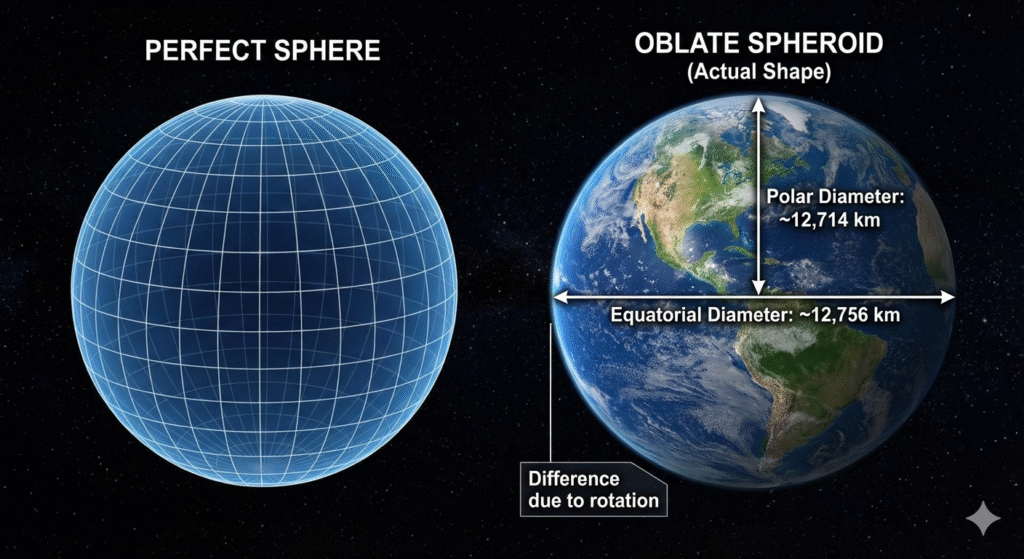
Scientists don’t just say Earth is “squashed”; they use a specific model called the World Geodetic System (WGS 84). This is the standard used by GPS. It defines Earth as an oblate ellipsoid of revolution with these precise dimensions:
- Equatorial Radius (Semi-major axis, a): 6,378,137.0 meters
- Polar Radius (Semi-minor axis, b): ~6,356,752.3 meters
- Flattening (f): The ratio of the “squash” is expressed as f = (a – b)/a. For Earth, this is approximately 1 / 298.25.
Essentially, Earth is about 42.77 kilometers (26.5 miles) wider than it is tall.
2. The Great “Orange vs. Lemon” Feud
In the late 1600s, one of the biggest scientific debates in history broke out over Earth’s shape:
- The “Orange” Theory (Isaac Newton): Newton argued that because Earth spins, centrifugal force must pull the equator outward, making it look like a squashed orange (oblate).
- The “Lemon” Theory (The Cassini Family): French astronomers, based on early (and flawed) ground measurements, argued Earth was stretched at the poles like a lemon (prolate).
To settle this, the French Academy of Sciences sent expeditions to the Equator (Ecuador) and the Arctic (Lapland) in 1735. The Arctic team found that a degree of latitude was longer there than at the equator, proving Newton correct. Voltaire famously joked to the leader of the Arctic mission, “You have flattened both the poles and the Cassinis!”
3. The Physics: Why the Bulge Happens
The Earth isn’t a rigid cue ball; it behaves more like a very viscous fluid over long timescales.
- Centrifugal Force: As Earth rotates, everything on the surface is being “thrown” outward. This force is strongest at the equator (where the spin speed is ~1,670 km/h) and zero at the poles.
- Hydrostatic Equilibrium: Gravity wants to pull everything into a perfect sphere. Centrifugal force wants to pull it into a flat disk. The “oblate spheroid” is the compromise—the shape where the two forces are in balance.
4. How Much Do You Weigh?
Because of the shape and the spin, your weight actually changes depending on where you stand!
- The Distance Factor: At the poles, you are closer to Earth’s center of mass, so gravity pulls on you more strongly.
- The Centrifugal Factor: At the equator, the outward “spin force” slightly cancels out some of gravity’s pull.
As a result, you weigh about 0.5% more at the North Pole than you do at the Equator. If you weigh 200 lbs at the equator, you’d weigh about 201 lbs at the pole.
5. The “Lumpy Potato” (The Geoid)
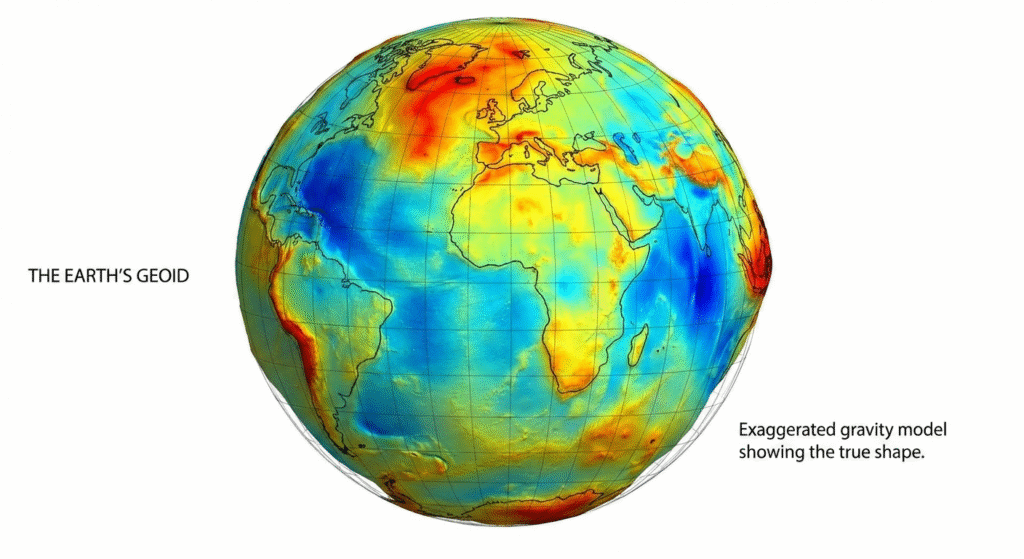
Even “oblate spheroid” is an oversimplification. Earth’s interior is not uniform; it has different densities of rock, magma, and water. This creates the Geoid—a theoretical surface where gravity is exactly the same everywhere.
- The Potsdam Potato: Maps of the Geoid look like a lumpy, colorful potato.
- The “Pear” Shape: Satellite data from missions like GOCE and GRACE have shown that the Southern Hemisphere is slightly bulkier than the Northern Hemisphere, giving Earth a very subtle “pear-like” asymmetry.
6. Why This Matters Today
If we assumed Earth was a perfect sphere, modern life would break:
- GPS: Satellite signals would be off by hundreds of meters within a day because the satellites orbit in a field that accounts for the equatorial bulge (which causes the orbit to “precess” or rotate).
- Ocean Currents: Water flows along the Geoid. To understand how sea levels are rising, scientists must first know exactly where the “lumps” in Earth’s gravity are.
- Spaceflight: Launching a rocket from near the equator (like Cape Canaveral or French Guiana) gives the rocket a “speed boost” from the Earth’s faster rotation at the bulge.
bắn cá 188v có hệ thống xếp hạng người chơi – thi đua công bằng, nhận thưởng theo thứ hạng mỗi tháng. TONY02-03H
Trying to find that Plus777 download! I am curious to see if it is as good as sources mentioned. Will give it a go. plus777 download
Just trying to get my Slotomania login working! Gotta spin those reels, right? Hope the bonuses are decent today! slotomania login
Yo, check out xoilac 87! It’s where all the live soccer action is at. Seriously, if you’re a football fan, you gotta be here! Go peep xoilac 87.