

Mercury Uncovered: How the Sun Creates the Solar System’s Wildest Temperatures
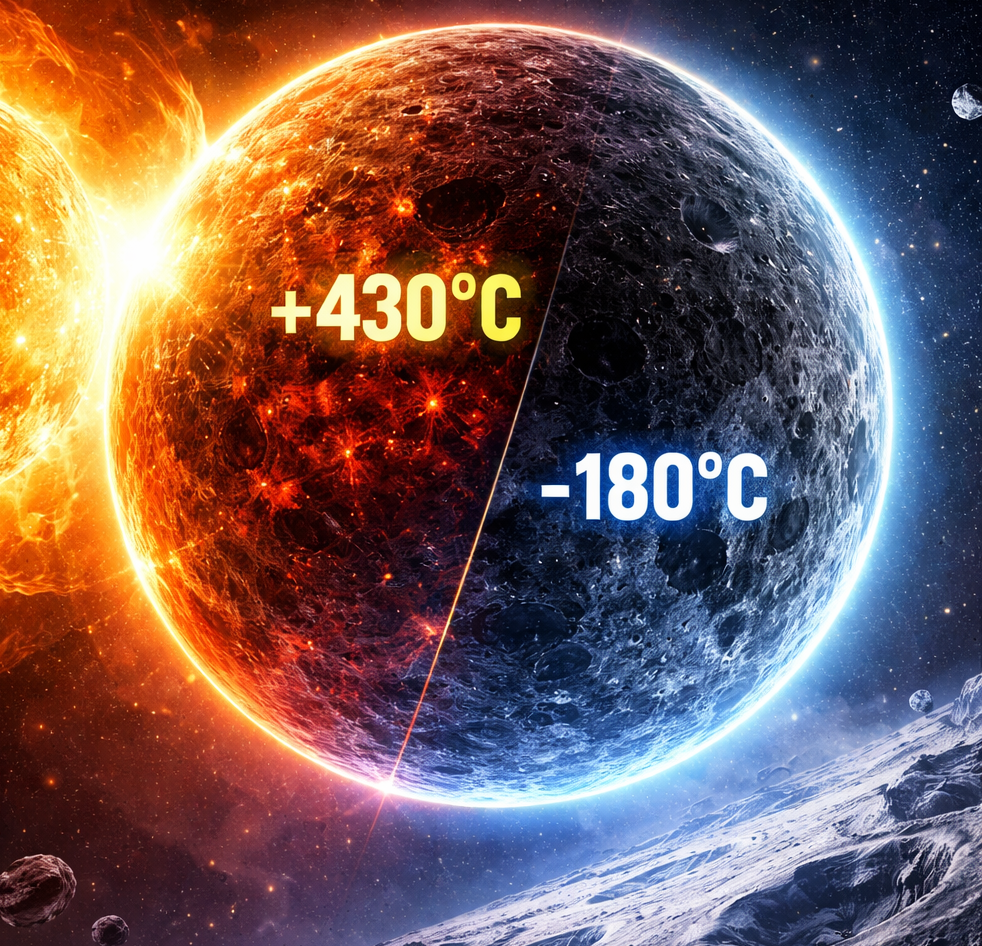
Mercury, the smallest and closest planet to the Sun in our solar system, is known for experiencing some of the most dramatic temperature variations observed on any planet. Scientists report that surface temperatures on Mercury can soar to approximately 430°C during the daytime, hot enough to melt certain metals such as lead, while plunging to around –180°C at night, creating a staggering temperature difference of more than 600°C within a single Mercury day.
These extreme conditions occur primarily because Mercury lacks a significant atmosphere. On Earth, the atmosphere acts like an insulating blanket, trapping heat and distributing it around the planet. Mercury, however, has only a very thin exosphere that cannot retain heat. As a result, when the side of the planet facing the Sun receives intense solar radiation, temperatures rise rapidly. Once that same region rotates into darkness, the accumulated heat escapes quickly into space, causing temperatures to drop sharply.
Another key factor contributing to these temperature swings is Mercury’s slow rotation. A single day on Mercury — the time it takes for the Sun to return to the same position in the sky — lasts about 176 Earth days. This prolonged exposure to sunlight allows the surface to heat for extended periods, followed by equally long, freezing nights.
Despite the intense daytime heat, scientists have discovered that some permanently shadowed craters near Mercury’s poles may contain water ice, preserved in regions where sunlight never reaches and temperatures remain extremely low. These findings have provided important clues about how water may exist even in some of the harshest environments in the solar system.
Mercury’s dramatic temperature contrasts make it a fascinating subject of study for planetary scientists, offering valuable insights into how atmospheres regulate planetary climates and how extreme conditions shape planetary surfaces across the solar system.
Why the Temperature Difference Is So Extreme
The enormous temperature swings on Mercury are not caused only by its closeness to the Sun; several unique planetary characteristics combine to create these conditions:
1. No Protective Atmosphere
Unlike Earth, Mercury does not possess a thick atmosphere capable of trapping and redistributing heat. Without this insulating layer, solar radiation heats the sunlit surface directly, and the absorbed heat escapes almost instantly once darkness falls. This leads to the rapid transition from scorching daytime temperatures (about 430°C) to freezing nighttime conditions (around –180°C).
2. Highly Elliptical Orbit
Mercury follows an elliptical (oval-shaped) orbit, meaning its distance from the Sun varies significantly. When the planet is closest to the Sun (perihelion), solar radiation is much stronger, further intensifying daytime heat in some regions.
3. Long Solar Days
Although Mercury rotates once every 59 Earth days, its orbital motion causes a solar day (sunrise to sunrise) to last about 176 Earth days. This extremely long period of sunlight allows the surface to heat continuously for months, followed by equally long cooling periods during night.
4. Rocky, Heat-Absorbing Surface
Mercury’s surface is made mostly of dark, rocky material that efficiently absorbs solar energy. Without atmospheric winds or oceans to distribute that heat, temperature differences between the sunlit and shadowed regions remain extreme.
Scientific Exploration and Discoveries
Data from spacecraft missions led by NASA and the European Space Agency have provided detailed measurements of Mercury’s surface temperatures, confirming the dramatic thermal variations and identifying permanently shadowed polar craters that may contain frozen water ice, despite the planet’s proximity to the Sun.
Why Scientists Study These Extremes
Mercury serves as a natural laboratory for understanding how atmospheres control planetary climates. By studying why Mercury experiences such severe temperature fluctuations, scientists gain insight into how planetary atmospheres, rotation speeds, and orbital properties influence environmental conditions on planets both within and beyond our solar system.
Inside the Most Extreme Climate in the Solar System
Mercury’s enormous temperature variation—ranging from about 430°C in sunlight to –180°C in darkness—is one of the most dramatic climate contrasts known on any planet. Scientists studying these extremes have uncovered several deeper physical processes that explain why the planet behaves so differently from Earth and other rocky worlds.
Surface Physics and Thermal Behavior
Mercury’s surface consists mainly of silicate rock and metallic materials with relatively low thermal inertia, meaning the ground heats up and cools down very quickly. On Earth, oceans, vegetation, and atmospheric circulation store and redistribute heat, smoothing temperature changes. Mercury lacks all of these mechanisms, so the temperature at any given point depends almost entirely on whether the Sun is shining on it at that moment.
The intense daytime heat is driven by the planet’s proximity to the Sun—Mercury receives about 6–7 times more solar energy per unit area than Earth. With nothing to scatter or absorb the incoming radiation, the surface directly absorbs this energy, pushing temperatures to metal-melting levels.
Polar Regions: Unexpected Ice Deposits
One of the most surprising discoveries is the presence of water ice at the poles. Some craters near the poles are so deep that sunlight never reaches their floors. These “permanently shadowed regions” remain at extremely low temperatures—far colder than the planet’s average nighttime temperature—allowing ice delivered by comets or meteorites to remain stable for billions of years.
Orbital Resonance and Heating Cycles
Mercury rotates in a 3:2 spin–orbit resonance, meaning it rotates three times for every two orbits around the Sun. This unusual relationship causes certain surface locations to experience repeated long-duration heating cycles, producing predictable “hot spots” where the Sun remains nearly overhead for extended periods. These repeated heating phases further intensify local daytime temperatures.
Spacecraft Measurements and Scientific Missions
Much of the modern understanding of Mercury’s climate comes from observations by missions operated by NASA and the European Space Agency, which mapped surface composition, shadowed craters, and temperature patterns in high detail. These measurements confirmed both the extreme day–night thermal contrast and the existence of long-lasting polar ice deposits.
Why These Extremes Matter
Studying Mercury helps scientists understand how atmospheres regulate planetary temperatures and how rocky planets without atmospheres behave under intense stellar radiation. These findings are especially important for interpreting observations of airless exoplanets orbiting close to their stars, many of which likely experience temperature swings similar to those seen on Mercury.
Hello mates, good paragraph and good urging
commented here, I am really enjoying by these.