
March’s Worm Moon: Ancient Traditions Meet Modern Astronomy
As winter slowly gives way to spring, the March full moon commonly known as the Worm Moon—rises brightly in the night sky. While it may sound unusual, the name carries centuries of history, cultural tradition, and scientific significance. Today, the Worm Moon stands as a fascinating example of how ancient human observations of nature connect with modern astronomical understanding.
A Name Rooted in Nature
The term “Worm Moon” became widely known through records preserved by the Old Farmer’s Almanac, which documented traditional full moon names used by Indigenous communities and early settlers in North America.
According to these traditions, March marked the time when the frozen ground began to thaw after the long winter months. As the soil softened, earthworms appeared near the surface again. Their return attracted birds such as robins and signaled that warmer days and the growing season were approaching.
However, historians suggest that the name might not always have referred to earthworms. In some Indigenous interpretations, it could have described beetle larvae emerging from tree bark as temperatures increased. Regardless of the exact origin, the name symbolizes the return of life and activity in nature.
Indigenous Knowledge and Seasonal Calendars
Long before modern calendars and meteorological systems existed, many Indigenous communities relied on natural cycles to measure time. The phases of the Moon served as an important guide for tracking months and seasonal changes.
Different tribes used various names for the March full moon, reflecting local environmental conditions. Some alternative names include:
- Crow Moon – referring to the cawing of crows that often signals the end of winter.
- Sap Moon – marking the time when maple tree sap begins to flow.
- Sugar Moon – associated with the production of maple sugar.
These names reveal how closely early societies observed nature and adapted their activities such as planting, hunting, and gathering—according to lunar and seasonal patterns.
The Scientific Perspective
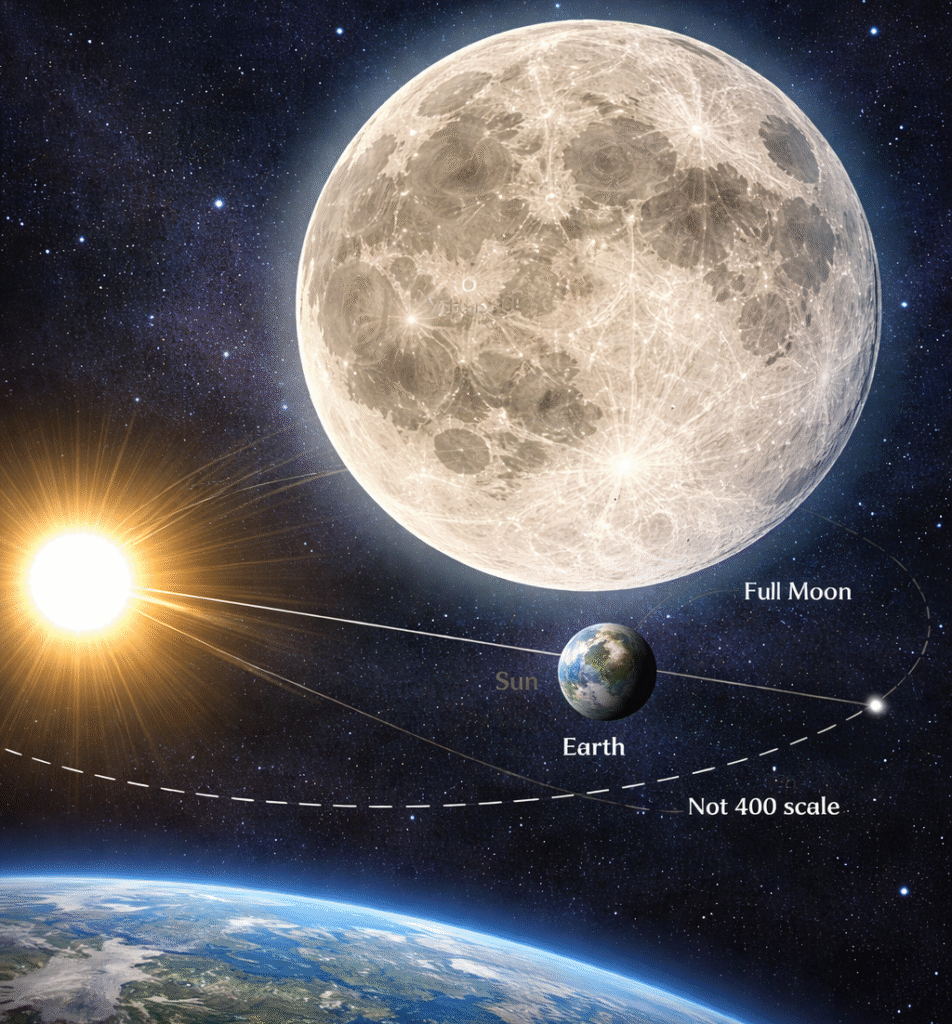
From a modern scientific viewpoint, the Worm Moon is simply the full moon phase occurring during March. A full moon happens when the Moon is positioned directly opposite the Sun relative to Earth, allowing the Sun’s light to fully illuminate the Moon’s visible side.
According to the NASA, the Moon completes one cycle of phases roughly every 29.5 days, known as the lunar cycle. During a full moon, the Moon rises at sunset and sets at sunrise, remaining visible throughout the entire night.
Although the name “Worm Moon” is cultural rather than scientific, the astronomical mechanics behind it remain the same as any other full moon.
Connection to the Arrival of Spring
The Worm Moon often occurs close to the March equinox the moment when day and night are nearly equal in length. In the Northern Hemisphere, this event marks the beginning of astronomical spring.
Because of this timing, the Worm Moon has long been seen as a symbol of renewal and seasonal transition. Snow begins to melt, animals become more active, and plants prepare to grow again.
For centuries, farmers and gardeners used this lunar timing as a signal to start preparing fields for planting.
Watching the Worm Moon
Observing the Worm Moon requires no special equipment. On a clear night, it can be seen rising in the eastern sky shortly after sunset.
When the Moon first appears near the horizon, it may look unusually large. This phenomenon known as the “moon illusion”is a visual effect caused by our perception of objects against the landscape.
With binoculars or a telescope, viewers may even spot details such as lunar craters and the darker plains known as “maria,” formed by ancient volcanic activity.
Where Tradition Meets Science
The story of the Worm Moon highlights a unique intersection between cultural heritage and modern astronomy. While ancient societies named the moon according to seasonal observations, contemporary science explains the precise celestial mechanics behind its appearance.
Together, these perspectives remind us that the night sky has always been a source of curiosity, guidance, and wonder. Each year, as March’s full moon rises once again, it connects modern observers with centuries of human history and with the timeless rhythms of the natural world.