
March Equinox 2026: Sun, Earth, and the Celestial Balance Explained
Chattogram, Bangladesh – March 8, 2026: Every year, the Earth experiences a moment of cosmic equilibrium known as the March Equinox, a celestial event that signals a pivotal transition in the planet’s seasons. This year, astronomers confirm that the equinox will occur on March 20, 2026, when day and night are nearly equal in length across the globe.
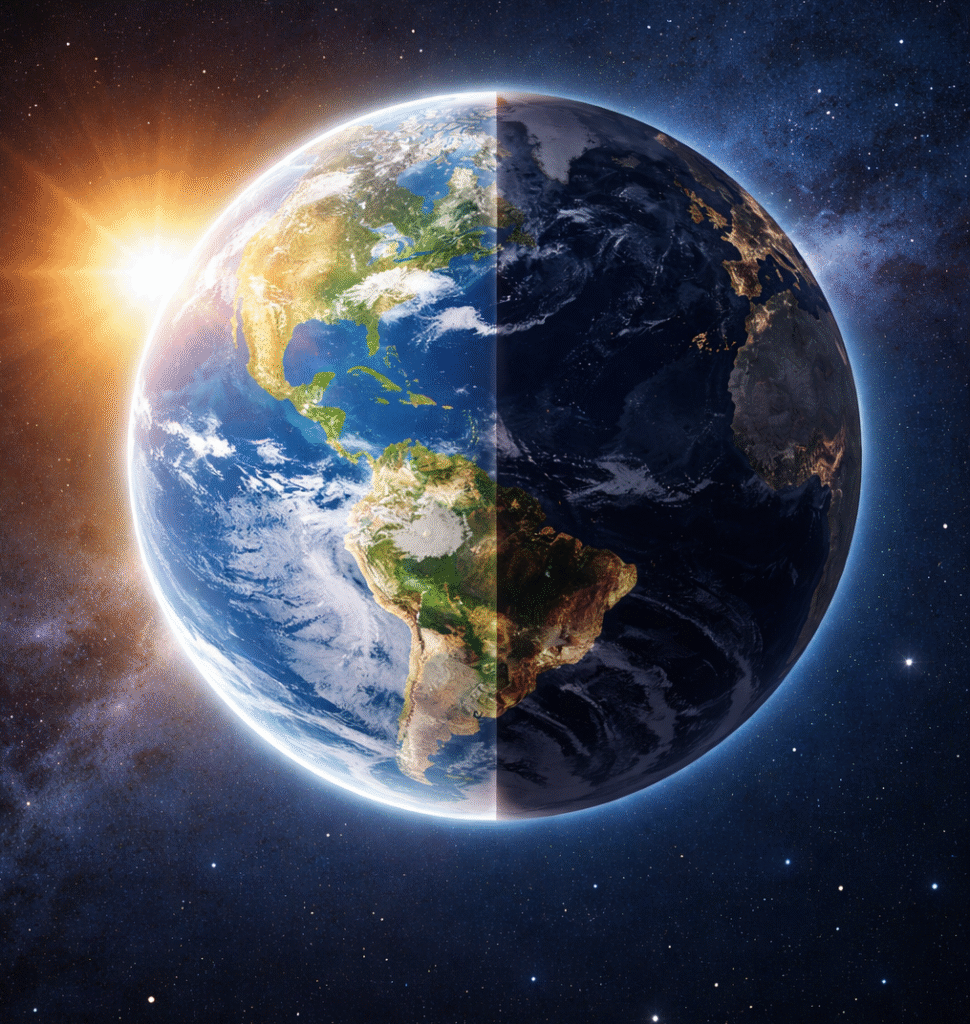
The March Equinox is one of two points in the year—alongside the September Equinox—when the Sun passes directly over the equator, creating a rare balance of daylight and darkness. During this event, the Earth’s tilted axis is neither leaning toward nor away from the Sun, allowing sunlight to shine equally on both hemispheres.
What Happens During the Equinox?
On the equinox, day and night are nearly equal in length across the globe. This happens because the Earth’s axis is tilted neither toward nor away from the Sun, allowing sunlight to illuminate both hemispheres equally.
- In the Northern Hemisphere, the March Equinox marks the start of spring, signaling longer days and warming temperatures.
- In the Southern Hemisphere, it marks the start of autumn, bringing shorter days and cooler weather
Northern Hemisphere: Welcoming Spring
For the Northern Hemisphere, the March Equinox heralds the start of spring, bringing longer days, rising temperatures, and the blossoming of flora. “The equinox is a natural calendar reset,” says Dr. Farhana Rahman, an astronomer at the Bangladesh Space Research Institute. “It signals a shift in the Sun’s apparent position in the sky and the start of a season of growth and renewal.”
Spring festivals around the world coincide with the equinox. In Iran and Central Asia, Nowruz, the Persian New Year, is celebrated with family gatherings, feasts, and traditional rituals. Across Europe and North America, cultures mark the equinox with symbolic events celebrating rebirth, fertility, and the rejuvenation of nature.
Southern Hemisphere: Entering Autumn
Meanwhile, the Southern Hemisphere transitions into autumn, experiencing gradually shorter days and cooler temperatures. In regions such as Australia, South America, and southern Africa, the equinox is a harbinger of harvest season, as farmers prepare for the natural cycles of crops and livestock.
Science Behind the Equinox
Astronomically, the March Equinox occurs when the Sun crosses the celestial equator from south to north. This precise alignment has implications beyond simple day length. Oceanographers note subtle shifts in tides, biologists observe changes in animal migration and breeding cycles, and climatologists monitor the effect on seasonal weather patterns.
Interestingly, while the term “equinox”—from Latin “aequus” (equal) and “nox” (night)—suggests equal day and night, atmospheric refraction causes daylight to last slightly longer than nighttime during the event.
Cultural and Historical Legacy
Human fascination with the equinox dates back thousands of years. Ancient civilizations, including the Egyptians, Mayans, and Druids, used the equinox to align monuments, calendars, and sacred sites with the Sun’s position. In modern times, scientists and stargazers continue to celebrate the event as both a cultural symbol and a scientific milestone.
Looking Up: How to Observe
Skywatchers can observe the equinox by noting the Sun’s position at local noon, which will be directly overhead along the equator. Many observatories and planetariums host special events, offering educational programs, telescope viewings, and cultural presentations to highlight the significance of this astronomical event.