

Lunar “X” and “V” Effect — March 25
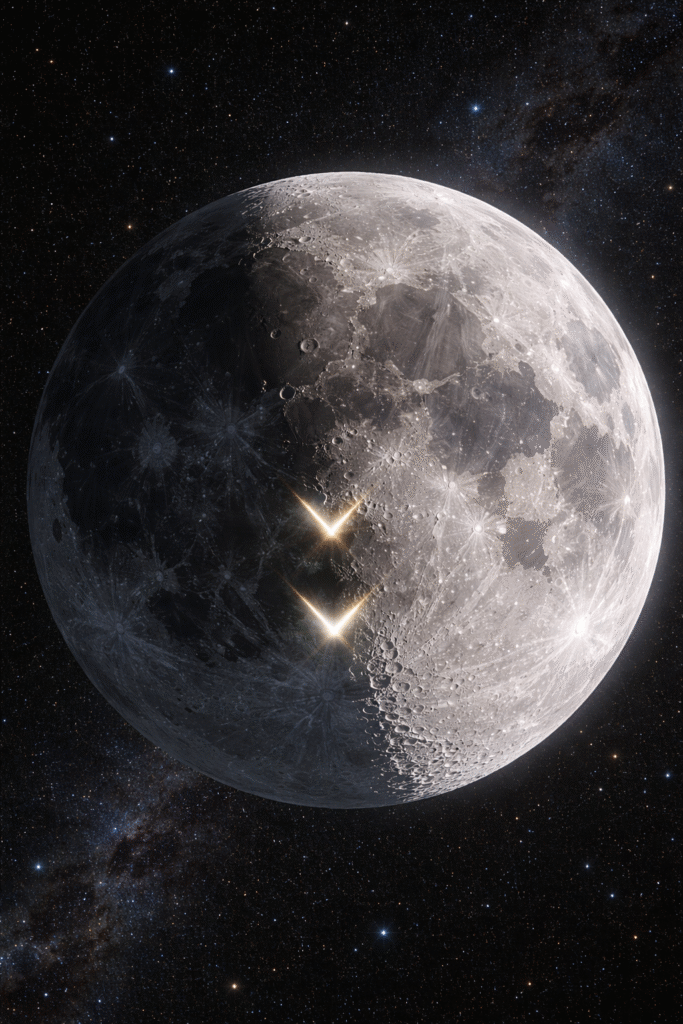
The Lunar X and V Effect is a fascinating optical phenomenon that appears on the surface of the Moon for a short time each month. It occurs when sunlight strikes certain lunar craters at a very specific angle near the terminator the line dividing the illuminated and dark sides of the Moon. Because of this lighting, the rims of several craters briefly form shapes that look like the letters “X” and “V.” These shapes are not actual markings on the Moon, they are created purely by the play of light and shadow across the rugged lunar surface.
The Lunar X forms from the illuminated rims of three craters: Purbach (lunar crater), La Caille (lunar crater) and Blanchinus (lunar crater). When the Sun rises over this region, only the highest parts of the crater rims catch the sunlight first. These bright segments connect visually to form a clear X-shaped pattern. It appears close to the lunar terminator and usually lasts for about one hour before the changing sunlight removes the illusion.
The Lunar V appears slightly earlier than the Lunar X and is formed by sunlight illuminating the rim of Ukert (lunar crater). The light highlights parts of the crater’s walls while surrounding areas remain in darkness, creating a shape that resembles the letter V. Like the Lunar X, this effect is temporary and fades as the Sun continues to rise over the lunar landscape.
This phenomenon usually occurs when the Moon is near the First Quarter Moon phase. During this phase, the angle between the Sun and the Moon’s surface produces long shadows that emphasize crater rims and mountains. Because the Sun’s position changes constantly, the alignment needed to create the “X” and “V” shapes happens only briefly each lunar cycle.
Astronomers and skywatchers find the Lunar X and V especially interesting because they are easy to observe with small telescopes or even good binoculars. The effect demonstrates how dramatically lighting conditions can change the appearance of the Moon’s surface. Many amateur astronomers plan observations around this event since it provides a striking example of lunar topography revealed by sunlight.
Events like the Lunar X and V Effect on March 25 attract attention from sky enthusiasts around the world. Although the phenomenon happens roughly once each lunar month, visibility depends on local viewing conditions and the exact timing of the terminator crossing that region of the Moon. When conditions are right, observers can see these glowing shapes for a short but memorable moment on the Moon’s surface.