
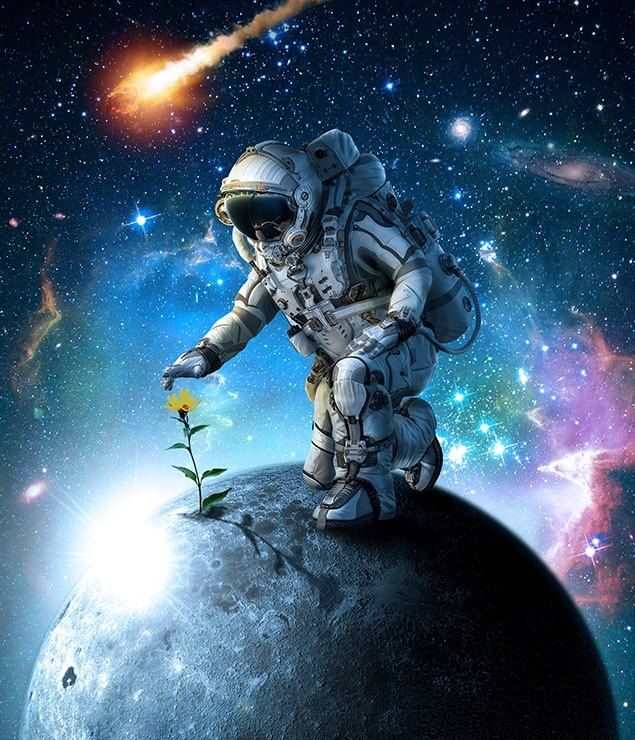
Liquid Dynamics: Why Tears Form “Blobs” Instead of Falling in Microgravity

In space, the biological process of crying remains the same, but the physical behavior of the liquid changes dramatically. On Earth, gravity pulls tears down your cheeks; in the microgravity of the International Space Station (ISS), physics takes over in a much messier way.
Here is the full breakdown of what happens when you cry in space.
1. The Physics: Surface Tension vs. Gravity
On Earth, tears are heavy enough that gravity overcomes their surface tension, causing them to break away from the eye and stream down the face.
In orbit, gravity is effectively absent (microgravity). Without that downward pull, surface tension becomes the dominant force. Water is “sticky”—its molecules want to cling to each other and to your skin. Instead of falling, the liquid forms a shimmering, wobbly sphere that stays anchored to your eye and face.
2. The “Blob” Effect
As you continue to cry, the tear doesn’t roll away. It grows into a larger and larger “liquid ball.”
- Vision Obstruction: Because the water clings to the eyeball and eyelids, it quickly blurs your vision.
- Migration: If the ball gets large enough, it can “crawl” across the bridge of your nose due to capillary action and surface tension, eventually merging with a tear in the other eye or covering a significant portion of your face.
- Stinging: Tears contain salt. On Earth, they wash away; in space, the salt stays concentrated in the pool sitting on your eye, which can cause significant stinging and irritation.
3. Real-Life Example: Chris Hadfield
Canadian astronaut Chris Hadfield famously demonstrated this using a bottle of water to simulate tears. He showed that the liquid simply builds up into a massive, wobbling bubble. He noted that the only way to get rid of it is to manually wipe it away with a cloth or “hanky,” or wait for it to slowly evaporate.
4. The Danger: Tears in a Spacesuit
While crying inside the space station is merely annoying, crying during a spacewalk (EVA) is a genuine safety hazard.
- Blindness: If an astronaut’s eyes water up inside a helmet, they cannot reach in to wipe them. The liquid blob can grow large enough to completely cover their eyes, effectively blinding them while they are performing critical tasks outside the station.
- Case Study: During a spacewalk, astronaut Andrew Feustel once got an anti-fogging agent in his eye. It caused his eyes to water profusely. Because he couldn’t wipe the tears away, he had to struggle to finish his task while partially blinded by a growing ball of saline and soap.
5. Why do astronauts cry?
It isn’t always sadness. Astronauts often experience “reflex tearing” due to:
- Dry Air: The ISS has a very controlled, often dry environment.
- Debris: Dust or small particles can irritate the eye.
- The “Overview Effect”: Many astronauts report being overwhelmed by the beauty of Earth, leading to emotional “happy” tears.
Conclusion: A Weightless Emotional Experience
Crying in space is a vivid reminder of how much our basic biological functions rely on the invisible pull of Earth’s gravity. While the emotional capacity to cry remains unchanged for astronauts, the physical manifestation is transformed from a “falling stream” into a “clinging sphere.”
This phenomenon is more than just a scientific curiosity; it represents a unique challenge for space exploration. From the stinging discomfort of salt-heavy water sitting on the eye to the potential safety risks during a spacewalk, astronauts must navigate a world where even the most human of responses—shedding a tear—requires a manual solution.
Key Takeaways
- Physics Wins: In the absence of gravity, surface tension is the boss, keeping liquid “stuck” to the surface of the eye.
- Safety Risk: Tears in a spacesuit are dangerous because they cannot be wiped away and can obstruct vision.
- Human Adaptation: Astronauts have to learn to “manage” their emotions physically, often keeping a towel or “hanky” nearby to clear their vision.
Been hearing about vn88l. Worth the hype? Give me the lowdown before I waste my time and data on vn88l.
G’day, fellas! Just had a punt on the 188bet88betapp. Pretty smooth experience, I reckon. Worth a crack if you’re keen for a bit of a flutter. Have a look: 188bet88betapp
Been playing on jlph7 for a bit. Decent selection of games and the payouts are… okay. Worth a look if you’re scouting around. Here is the link: jlph7
Bạn có thể gửi phản hồi trực tiếp từ giao diện 188V – đội ngũ sản phẩm sẽ tiếp nhận, đánh giá và triển khai cải tiến trong các bản cập nhật tiếp theo. TONY01-26