
Jupiter’s Galilean Moons: Io, Europa, Ganymede, and the Search for Extraterrestrial Water
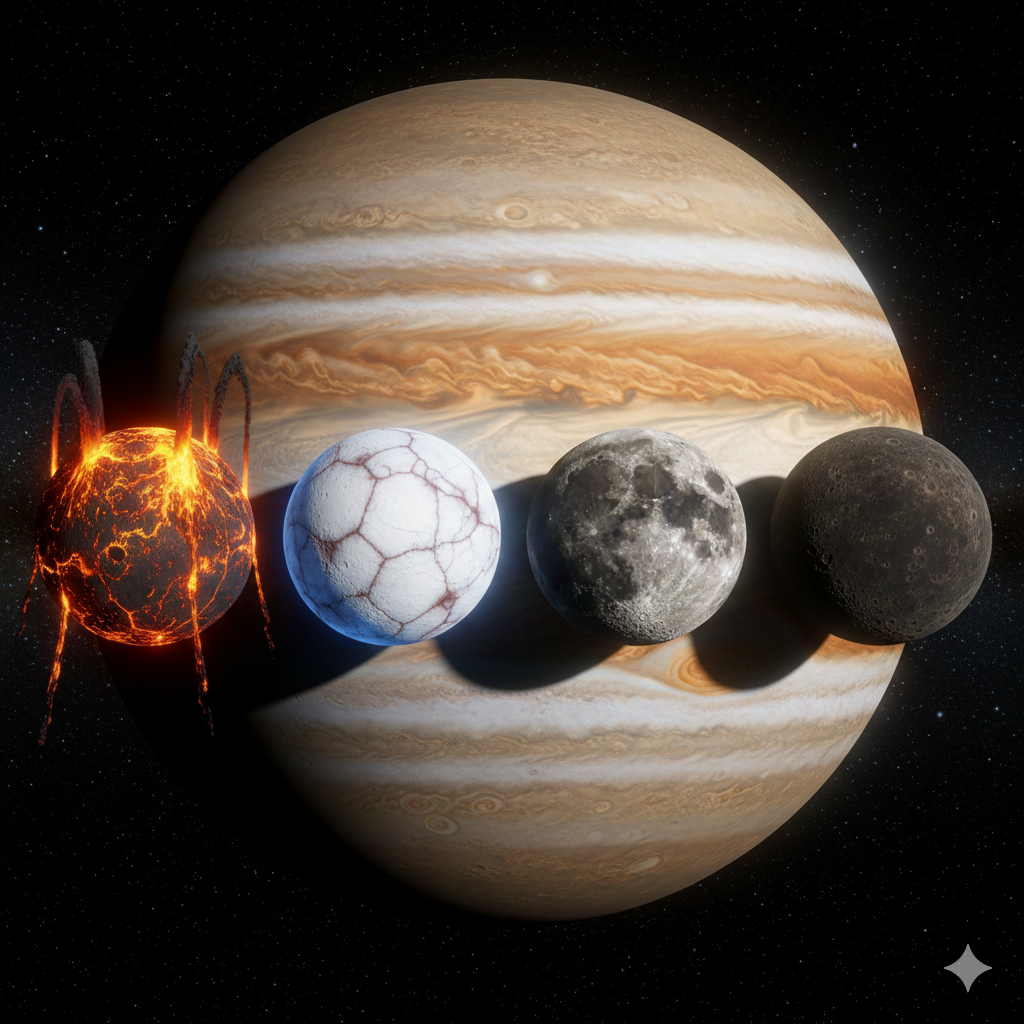
As of late 2025, Jupiter currently holds the record for the most moons of any planet in our solar system, with 95 officially recognized by the International Astronomical Union (IAU). The actual current count of known moons, including those awaiting official naming, is 97.
Key Facts About Jupiter’s Moons
- The Big Four: The most famous and significant are the four large Galilean moons: Io, Europa, Ganymede, and Callisto. They were first discovered by Galileo Galilei in 1610 and are all roughly the size of a planet or dwarf planet.
- Ganymede is the largest moon in the entire solar system, bigger even than the planet Mercury.
- Io is the most volcanically active world in the solar system.
- Europa is of great interest to scientists because it is believed to harbor a vast, subsurface ocean of liquid water, making it a prime target in the search for extraterrestrial life.
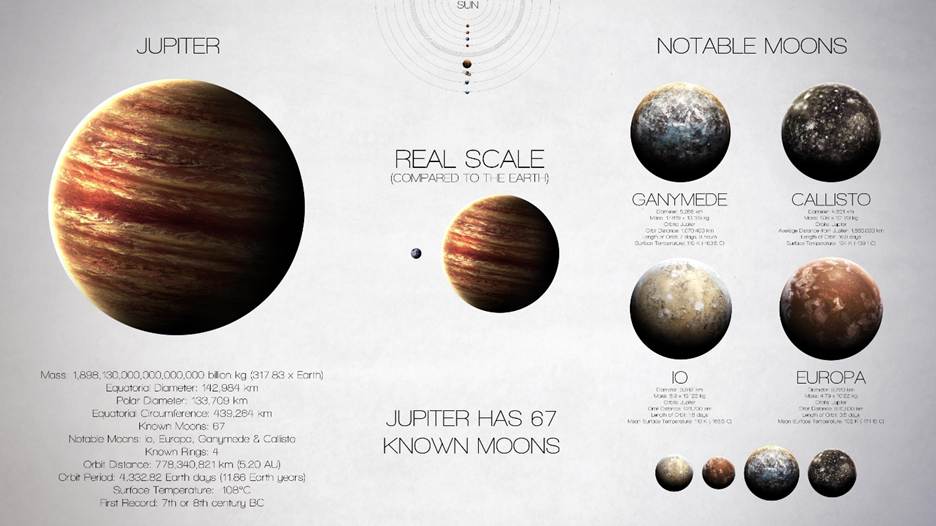
- Irregular Satellites: Most of the other moons are much smaller and are thought to be captured asteroids. They typically have highly elongated and inclined orbits. Many of these have been discovered relatively recently, thanks to improved telescope technology and survey efforts.
- Nomenclature: The moons are named after figures from Greek and Roman mythology who were lovers or descendants of the god Jupiter (Zeus). The IAU has established conventions for how the names should end, often based on the moon’s orbital direction.
The number of confirmed moons for Jupiter continues to rise as new small, faint objects are detected by modern astronomical surveys.
The details of Europa are what make it one of the most fascinating worlds in our solar system. Its defining feature is the strong evidence pointing to a massive, global ocean of liquid water beneath its icy shell.
Europa’s Subsurface Ocean: A Habitable World?
Europa is considered one of the most promising places to search for extraterrestrial life because of this vast, hidden ocean.
- Size and Depth: While Europa is slightly smaller than Earth’s Moon, the estimated depth of its ocean is truly enormous—ranging from 60 to 150 kilometers (40 to 100 miles) deep. This means Europa’s ocean may contain more than twice the volume of all of Earth’s oceans combined.
- Composition: Evidence suggests this ocean is salty (conductive), likely containing salts such as magnesium sulfate, sodium chloride (table salt), and others. This salinity is inferred from how the moon interacts with Jupiter’s intense magnetic field.
- Heating Mechanism (Tidal Flexing): Despite its great distance from the Sun, the ocean is kept liquid by internal heat generated by tidal forces (gravitational tug-of-war) with Jupiter and its neighboring large moons (Io and Ganymede). As Jupiter’s gravity stretches and squeezes Europa, the resulting friction heats the interior—a process called tidal heating.
- The Three Ingredients for Life: Astrobiologists believe Europa has three key requirements for life as we know it:
- Liquid Water: The subsurface ocean.
- Essential Chemical Elements: Carbon, hydrogen, nitrogen, oxygen, phosphorus, and sulfur are likely present.
- Energy Source: The heat from tidal flexing and potential hydrothermal vents on the seafloor could provide chemical energy, similar to “black smokers” that support life in Earth’s deep, dark oceans.
Europa’s Icy Surface
The moon’s surface provides the major visual clues about the ocean below.
- Smooth and Young: Europa has the smoothest surface of any known solid object in the solar system. It has very few large impact craters, which is evidence that its surface is geologically young and constantly being refreshed or resurfaced.
- Cracks and Ridges: The surface is crisscrossed by a vast network of reddish-brown lines, ridges, and bands called lineae. These are thought to be fractures in the ice shell caused by the immense tidal stresses as the moon orbits Jupiter.
- Possible Plumes: Observations from the Hubble Space Telescope suggest the presence of occasional water vapor plumes erupting from the surface. If confirmed, these plumes could offer scientists a way to sample the subsurface ocean without having to drill through the thick ice.
NASA’s Europa Clipper mission (launched in October 2024, arriving in 2030) and the European Space Agency’s JUICE mission (Jupiter Icy Moons Explorer) are dedicated to studying this ocean and the moon’s potential habitability.
Io: The Volcanic Inferno
Io is the innermost of the four large Galilean moons and is, without a doubt, the most geologically active object in the entire solar system.
- Tidal Heating is Extreme: Io is in a constant gravitational tug-of-war between Jupiter and its two neighboring moons, Europa and Ganymede. This results in Io’s orbit being slightly elliptical. As it moves closer to and farther from Jupiter, the planet’s immense gravity constantly stretches and squeezes Io’s solid body. This internal friction, called tidal heating, creates so much heat that it melts rock into magma.
- Volcanic Activity: Io is covered in hundreds of volcanoes, with over 150 confirmed active centers. It has no impact craters because its surface is continually being resurfaced by lava flows and volcanic ash deposits.
- Plumes: Some volcanoes spew plumes of sulfur and sulfur dioxide gas up to 500 kilometers (310 miles) high into space.
- Lava: The lava flows are primarily basaltic (like on Earth), but are mixed with sulfur compounds, giving Io its distinctive and colorful surface of yellows, reds, and whites.
- Composition: Unlike the other icy moons, Io is mostly composed of silicate rock surrounding a molten iron or iron sulfide core, and it is largely water-free. This is why its volcanism is rock-based rather than cryovolcanism (ice volcanoes) like those possibly found on Europa or Saturn’s Enceladus.
Ganymede: The Magnetic Giant
Ganymede is the largest moon in the solar system, even bigger than the planet Mercury and the dwarf planet Pluto.
- Own Magnetic Field: Ganymede is the only moon in the solar system known to generate its own magnetic field (called a magnetosphere). This is evidence of a differentiated interior with a convecting liquid iron core, similar to Earth’s. Its magnetosphere is embedded within Jupiter’s much larger one, creating a complex interaction that generates bright polar auroras.
- Dual Surface Terrain: Its surface is composed of two distinct types of terrain:
- Dark Terrain: Heavily cratered and very old (like Callisto).
- Bright Terrain: Covered in complex patterns of grooves and ridges that are geologically younger. This is thought to be evidence of ancient tectonic activity or periods where water-ice erupted and resurfaced the crust.
- Subsurface Ocean: Like Europa, Ganymede is believed to have a massive subsurface ocean, but its structure may be more complex. Models suggest it might be a “club sandwich” of several layers of ice and liquid water, potentially separated by high-pressure phases of ice.
The Galilean Moons at a Glance
| Moon | Primary Feature | Diameter (approx.) | Orbit Distance from Jupiter |
| Io | Most Volcanically Active world. Driven by intense tidal heating. | 3,643 km | 422,000 km |
| Europa | Subsurface Salty Ocean, making it a prime target for life. | 3,122 km | 671,000 km |
| Ganymede | Largest Moon in the Solar System, and the only one with its own magnetic field. | 5,268 km | 1,070,000 km |
| Callisto | Most Heavily Cratered (geologically dead) surface. May have a subsurface ocean. | 4,821 km | 1,883,000 km |
Conclusion: A System of Unparalleled Extremes
The exploration of the Jupiter system reveals a staggering truth: complexity and the potential for habitability are not limited to planets. With 95+ moons officially confirmed, the gas giant commands a miniature solar system, dominated by the incredible variety of the four Galilean satellites.
From the relentless tidal engine that fuels the fires of Io’s volcanism to the tranquil, ice-bound potential of Europa’s subsurface ocean, these moons represent a cosmic laboratory. They demonstrate how internal heat, driven by gravitational mechanics (orbital resonance), can sustain liquid water and dynamic geological processes far from the warmth of the Sun.
The primary scientific thrust of the coming decade lies in penetrating the icy shells to sample this extraterrestrial water. With the launch of the Europa Clipper and JUICE missions, humanity is embarking on its most ambitious effort yet to answer the profound question: Does life exist beyond Earth, hidden within the oceans of Jupiter’s icy moons? The vast, varied, and dynamic nature of the Jupiter system ensures that the next chapter of solar system exploration will be among the most thrilling.
I’ve tried 55hhbet a few times. The odds seem fair enough and they pay out quick. Standard sportsbook stuff, but reliable. Give it a whirl if you’re looking to place a bet 55hhbet.
Terms are quite cool yet must heard to remember…uhh
Alright, guys, let’s talk 88phatbet. I gotta say, this site’s got some serious potential. Good selection of games, and seems reliable enough. Just a heads-up, do your due diligence as always, but I’m cautiously optimistic! Check it out here: 88phatbet
Alright, so I went to vvjl444login and the login process was smooth af! No hiccups, straight to the point. If you’re looking for a hassle-free experience, this might be your place. Give vvjl444login a try!
Alright, so gachoic1 seems to be all about cockfighting. Not my cup of tea personally, but if you’re into that, it looks like this site covers it. Check it out if you dare: gachoic1
Watching some live games on tv8820. Stream quality is decent. Worth checking out I think: tv8820
S9gamedownload? Yeah, I’ve used it before. It’s pretty handy for grabbing some of those smaller game files. Worth checking it out. Get your games here: s9gamedownload
Downloaded the Teen Patti Gold APK from here. Installation was smooth, and the game’s running great on my phone. Definitely beats playing on a tiny screen. Give it a try teenpattigoldapk!
Signed up for the GV777 VIP program. The perks are pretty good. Got some free spins and a small bonus on my first deposit. Hoping to make it big! Thanks to gv777vip
88qqbet! That name’s got some energy. High rollers only? Or can a regular dude take a shot at winning big? 88qqbet
11tt seems like a promising platform. Still exploring, but the initial impression is positive. The interface is clean and user-friendly. Check ’em out 11tt!
Downloaded the 12betapp the other day. Betting on the go is so much easier now! The app is well-optimized and doesn’t lag. Get it from 12betapp if you’re on the move a lot.
Alright, mates! Gave 10betapp a whirl and it’s not bad at all. Easy to navigate even after a few pints, haha! Give it a go: 10betapp
kkbdlogin makes it easy to get in and play. Love the simplicity! Smooth experience. Go and see yourself kkbdlogin
77bdwin is on my radar. Nothing spectacular but solid. Might be your lucky day so give it a go See you there 77bdwin