
How the Sun Bends Light (Gravity and Space)
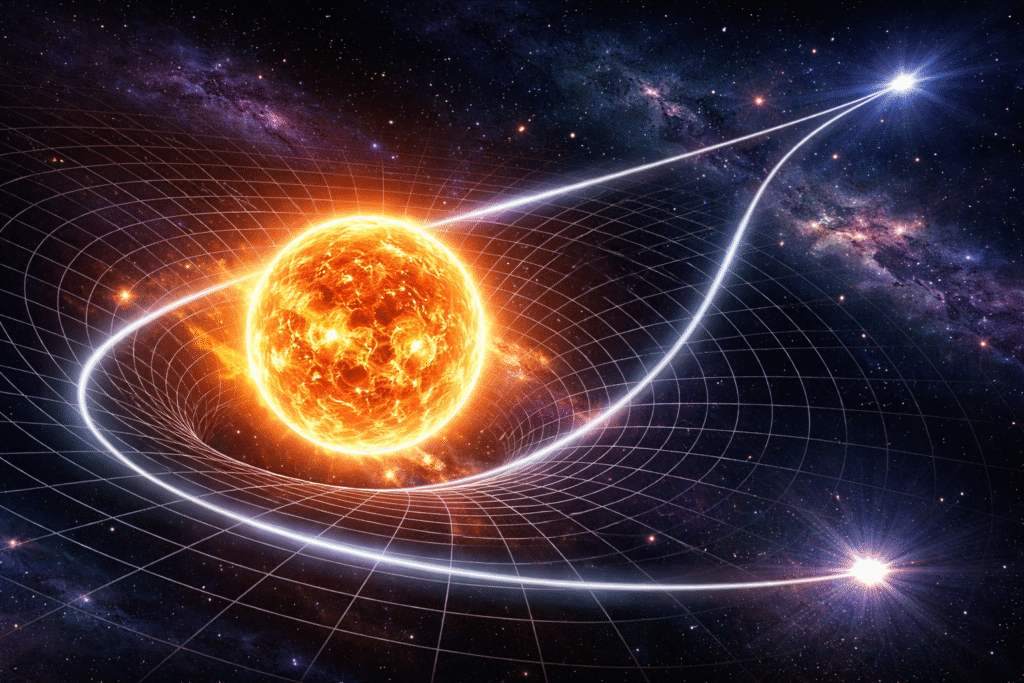
What you’re seeing in the image is a visual representation of gravitational lensing, a prediction of Albert Einstein’s General Theory of Relativity. According to this theory, gravity is not just a force pulling objects together it is the bending of space and time caused by mass and energy. The Sun, being extremely massive curves the space around it.
In the illustration, the Sun appears to sit in a dip or curved grid. That grid represents spacetime. The heavier an object is, the deeper the curve it creates. The Sun warps the surrounding space so strongly that anything passing nearby even light must follow that curved path.
The bright curved lines in the image show light traveling from distant stars. Normally, light moves in a straight line. However, when it passes close to the Sun, the curved spacetime redirects it. The light isn’t being “pulled” like a physical object instead it is following the bent geometry of space itself.
This bending effect was first confirmed in 1919 during a solar eclipse led by Arthur Eddington. By observing stars positioned near the Sun during the eclipse, scientists noticed their apparent positions had shifted slightly exactly as Einstein predicted.
In real space, this effect allows massive objects like stars and galaxies to act as natural lenses. Astronomers use gravitational lensing to study distant galaxies, detect dark matter and even discover exoplanets. The image simplifies the concept using a grid and glowing light arcs to make the invisible curvature of spacetime easier to understand.