
How the Sun Ages the Moon’s Surface (Space Weathering
Introduction to Space Weathering on the Moon
The Moon has no atmosphere, magnetic field or weather system to protect its surface. Because of this, it is constantly exposed to the Sun’s energy and particles. Over millions and billions of years, this exposure slowly changes the Moon’s surface. This long-term alteration caused mainly by the Sun is called space weathering. It affects how the lunar surface looks, reflects light and evolves over time.
Role of Solar Wind in Aging the Lunar Surface
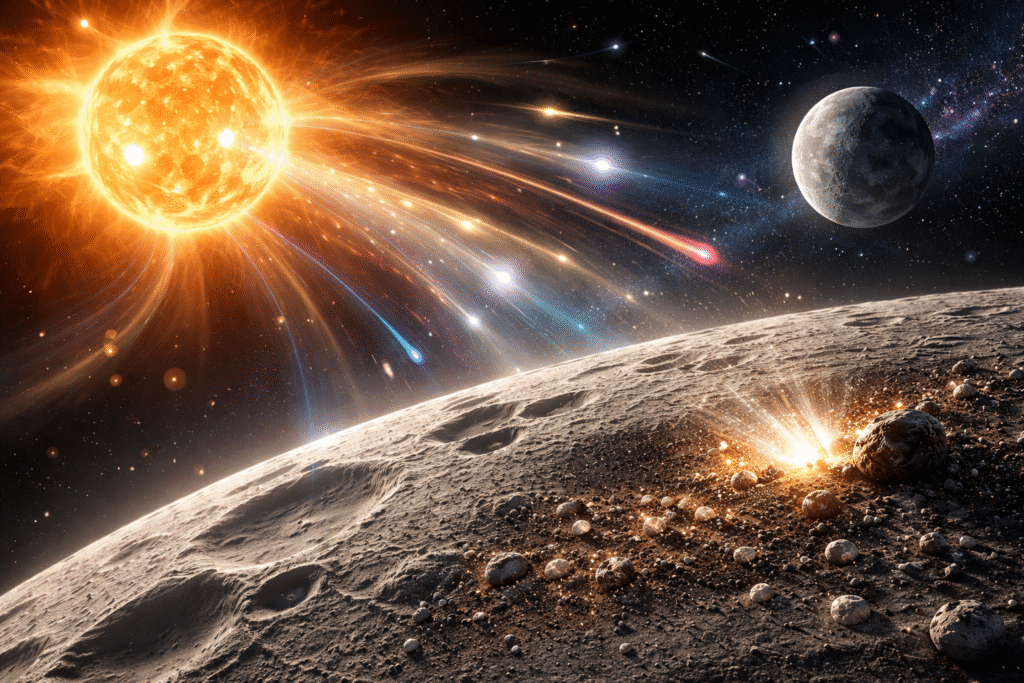
The solar wind is a continuous stream of high-energy charged particles mainly protons and electrons emitted by the Sun. When these particles strike the Moon, they hit the exposed rocks and soil (regolith) directly. This bombardment breaks chemical bonds in minerals, implants hydrogen and helium into the surface and alters the crystal structure of lunar grains. Over time, this process darkens the soil and reduces its reflectivity.
Formation of Nanophase Iron
One of the most important effects of solar wind exposure is the creation of nanophase iron particles. The intense particle impact and heating cause tiny amounts of iron inside lunar minerals to separate and form extremely small metallic iron particles. These particles are invisible to the naked eye but significantly change how the Moon reflects sunlight. They make the surface darker and give it a reddish tint when observed from space.
Solar Radiation and Surface Damage
In addition to particles, the Sun emits strong ultraviolet (UV) and X-ray radiation. This radiation damages the outer layers of lunar rocks by breaking molecular bonds and weakening mineral structures. Over long periods, radiation exposure contributes to surface erosion at a microscopic level and accelerates the breakdown of rocks into fine dust.
Micrometeorite Interaction Enhanced by Solar Effects
Although micrometeorites come from space, solar heating makes their effects stronger. When tiny meteoroids strike the Moon, they hit an already weakened surface due to solar weathering. These impacts melt small portions of the regolith forming glassy coatings on soil grains. The combination of solar wind damage and micrometeorite impacts speeds up the aging of the Moon’s surface.
Changes in Optical Properties of the Moon
Because of continuous solar exposure, older regions of the Moon appear darker, redder and less reflective than younger areas. Fresh crater walls look bright because they expose new material that has not yet been weathered by the Sun. As time passes, solar wind and radiation gradually alter these fresh surfaces until they blend in with older terrain.
Loss of Volatile Elements
The Sun also causes the Moon to lose volatile elements such as sodium and potassium from its surface. Solar wind particles can knock these atoms loose allowing them to escape into space. This slow loss changes the chemical composition of the lunar soil and contributes to the Moon’s extremely thin and temporary exosphere.
Long-Term Evolution of the Lunar Surface
Over billions of years, solar weathering has transformed the Moon into the dark, dusty world we see today. Without protection from an atmosphere or magnetic field, the Moon’s surface continuously records the Sun’s activity. Each layer of lunar soil acts like a history book preserving evidence of how solar radiation and particles have shaped the Moon across geological time.
Alright, Winbuzz com, huh? I tried it out. Seems legit! Good UI and fast loading. Give it a shot if youre looking for something new.Check it out and see for yourself! winbuzz com
Yo, is tj777app legit? I’m always a little wary of new platforms, but this one’s been popping up everywhere. Gonna do some digging on tj777app.
Heard h88game has some sweet bonuses going on. Might be worth a punt. I’ll let you know if I win big Check h88game for me ok?
Anyone got the official tayabetlink? Don’t want to end up on some dodgy site. Share the love if you’ve got it Find tayabetlink, good luck!