

How Safe Are We? Inside the Latest Asteroid Flyby Event
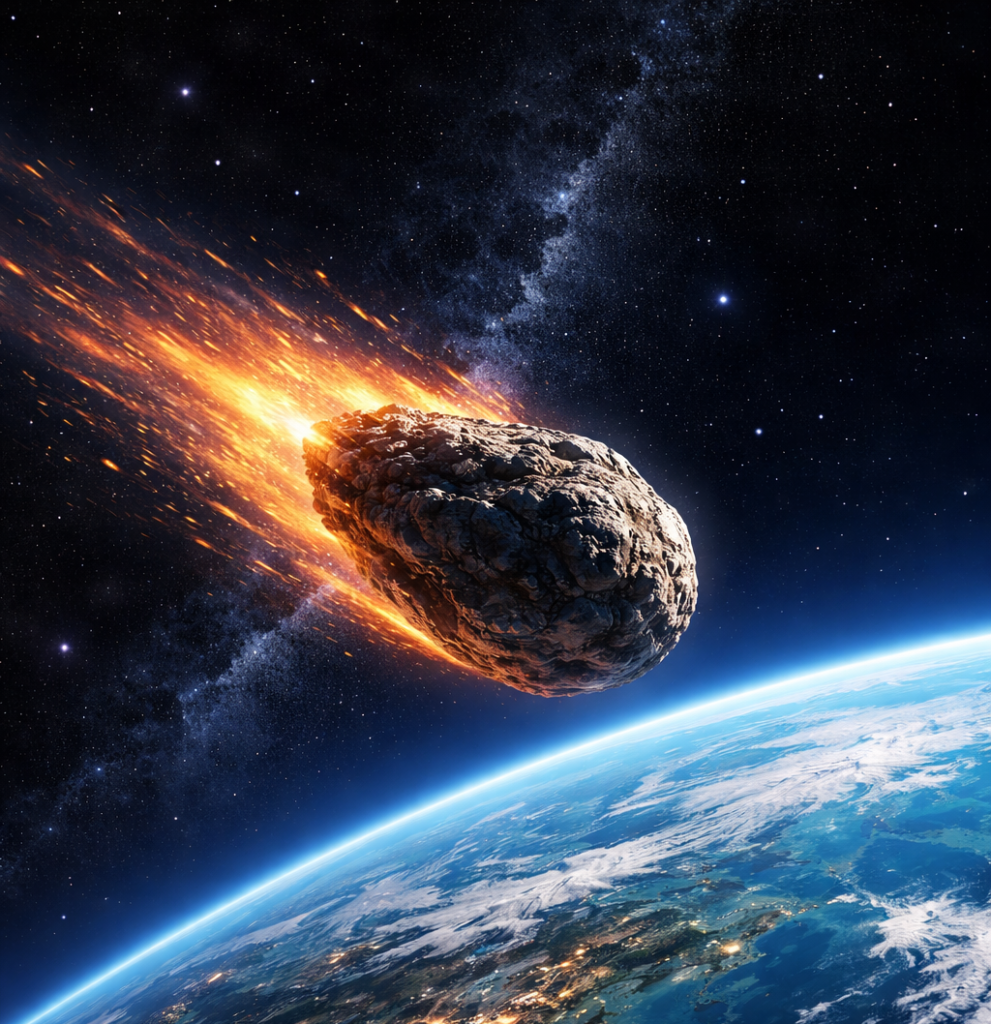
Hello space explorers! Imagine standing under the night sky, completely unaware that a giant rock from space just rushed past Earth at incredible speed. Sounds like a movie, right? But this is real and it happened very recently.
A Thrilling Space Story Unfolds
Deep in the darkness of space, an ancient traveler an asteroid formed billions of years ago continued its endless journey around the Sun. As it moved along its path, it entered Earth’s neighborhood, catching the attention of scientists at NASA.
Powerful telescopes detected it early, and within hours, computers began calculating its exact orbit. Scientists watched closely as the asteroid approached, its speed reaching tens of thousands of kilometers per hour. For a brief moment in cosmic time, it made a close flyby of Earth, then continued its journey back into the vast unknown.
What Does “Close Flyby” Really Mean?
Let’s break it down simply. When astronomers say “close,” it doesn’t mean danger.
- The average distance between Earth and the Moon is about 384,000 km
- Many asteroids pass at distances between 300,000 km to several million km
- Even the closest ones are still far beyond our atmosphere
So, while headlines may sound dramatic, these flybys are safe and carefully monitored.
The Asteroid Itself — Size, Speed & Power
Most recent flyby asteroids are relatively small, but don’t let that fool you.
- Size: Can range from a few meters (car-sized) to over 100 meters (building-sized)
- Speed: Often travel at 30,000–70,000 km/h
- Energy: If one entered Earth’s atmosphere, it could release energy similar to multiple atomic bombs
Luckily, this asteroid stayed safely in space but its sheer power reminds us why scientists take these events seriously.
Why This Event Is So Exciting
There’s a sense of awe in knowing that something from the early solar system just passed by us. These asteroids are like time capsules, containing clues about how planets including Earth were formed billions of years ago.
Every close flyby is an opportunity:
- Scientists study its shape, rotation, and composition
- Telescopes capture rare data
- Models improve for future predictions
It’s not just a flyby, it’s a scientific goldmine.
The Human Side of the Story
Behind the scenes, teams of dedicated scientists work day and night. At NASA and observatories worldwide, experts track thousands of near-Earth objects.
Picture a scientist staring at a screen late at night, watching a tiny dot move across space. That dot represents something powerful, mysterious, and potentially dangerous. Their job is to make sure we are never caught off guard.
Thanks to their efforts, no known asteroid currently threatens Earth.
Could One Ever Hit Earth?
This is the question everyone wonders about.
The answer: Yes, but very rarely.
- Small objects hit Earth frequently but burn up in the atmosphere
- Medium-sized impacts happen once every hundreds to thousands of years
- Large, dangerous asteroids are extremely rare and heavily tracked
Scientists even have planetary defense strategies, including missions to deflect asteroids if needed.
This flyby is a powerful reminder: Earth is not isolated. We are part of a busy cosmic environment, surrounded by moving objects.
But here’s the comforting truth:
Humanity is now watching the skies more closely than ever before
Technology allows us to predict and prepare
Each event makes us smarter and safer
What once was a mystery is now a monitored cosmic dance.
So don’t worry there’s no danger, only wonder. The next time you gaze at the night sky, remember: somewhere out there, another asteroid is quietly passing by, carrying secrets of the early solar system. And who knows? The next big space story might already be on its way