
How Cold Air Improves Astronomical Seeing
Atmospheric turbulence and seeing
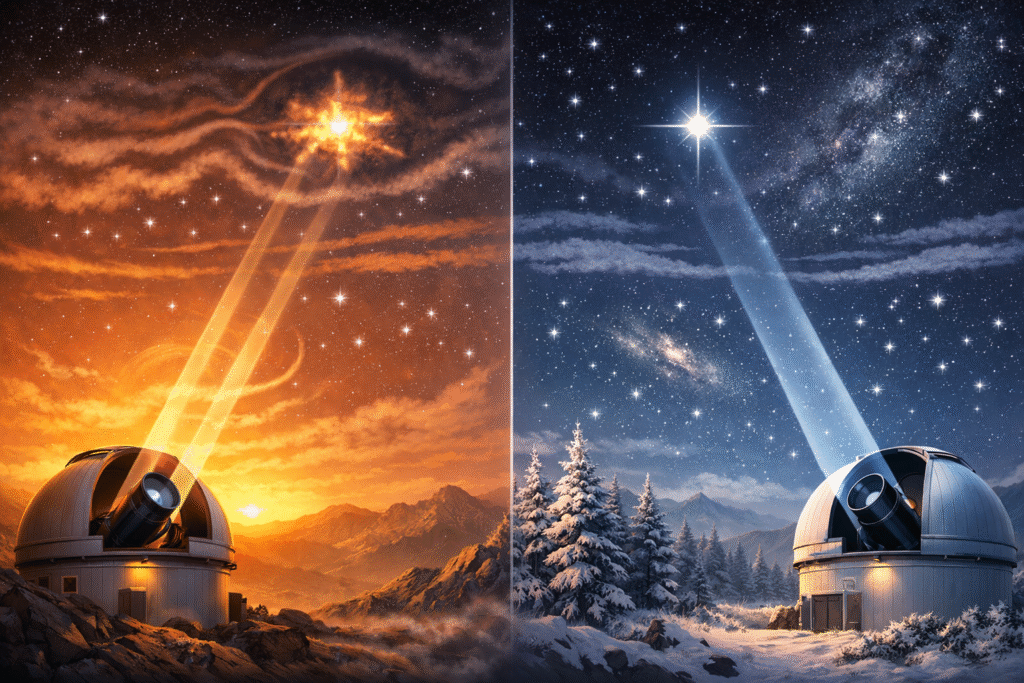
Astronomical “seeing” describes how steady or distorted celestial objects appear when observed through a telescope. The main factor limiting seeing is turbulence in Earth’s atmosphere. When air layers of different temperatures mix, they bend (refract) incoming starlight unevenly. This causes stars to shimmer and fine details on planets to blur even when the telescope optics are perfect.
Why temperature matters
Warm air is less dense than cold air. When the ground is warm especially after sunset it heats the air above it, causing rising plumes and convection currents. These moving air cells continuously change the refractive index of the atmosphere breaking a smooth wave of starlight into many distorted paths. Cold air by contrast, is denser and tends to remain more stable, reducing these random motions.
Cold air and atmospheric stability
Cold conditions usually suppress convection. When the ground and air temperatures are similar there is little vertical motion. This creates a more laminar (smoothly layered) atmosphere, allowing light from stars and planets to travel through with minimal distortion. As a result, star images appear tighter and planetary features become sharper.
Reduced thermal gradients at night
In cold nights especially in winter the temperature difference between the ground and the air above it is often smaller than on warm evenings. Fewer thermal gradients mean fewer turbulent eddies. This is why many of the best high-resolution planetary observations are made during cold, calm nights rather than warm ones.
High-altitude cold air advantages
Cold air at higher altitudes also plays a role. Jet streams and fast-moving upper-level winds introduce strong turbulence. When these winds are weak or absent which often coincides with cold, settled weather systems, the entire column of atmosphere above the telescope becomes more stable, greatly improving seeing.
Local effects around the telescope
Cold air also reduces local heat sources. Buildings, roads and even the telescope itself release less heat in cold conditions. This minimizes “tube currents” inside the telescope and thermal plumes around the observatory both of which can severely degrade image quality if the instrument is warmer than the surrounding air.
Why cold does not always mean good seeing
It’s important to note that cold alone is not enough. Strong winds, passing weather fronts or jet streams can still produce poor seeing even on very cold nights. The best conditions occur when cold air is combined with calm winds, clear skies and a stable pressure system .
Practical takeaway for observers
For astronomers, cold still nights are often worth the discomfort. They offer steadier star images, higher useful magnification, and clearer planetary detail. This is why many professional observatories are placed in cold, high, and dry environments—and why patient observers learn to appreciate winter skies as some of the sharpest of the year.