

Ganymede: Largest Moon and Only Satellite with a Magnetosphere
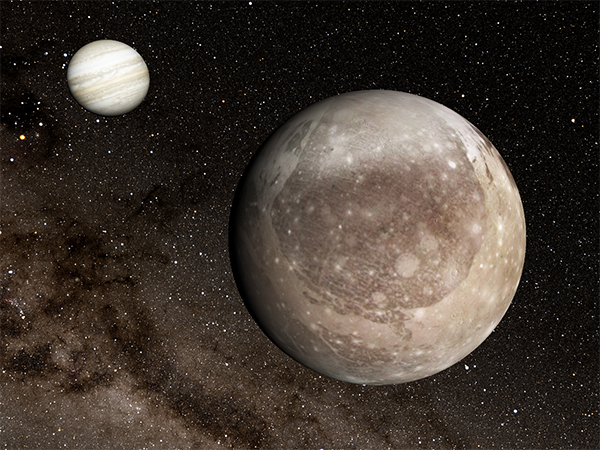
Ganymede is one of the most fascinating worlds in our Solar System. As the largest moon of Jupiter, it holds several unique distinctions that set it apart from all other satellites.
Discovery & Naming:
- Discoverer: First observed by Galileo Galilei in 1610.
- Name Origin: Named after Ganymede, a figure from Greek mythology, by German astronomer Simon Marius.
Key Distinctions
- Largest Moon: Ganymede is the largest and most massive moon in the entire Solar System, with a diameter of approximately 5,260 kilometers (3,270 miles). It is even larger than the planet Mercury and the dwarf planet Pluto.
- Only Moon with a Magnetosphere: Ganymede is the only moon known to possess its own magnetic field (magnetosphere), which is generated by convection within its liquid iron core. This field creates auroras around its poles, similar to Earth’s Northern and Southern Lights, which are embedded within Jupiter’s much larger magnetic field.
- Subsurface Ocean: Strong evidence from the Hubble Space Telescope and NASA’s Galileo mission suggests that Ganymede harbors a massive subsurface saltwater ocean beneath its icy crust. This ocean is estimated to be 100 kilometers (60 miles) thick—ten times deeper than Earth’s oceans—and may contain more water than all the water on Earth’s surface.
Internal Structure and Composition
Ganymede is a fully differentiated body, meaning its interior is separated into distinct layers.
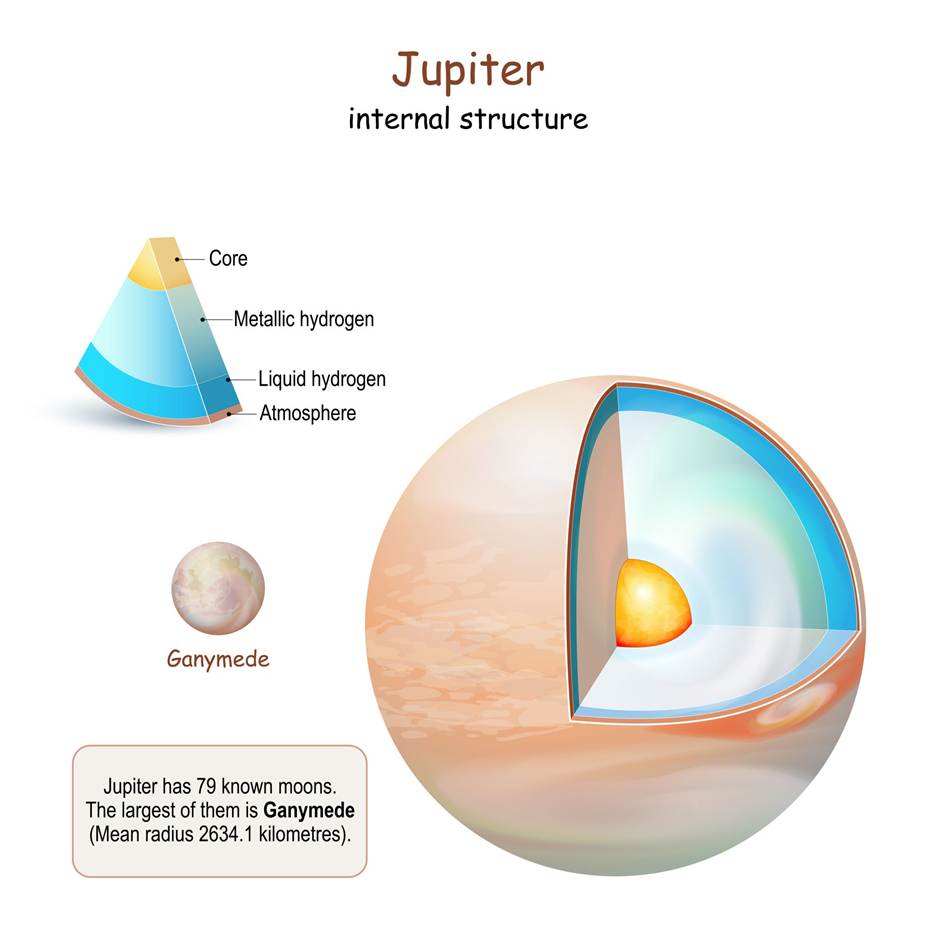
Core: A dense, metallic iron core (likely liquid in part) which generates its magnetic field.
Mantle: A surrounding spherical shell of silicate rock.
Ocean Layer: A deep, global saltwater ocean is believed to lie beneath the icy shell. The interaction of this electrically conductive ocean with Jupiter’s magnetic field helps confirm its existence.
Icy Shell: A thick layer of water ice forms the outermost crust. Models suggest that the ice and ocean may be layered like a “club sandwich” due to different phases of ice formation.
The moon is composed of roughly equal parts silicate rock and water ice.
Surface Features
Ganymede’s surface is a mix of two main types of terrain:
- Dark Terrain: Covers about 40% of the surface, is heavily cratered, and represents the oldest terrain on the moon, dating back around 4 billion years.
- Bright Terrain: Covers the remaining 60% and is younger, characterized by complex patterns of grooves and ridges (tectonic features). This suggests a period of geological activity, possibly due to tidal heating from Jupiter’s immense gravity.
Exploration
- Spacecraft: It has been visited by several NASA probes, including Pioneer 10 & 11, Voyager 1 & 2, and the Galileo orbiter. The European Space Agency’s JUICE (Jupiter Icy moons Explorer) mission, launched in 2023, is specifically designed to study Ganymede and is scheduled to enter its orbit in 2034.
Star777bet’s got a cool name! Just wondering if anyone had a good experience with them? Good bonuses? Let me know! I’m looking for a new place to play. Explore it here: star777bet
Hey guys, been playing around on hi66bet. Not gonna lie, it’s pretty slick. The interface is clean, and I haven’t had any major issues. Worth checking out if you’re looking for something new. Head over to hi66bet.
Opa! Me falaram da Stakerbet, e parece que tão dando uns bônus maneiros. Será que vale a pena se cadastrar? Alguém aí já testou a plataforma deles? Dá uma olhada aqui: stakerbet
Trying out Lotus365loginid. Signing up was easy enough. Now to explore the platform and hopefully win something substantial. This login id better be lucky! Explore: lotus365loginid
Just finished the taya 777 app download. Seems good so far, graphics are sharp and works fine. Lets see if I’ll get some payouts! Cheers.
Jili and Donnalyn? Color me interested! Gotta see what this collab is all about. Maybe some sweet bonuses? Headed to jili donnalyn now!
Yo, got the taya 777 download! Fast download, no problems. Time to test my luck! Good luck everyone.