

Galactic Ancestors: Stars That Existed Before the Milky Way Took Shape
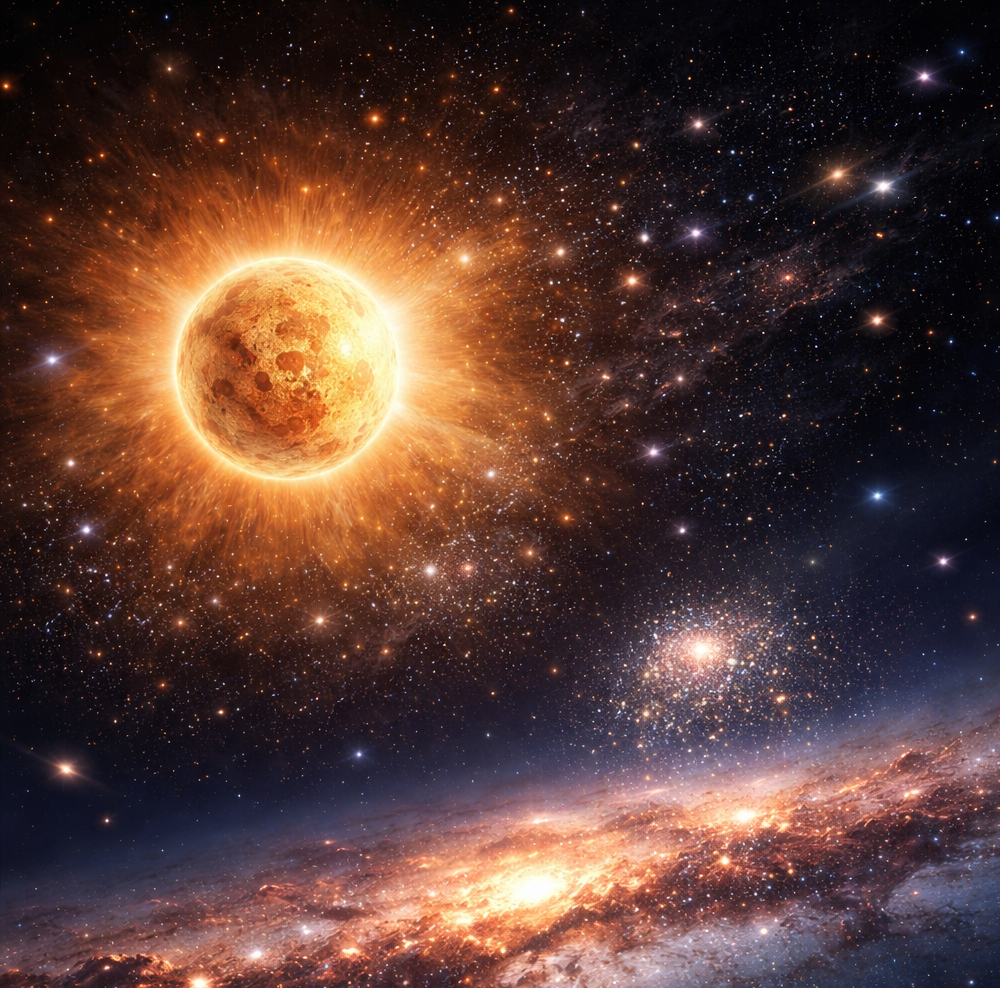
Astronomers have uncovered compelling evidence that some stars in the Milky Way formed billions of years before its familiar disk structure existed, revealing crucial information about how galaxies were born and evolved in the early universe. These ancient stars, among the oldest objects ever observed, formed shortly after the Big Bang, when the universe was still young, chaotic, and dramatically different from what we see today.
A Galaxy That Grew in Layers
The Milky Way did not always look like the majestic spiral galaxy we observe today. In its earliest stages, more than 13 billion years ago, it existed as a loose collection of gas clouds and smaller proto-galactic fragments. These fragments collided and merged over time, gradually building the galaxy’s mass. During this early period, stars began forming in a roughly spherical region called the galactic halo, long before the flat, rotating disk formed.
The disk itself—the region where most stars, including our Sun, exist today—developed later, likely between 8 and 10 billion years ago. This means many halo stars are significantly older than the disk, making them survivors from the galaxy’s earliest construction phase.
Born in the Aftermath of the Big Bang
In the first few hundred million years after the universe began, only the simplest elements existed—mostly hydrogen and helium. The very first stars, known as Population III stars, formed from this primitive material. These stars were massive, bright, and short-lived. When they exploded as supernovae, they created heavier elements like carbon, oxygen, and iron.
The ancient stars astronomers observe today formed shortly after those first explosions. They contain very small amounts of heavy elements, meaning they were born before the universe became chemically enriched. Because of their extremely low metal content, astronomers call them “metal-poor stars,” and they serve as direct evidence of early cosmic conditions.
Located in the Galactic Halo
Most of these ancient stars are found in the Milky Way’s halo, which surrounds the galaxy in a vast spherical region extending far beyond the visible disk. Unlike disk stars, which orbit in orderly circular paths, halo stars move in elongated, irregular orbits. This chaotic motion reflects the violent merging events that built the early galaxy.
Some of these stars may not have formed inside the Milky Way at all. Instead, they likely originated in smaller dwarf galaxies that were later absorbed by the growing Milky Way. This process, called galactic cannibalism, played a major role in shaping large galaxies.
Modern Space Missions Reveal Their True Ages
Powerful instruments such as the European Space Agency’s Gaia spacecraft have revolutionized the study of ancient stars. Gaia precisely measures star positions, motions, distances, and brightness. By combining this data with chemical analysis from ground-based telescopes, astronomers can estimate stellar ages and trace their origins.
These observations have revealed stars more than 13 billion years old—nearly as old as the universe itself. Some of these stars formed just a few hundred million years after the Big Bang, making them among the oldest surviving objects in existence.
Evidence of Early Galactic Collisions
Astronomers have also discovered evidence of ancient collisions preserved in the motions of old stars. One major event, known as the Gaia-Enceladus merger, occurred about 10 billion years ago when the Milky Way absorbed a smaller galaxy. Many ancient stars observed today originated from such mergers, providing direct evidence that large galaxies grow by consuming smaller ones.
Why These Ancient Stars Matter
These stars are incredibly important because they act as cosmic fossils. Unlike planets or gas clouds, stars preserve chemical and physical records from the time they formed. By studying them, astronomers can answer major questions such as:
- How the first stars formed
- How galaxies assembled over billions of years
- How heavy elements were created
- How the Milky Way evolved into its current form
A Window Into the Universe’s Earliest History
The discovery of stars older than the Milky Way’s disk confirms that galaxy formation is a long, gradual process that began shortly after the universe itself formed. These ancient stars survived billions of years of cosmic change, acting as living relics of the early universe. As new telescopes and missions continue to explore the galaxy, scientists expect to uncover even older stars, bringing humanity closer to understanding the very first chapter of cosmic history.
References:
How does winstrol work
References:
https://jobplacementsguyana.com/employer/clenbuterol-hydrochloride-100-mg-cas-21898-19-1/
References:
Testosteron steigern Ernährung
References:
https://servodriven.com/forums/users/crimeafrica61/
References:
Testosteron steigern Ernährung
References:
https://aryba.kg/user/radardrop60/
References:
What steroids should i take
References:
https://espinoza-starr.technetbloggers.de/anavar-deutschland-legal-alles-was-sie-uber-legale-steroide-wissen-mussen
References:
Anabolic steroid bodybuilding
References:
https://apunto.it/user/profile/576126
References:
Steroid side effects for men
References:
https://marcussen-le-2.technetbloggers.de/bruleurs-de-graisse-5-choses-a-savoir
References:
Why do people use steroids
References:
https://lovewiki.faith/wiki/Spiropent_100_St_mit_dem_ERezept_kaufen
References:
Pro-anabolics
References:
https://clinfowiki.win/wiki/Post:Jetzt_im_OnlineShop_kaufen
References:
Best legal testosterone steroid
References:
https://stackoverflow.qastan.be/?qa=user/coachicicle55