Frozen Among the Stars: The Extreme Chill of the Boomerang Nebula
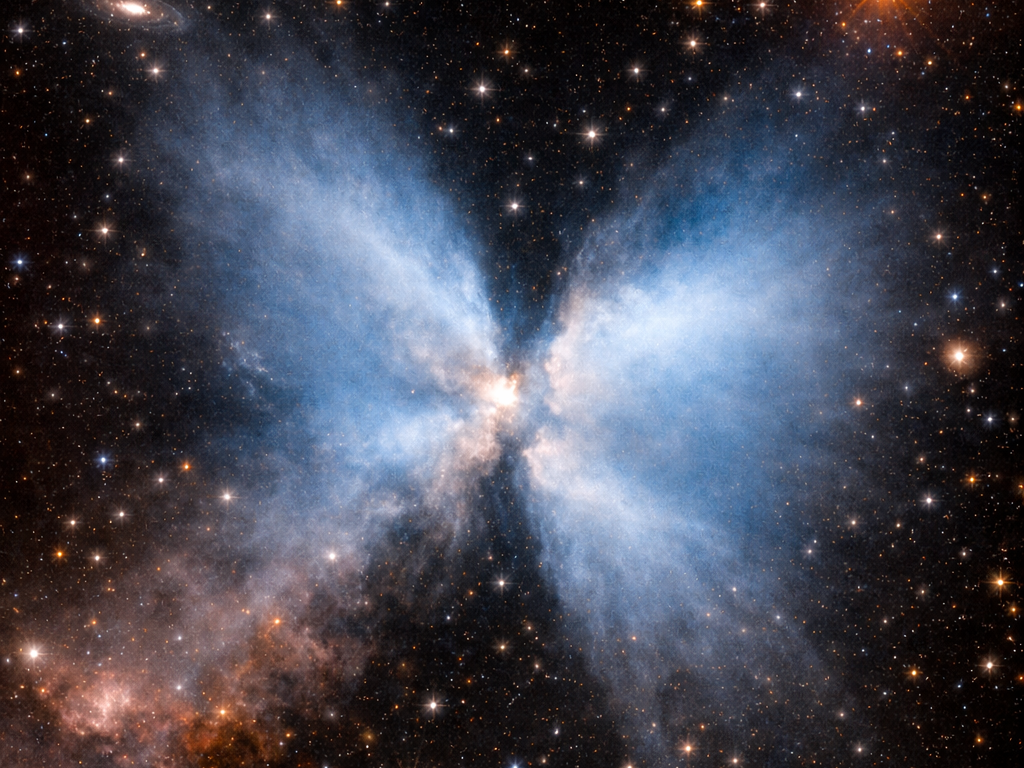
In a universe filled with blazing stars, violent explosions, and superheated plasma, one remote cloud of gas stands out for the opposite reason — it is unimaginably cold. The Boomerang Nebula, located approximately 5,000 light-years from Earth in the constellation Centaurus, is officially the coldest naturally observed place in the universe, with temperatures plunging to around −272°C (about 1 Kelvin). That is just one degree above absolute zero — the theoretical point at which atomic motion nearly stops entirely.
Colder Than the Afterglow of the Big Bang
What makes this discovery so extraordinary is that the nebula is actually colder than outer space itself. The universe is filled with faint background radiation known as the Cosmic Microwave Background (CMB) — the leftover heat from the Big Bang — which maintains a temperature of about −270.45°C (2.7 Kelvin). Yet the Boomerang Nebula is even colder than this cosmic baseline, making it the only known natural object that dips below the temperature of the universe’s background radiation.
Astronomers confirmed this astonishing measurement using radio telescopes that detected the nebula absorbing microwave radiation from the CMB — a rare and definitive sign that it is colder than its surroundings.
A Dying Star’s Final Breath
The Boomerang Nebula is classified as a pre-planetary (or proto-planetary) nebula, representing a brief transitional phase in the life of a Sun-like star. When such stars exhaust their nuclear fuel, they shed their outer layers into space. In most planetary nebulae, this expelled gas glows brightly under ultraviolet radiation from the remaining stellar core.
However, the Boomerang Nebula is different. Its central star is ejecting gas at an exceptionally high rate — about 100 billion times faster than our Sun’s solar wind. The gas is being blasted outward at speeds reaching 160 kilometers per second (about 580,000 km/h).
The Physics Behind the Deep Freeze
The extreme cold is caused by a process known as adiabatic expansion. As the gas rapidly expands into space, it spreads out and loses energy. This energy loss translates directly into a dramatic drop in temperature — similar to how air escaping from a pressurized can feels cold to the touch, but on a cosmic scale.
Because the gas is expanding so quickly and in such vast quantities, it cools to temperatures below the cosmic microwave background. Essentially, the nebula is acting as a gigantic natural refrigeration system in space.
A Strange and Beautiful Shape
The nebula’s name comes from its distinct two-lobed shape, resembling a boomerang when viewed from Earth. High-resolution images captured by the Hubble Space Telescope reveal intricate arcs and dusty filaments extending from its center. The unusual shape may be caused by interactions between stellar winds or possibly the presence of a hidden companion star influencing the outflow.
Over time, as the central star continues to heat up, the nebula is expected to evolve into a typical planetary nebula, glowing brightly instead of remaining dark and frigid. This means the Boomerang Nebula’s record-breaking cold may be temporary in cosmic terms.
Natural vs. Artificial Cold
Scientists note that while laboratories on Earth have achieved temperatures even closer to absolute zero using advanced cryogenic technology, the Boomerang Nebula holds the title for the coldest naturally occurring environment ever observed in the universe.
Its existence provides valuable insights into:
- The late evolutionary stages of Sun-like stars
- Gas dynamics and extreme cooling mechanisms
- The interaction between stellar winds and interstellar space
- Conditions approaching absolute zero in natural cosmic environments
A Rare Cosmic Laboratory
Because such extreme cooling is incredibly rare, the Boomerang Nebula offers astrophysicists a unique opportunity to study matter under near-absolute-zero conditions on a massive scale. Understanding these processes helps scientists refine models of stellar evolution and cosmic thermodynamics.
Even in a universe defined by intense heat and explosive energy, the Boomerang Nebula stands as a reminder that space can also harbor astonishing cold — colder than the faint echo of the Big Bang itself.