

Exploring the Invisible Mass of the Universe
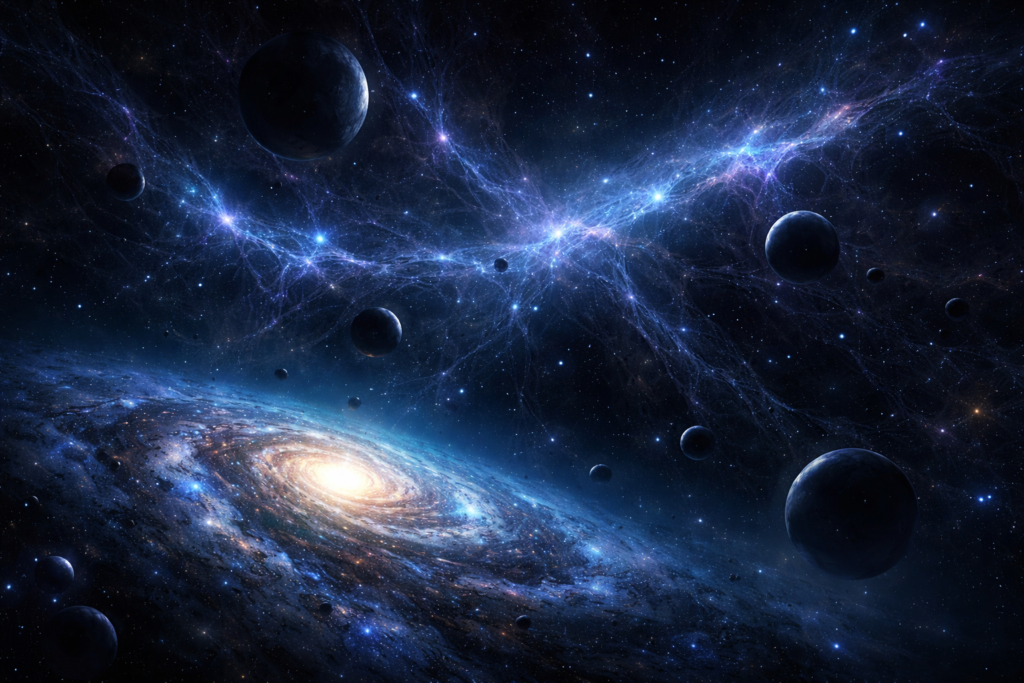
Have you ever looked at the night sky and wondered what’s really out there? Surprisingly, most of the universe is actually invisible! Scientists call it Dark Matter , a mysterious substance that we can’t see but we know it’s there because of how it affects stars and galaxies.
It’s like a hidden force quietly shaping the universe. And the more we learn about it, the more fascinating it becomes!
Let’s dive into one of the greatest mysteries of modern science.
Introduction
Dark matter is one of the greatest mysteries in modern astrophysics. It refers to a type of matter that does not emit, absorb or reflect light making it completely invisible to current instruments. Despite this, scientists are confident it exists because of its strong gravitational effects on visible objects like stars and galaxies.
Discovery and Early Evidence
The idea of dark matter first emerged in the 1930s when astronomer Fritz Zwicky studied galaxy clusters. He noticed that galaxies were moving faster than expected and concluded that some unseen mass must be holding them together. Later, in the 1970s, Vera Rubin provided stronger evidence by observing the rotation of galaxies which further confirmed the presence of hidden mass.
Why Scientists Believe It Exists
Even though dark matter cannot be seen directly, its presence is inferred through several observations. One major clue is how galaxies rotate stars at the edges move just as fast as those near the center which would be impossible without extra unseen mass. Another important phenomenon is Gravitational Lensing where light from distant objects bends around massive invisible structures, indicating the presence of dark matter.
Composition and Nature
Scientists still do not know exactly what dark matter is made of. It is not composed of ordinary matter like atoms, protons, or neutrons. Instead, researchers believe it may consist of unknown particles such as Weakly Interacting Massive Particles (WIMPs) or axions. These particles interact very weakly with normal matter, making them extremely difficult to detect.
Role in the Universe
Dark matter plays a crucial role in the structure and evolution of the universe. It acts like a cosmic scaffold, helping galaxies form and stay together. Without dark matter, galaxies would not have enough gravitational force to hold their stars in place and the universe would look very different from what we observe today.
Distribution in the Universe
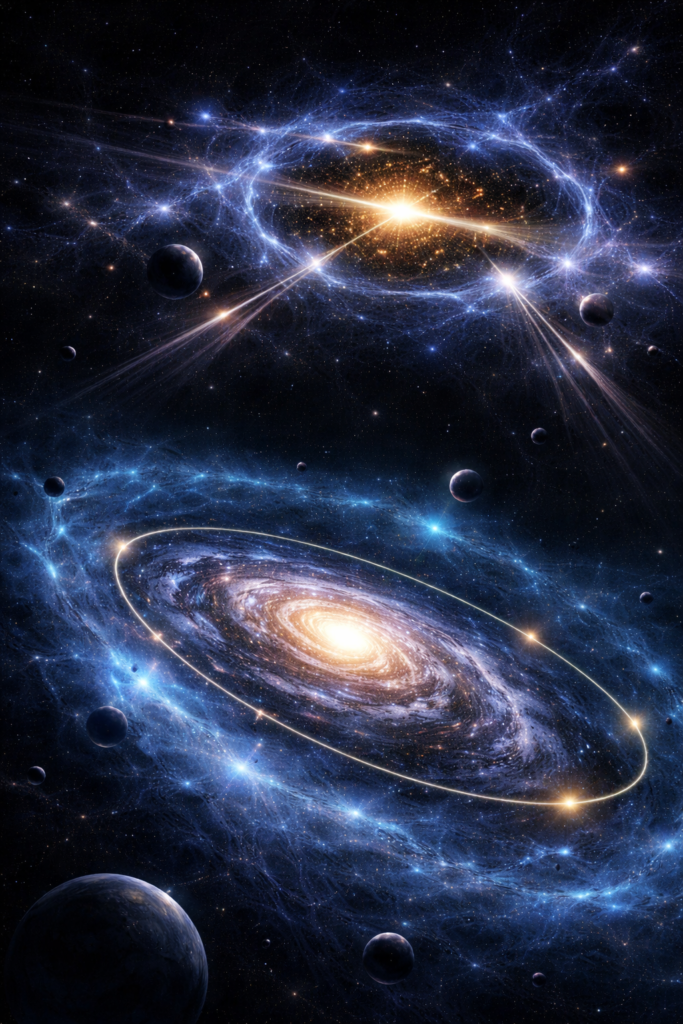
Dark matter is not evenly spread out. It forms a vast network known as the “cosmic web,” connecting galaxies and clusters across the universe. This web-like structure influences how matter is distributed on a large scale and helps scientists understand the formation of cosmic structures.
Current Research and Experiments
Scientists around the world are actively trying to detect dark matter directly. Experiments are conducted deep underground and in space to avoid interference from other particles. Advanced detectors and telescopes are used to search for signals that could reveal the true nature of dark matter.
Conclusion
Although invisible, dark matter is a fundamental part of our universe. It makes up about 27% of the universe, far more than the ordinary matter we can see. Understanding dark matter could unlock answers to some of the biggest questions in science and bring us closer to knowing how the universe truly works.