

COSMIC THERMOSTAT: Scientists Map the 13.8 Billion-Year-Old Afterglow of the Big Bang
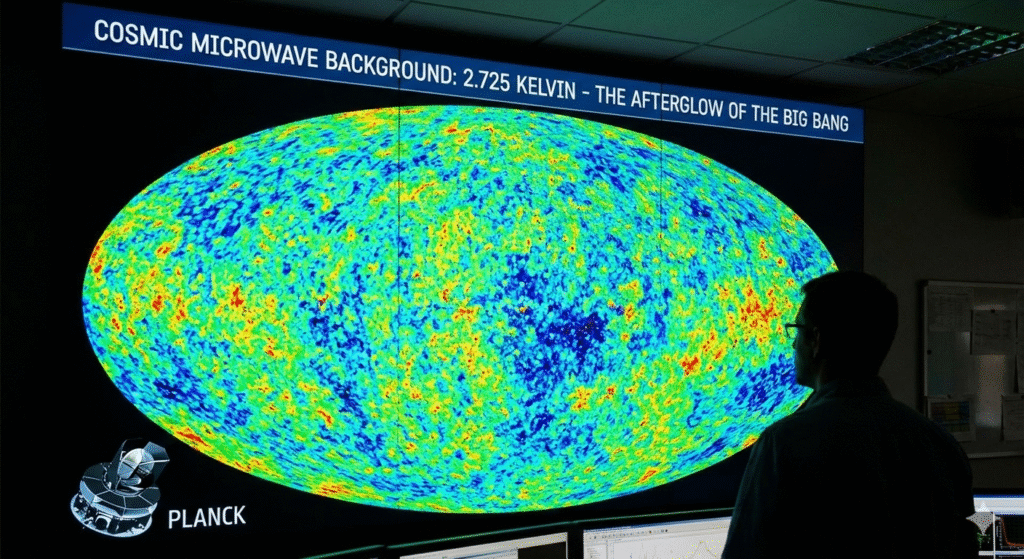
GENEVA – In what researchers are calling the “ultimate baby picture,” astrophysicists have confirmed that the universe isn’t just a vast, empty void—it has a definitive temperature. Data from space-based observatories have solidified our understanding of the Cosmic Microwave Background (CMB), the faint thermal glow left over from the dawn of time.
While the night sky looks pitch black to the naked eye, sensitive radio telescopes reveal a universe bathed in a uniform “hiss” of radiation. This radiation maintains a nearly perfect temperature of 2.725 Kelvin (roughly -270.4°C), just a fraction above absolute zero.
The Fossil Heat of Creation
The temperature we measure today is the significantly cooled remains of the Big Bang. Approximately 380,000 years after the universe began, it had cooled enough for atoms to form—an event known as “Recombination.” Before this moment, the universe was a hot, opaque plasma of protons and electrons. Once atoms formed, light was finally able to travel freely across the cosmos. That first burst of light, originally blazing at thousands of degrees, has been traveling for 13.8 billion years.
As the universe expanded, the fabric of space stretched. This process, known as cosmological redshift, stretched those high-energy light waves into the microwave part of the spectrum, cooling the “ambient temperature” of space to the frigid levels we detect today.
A “Lumpy” Uniformity
While the temperature is remarkably consistent across the entire sky, it isn’t perfectly smooth. Detailed maps from the Planck Satellite show tiny fluctuations—differences of only a few millionths of a degree.
Why These Fluctuations Matter:
- The Seeds of Galaxies: The slightly warmer (denser) spots in the CMB map represent areas where gravity began to pull matter together.
- The Composition of Space: By analyzing these temperature ripples, scientists have calculated that the universe is made of roughly 5% ordinary matter, 27% dark matter, and 68% dark energy.
- The Shape of Reality: The distribution of these temperatures confirms that the universe is “flat” to a high degree of precision.
The Future: A Deep Freeze
As the expansion of the universe continues to accelerate, the cosmic temperature will continue to drop. Billions of years from now, the wavelength of the CMB will be so stretched that it will be virtually undetectable, leaving the universe in a state often referred to by cosmologists as the “Big Freeze.”
“The CMB is the oldest light in the universe,” says one lead researcher. “It’s the thermal blueprint of everything we see today—from the smallest planet to the largest galaxy cluster.”
For now, the 2.7 Kelvin glow remains the most powerful tool in the shed for astronomers trying to decode the history of our existence.
GENEVA – In what researchers are calling the “ultimate baby picture,” astrophysicists have confirmed that the universe isn’t just a vast, empty void—it has a definitive temperature. Data from space-based observatories have solidified our understanding of the Cosmic Microwave Background (CMB), the faint thermal glow left over from the dawn of time.
While the night sky looks pitch black to the naked eye, sensitive radio telescopes reveal a universe bathed in a uniform “hiss” of radiation. This radiation maintains a nearly perfect temperature of 2.725 Kelvin (roughly -270.4°C), just a fraction above absolute zero.
The Fossil Heat of Creation
The temperature we measure today is the significantly cooled remains of the Big Bang. Approximately 380,000 years after the universe began, it had cooled enough for atoms to form—an event known as “Recombination.” Before this moment, the universe was a hot, opaque plasma of protons and electrons. Once atoms formed, light was finally able to travel freely across the cosmos. That first burst of light, originally blazing at thousands of degrees, has been traveling for 13.8 billion years.
As the universe expanded, the fabric of space stretched. This process, known as cosmological redshift, stretched those high-energy light waves into the microwave part of the spectrum, cooling the “ambient temperature” of space to the frigid levels we detect today.
A “Lumpy” Uniformity
While the temperature is remarkably consistent across the entire sky, it isn’t perfectly smooth. Detailed maps from the Planck Satellite show tiny fluctuations—differences of only a few millionths of a degree.
Why These Fluctuations Matter:
- The Seeds of Galaxies: The slightly warmer (denser) spots in the CMB map represent areas where gravity began to pull matter together.
- The Composition of Space: By analyzing these temperature ripples, scientists have calculated that the universe is made of roughly 5% ordinary matter, 27% dark matter, and 68% dark energy.
- The Shape of Reality: The distribution of these temperatures confirms that the universe is “flat” to a high degree of precision.
The Future: A Deep Freeze
As the expansion of the universe continues to accelerate, the cosmic temperature will continue to drop. Billions of years from now, the wavelength of the CMB will be so stretched that it will be virtually undetectable, leaving the universe in a state often referred to by cosmologists as the “Big Freeze.”
“The CMB is the oldest light in the universe,” says one lead researcher. “It’s the thermal blueprint of everything we see today—from the smallest planet to the largest galaxy cluster.”
For now, the 2.7 Kelvin glow remains the most powerful tool in the shed for astronomers trying to decode the history of our existence.
Alright, qh88bets! I’m feeling lucky. Let’s see if you can prove yourself. Hoping for a big score!! Try what ‘s trending at qh88bets
Downloaded the Wolf777app. It’s not bad. The app itself runs smoothly on my phone. Will see how it goes. get yours here : wolf777app
Hey guys, quick heads up about 92star. Been using it for a bit and it’s been working great. If you’re looking for something similar, give it a look: 92star
Alright, so I snagged the a55gameapk and it’s not bad at all! Quick download and smooth gameplay. Give it a shot: a55gameapk