

Cosmic News: Saturn’s Rings Revealed as Vast Fields of Shimmering Ice
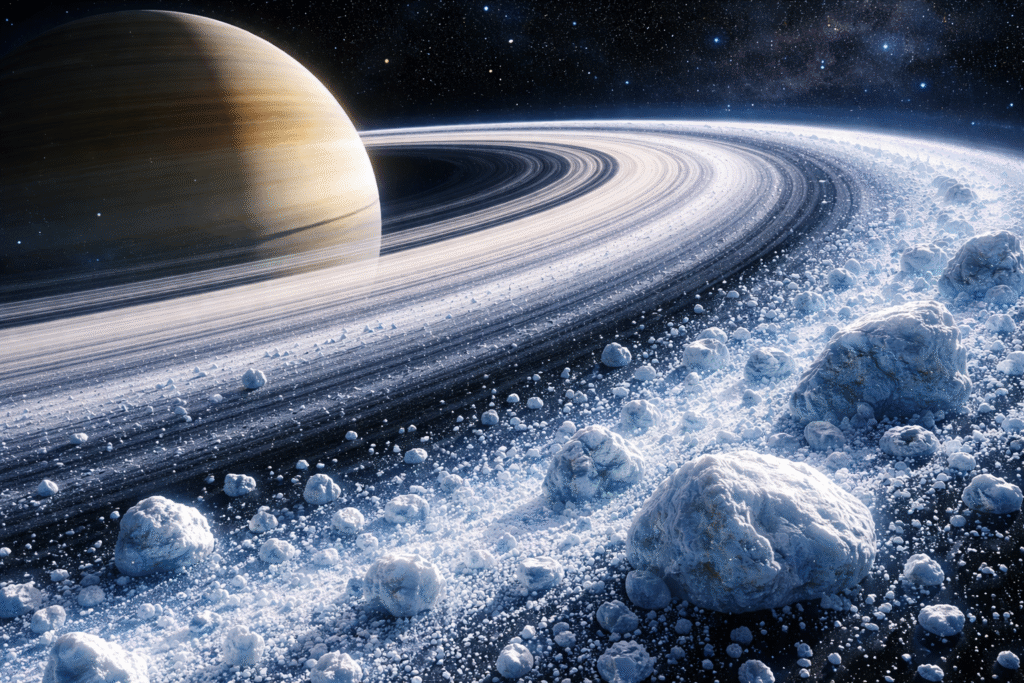
Astronomers have revealed extraordinary new insights into Saturn’s rings, confirming they are not solid structures but vast, orbiting fields of ice particles that behave like a frozen cosmic ocean. These rings contain trillions of individual fragments, composed of about 95–99% pure water ice, making them one of the brightest objects in the solar system. Their extreme reflectivity allows them to shine brilliantly, reflecting up to 90% of incoming sunlight, far more than most planets or moons.
A Massive Yet Delicate Structure
Saturn’s rings stretch an astonishing 282,000 kilometers across, which is nearly the distance from Earth to the Moon. However, despite their enormous width, they are incredibly thin. In many places, the rings are only 10 meters thick, roughly the height of a three-story building. This makes them one of the flattest natural structures ever observed.
The rings are divided into several major sections, including:
- A Ring – The outer bright ring
- B Ring – The largest, brightest, and most massive ring
- C Ring – A dimmer, more transparent ring
- Cassini Division – A large gap separating major rings
These rings appear solid from afar, but close observation shows they are made of countless individual icy objects orbiting independently.
Ice Particles of Every Size
The ice particles in Saturn’s rings vary dramatically in size:
- Tiny grains smaller than sand
- Pebble-sized fragments
- Boulder-sized chunks
- Massive blocks as large as houses or buses
Each particle orbits Saturn at speeds reaching tens of thousands of kilometers per hour, controlled by Saturn’s immense gravity. Despite these high speeds, collisions are usually gentle because nearby particles move at similar velocities.
The temperature inside the rings averages around –178°C, cold enough to keep the water ice permanently frozen.
Violent Origins: Born From Destruction
Scientists believe Saturn’s rings likely formed from a catastrophic event. Possible origins include:
- A moon that wandered too close and was torn apart by gravity
- A comet or asteroid destroyed by Saturn’s tidal forces
- Leftover material from early planetary formation
Saturn’s gravity creates a region called the Roche limit, where large objects cannot hold themselves together. Any object entering this region can be shattered, producing the icy debris that forms rings.
Observations from NASA and the European Space Agency through the Cassini–Huygens mission provided the clearest evidence of this icy composition and dynamic behavior.
Constant Motion and Change
Saturn’s rings are not permanent—they are constantly evolving. Scientists observed several important processes:
- Collisions: Ice particles frequently collide and break apart
- Clumping: Gravity causes particles to temporarily stick together
- Ring Rain: Ice particles slowly fall into Saturn’s atmosphere
- Gravitational shaping: Saturn’s moons create waves and gaps
Researchers estimate Saturn is losing its rings gradually, and they may disappear completely in about 100 to 300 million years, making them temporary on cosmic timescales.
A Discovery That Changed Astronomy
Saturn’s rings were first correctly explained in 1655 by Christiaan Huygens, who realized they were a thin disk surrounding the planet rather than solid handles, as earlier astronomers believed. Since then, advancing technology has revealed their true icy nature and complex structure.
Cosmic Significance
Saturn’s rings are more than just beautiful—they serve as a natural laboratory for understanding how planets, moons, and solar systems form. The same physical processes shaping the rings also help scientists understand how galaxies and planetary systems evolve.
Final Insight
Saturn’s rings are vast, fragile systems made almost entirely of frozen water ice, with particles ranging from microscopic dust to enormous blocks. These shimmering remnants of cosmic destruction continue orbiting in delicate balance, creating one of the most spectacular and scientifically valuable structures in the entire solar system.