

Cosmic Cuisine and Hidden Lighthouses: Unlocking the Secrets of Neutron Stars
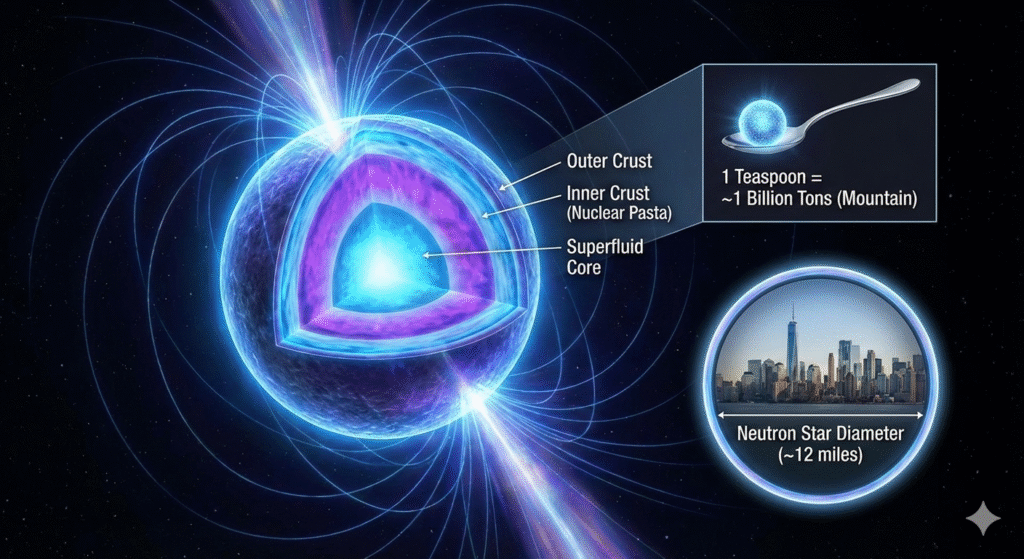
To understand the density of a neutron star, imagine taking something twice the mass of our Sun—a star 1.3 million times the size of Earth—and crushing it down until it fits inside the boundaries of a city like Manhattan or Paris.
The resulting object is so dense that it pushes the very limits of what physics allows matter to do before it collapses into a black hole.
1. The Scale of Density
A neutron star has an average density of roughly 4 * 1017 kg/m3 To put that into perspective:
- The Teaspoon Analogy: A single teaspoon (or sugar cube) of neutron star material would weigh about 1 billion tons. That is equivalent to the weight of the entire human population, or a literal mountain, packed into a space the size of your thumb.
- Comparison to Atoms: Normal matter is mostly empty space because of the distance between the nucleus and the electrons. In a neutron star, that empty space is gone. It is effectively a “giant atomic nucleus” 12 miles wide.
2. How They Form: The Great Collapse
Neutron stars are the “corpses” of massive stars (at least 8 times the mass of our Sun).
- Fuel Exhaustion: When a massive star runs out of nuclear fuel, it can no longer produce the outward pressure needed to fight its own gravity.
- The Supernova: The outer layers of the star are blown away in a massive explosion.
- The Core Collapse: The core, however, implodes. Gravity is so strong that it overcomes electron degeneracy pressure (the force that keeps “normal” dead stars like White Dwarfs stable).
- Neutronization: Electrons and protons are literally squeezed together, fusing into neutrons. This releases a massive burst of neutrinos and leaves behind a solid ball of neutrons.
3. Internal Structure: The Layers of Extremes
Because the pressure increases as you go deeper, the “state” of matter changes within those 12 miles:
- Atmosphere: A thin (centimeters deep) layer of hot plasma.
- Outer Crust: A solid lattice of iron nuclei.14 Because of the gravity, the tallest “mountains” on the surface are only a few millimeters high.
- Inner Crust: Here, “neutron drip” occurs. Neutrons begin to leak out of nuclei and form a sea of free neutrons. This is where “Nuclear Pasta” forms—strange shapes of matter resembling spaghetti or lasagna due to the competition between nuclear attraction and electrical repulsion.
- Outer Core: A superfluid of neutrons and a superconductor of protons. It flows with zero friction.
- Inner Core: The physics here is a mystery. It might contain “strange” quarks or a quark-gluon plasma, where particles have broken down into their most fundamental components.
4. Why doesn’t it collapse further?
If gravity is this strong, why doesn’t the star just become a point of infinite density (a black hole)?
The answer lies in Quantum Mechanics:
- Neutron Degeneracy Pressure: According to the Pauli Exclusion Principle, two neutrons cannot occupy the same space at the same time.19 This creates an outward “degeneracy pressure.”
- The Limit: If the remaining core is more than about 2.1 to 3 times the mass of the Sun (the Tolman-Oppenheimer-Volkoff limit), even the neutrons can’t hold it up.21 At that point, the star collapses into a black hole.
5. Other “Extreme” Traits
- Gravity: If you dropped a marshmallow onto a neutron star, it would hit the surface with the force of a nuclear bomb because of the intense gravitational acceleration.
- Rotation: Because they are “shrunken” versions of huge stars, they spin incredibly fast to conserve angular momentum (like a figure skater pulling in their arms).Some, called Pulsars, spin hundreds of times per second.
- Magnetism: They have the strongest magnetic fields in the universe (Magnetars). These fields are so strong they would strip the data from every credit card on Earth from halfway to the Moon.
“Nuclear pasta”
The density of a neutron star is so extreme that it creates some of the most bizarre environments in the known universe. Here is a deeper look into the “nuclear pasta” found in its crust and the ingenious ways astronomers detect these invisible titans from Earth.
1. Nuclear Pasta: The “Menu” of the Inner Crust
Just beneath the solid iron surface of a neutron star, the pressure becomes so intense that atomic nuclei are literally squeezed together. This creates a transition zone where matter takes on exotic, elongated shapes. Scientists call this Nuclear Pasta because of its resemblance to Italian cuisine.
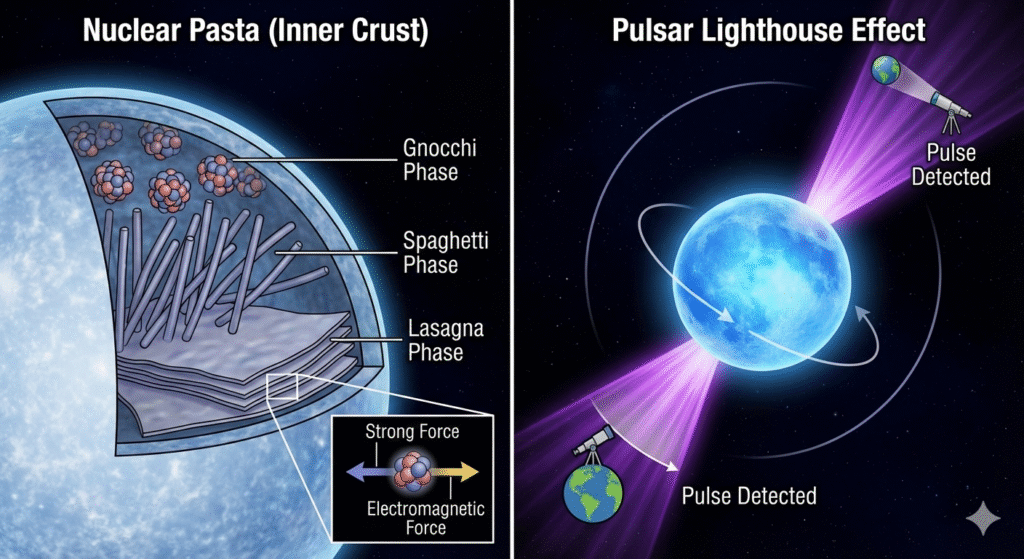
It forms because of a “tug-of-war” between two fundamental forces:
- The Strong Nuclear Force: Tries to pull protons and neutrons together.
- The Electromagnetic Force: Tries to push protons apart due to their positive charge.
As you go deeper, the shapes evolve:
- Gnocchi Phase: Small, spherical clumps of nucleons.
- Spaghetti Phase: As pressure increases, the “gnocchi” are squeezed into long, thin rods.
- Lasagna Phase: Further down, the rods are flattened into thin, parallel sheets.
- Swiss Cheese Phase: Eventually, the sheets merge into a solid block, but with “bubbles” or holes of empty space (also called Anti-Spaghetti or Bucatini).
The World’s Strongest Material: Computer simulations suggest that nuclear pasta is roughly 10 billion times stronger than steel, making it the strongest material in the entire universe.
2. How Do We “See” Them?
Because neutron stars are only about 12 miles wide and do not produce “new” light like the Sun, they are incredibly hard to see with traditional telescopes. Instead, we find them through their extreme behavior:
A. The Pulsar “Lighthouse”
Most neutron stars are discovered as Pulsars. They have intense magnetic fields and spin rapidly. These magnetic fields funnel radiation into two narrow beams of radio waves or light.
- If the star is angled so that a beam sweeps across Earth, we see a “pulse” of light every time it rotates.
- It is exactly like a lighthouse: the light is always on, but you only see the flash when the beam points at you.
B. X-Ray Binaries (Stellar Theft)
Sometimes a neutron star orbits a “normal” star. Because the neutron star’s gravity is so powerful, it can literally rip the outer layers off its neighbor.
- This stolen gas spirals inward, heating up to millions of degrees.
- This process releases massive amounts of X-rays, which our space telescopes (like NASA’s Chandra) can easily detect.
C. Gravitational Waves
When two neutron stars orbit each other, they create “ripples” in the fabric of space-time called Gravitational Waves.
- In 2017, the LIGO and Virgo detectors picked up the signal of two neutron stars colliding 130 million light-years away.
- This “shook” the entire universe, allowing us to “hear” the stars even if we couldn’t see them.
Bong88999, yeah, it’s alright. Nothing too crazy, but it gets the job done. If you’re looking for something simple and straightforward, it might be your thing. bong88999
Signing up for mwplaysignup! Hope the registration process is smooth. Ready to dive in and hopefully win some moolah! Check it out at mwplaysignup