

Black Holes Aren’t Cosmic Vacuum Cleaners: Debunking One of Space’s Biggest Myths
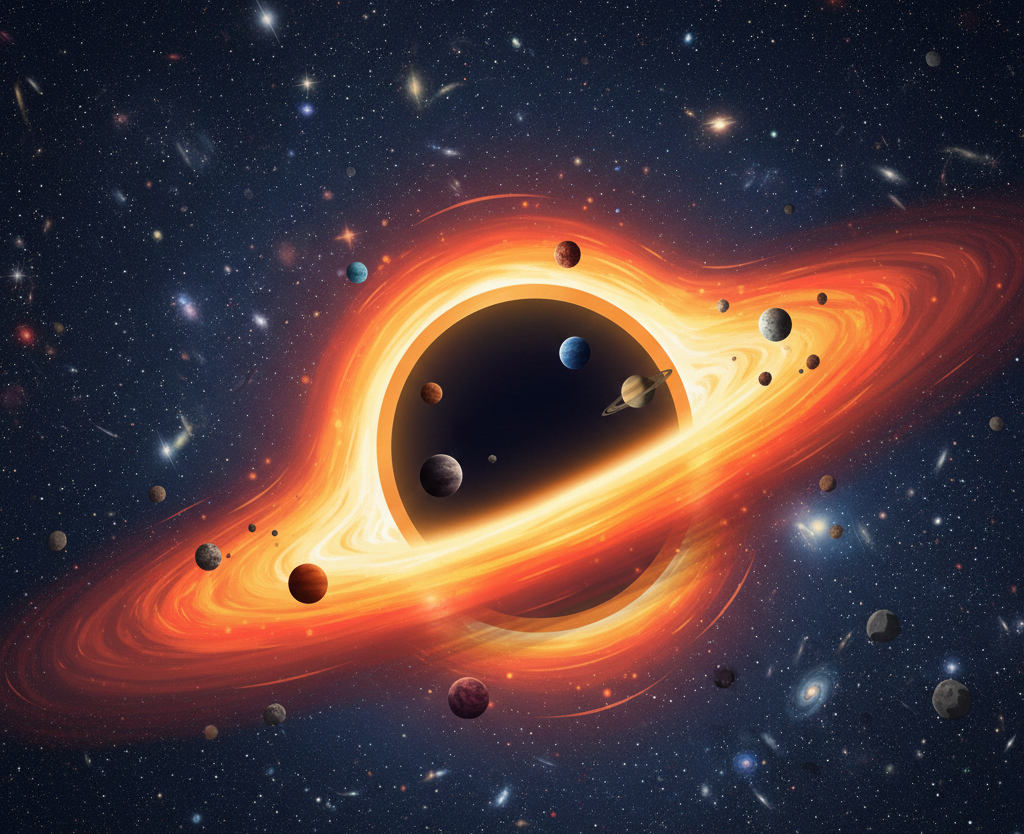
Black holes are often imagined as unstoppable forces that drag in everything nearby, tearing apart stars, planets, and even entire galaxies. Movies and science fiction have cemented this idea in the public imagination. But modern astrophysics tells a far more nuanced—and far more fascinating—story. Black holes do not endlessly “suck” matter from space. Instead, they obey the same gravitational laws as any other object in the universe, with their extreme behavior limited to a very small region around them.
Gravity, Not Suction
At the heart of the misconception is a misunderstanding of gravity. A black hole pulls on surrounding objects purely through gravity, not through any kind of vacuum or suction force. Far from the black hole, its gravitational influence is indistinguishable from that of a star or planet with the same mass.
For example, if the Sun were replaced by a black hole of equal mass, Earth would not be pulled inward. Our planet would continue to orbit normally because the gravitational force acting on it would remain unchanged. This principle applies throughout the universe: stars can orbit black holes peacefully for billions of years without being consumed.
The Critical Boundary: The Event Horizon
The defining feature of a black hole is the event horizon, an invisible boundary surrounding it. Outside this boundary, objects can still escape if they have enough speed. Inside it, escape becomes impossible because the gravitational pull exceeds the speed of light—the universal speed limit.
Crucially, the event horizon is extremely small compared to the black hole’s overall surroundings. For a black hole with the mass of the Sun, the event horizon would be only about 3 kilometers in radius. This means the region where gravity becomes truly inescapable is tiny on a cosmic scale.
Why Nearby Matter Doesn’t Instantly Fall In
Another myth is that matter near a black hole is automatically doomed. In reality, matter usually orbits a black hole, just as planets orbit stars. To fall in, gas or dust must lose energy and angular momentum. This process takes time and often requires interactions such as collisions or friction within surrounding material.
As matter spirals inward, it forms a rapidly rotating accretion disk. Friction and compression within this disk heat the material to extreme temperatures, causing it to glow intensely and emit X-rays and other high-energy radiation. These brilliant emissions are what make black holes “visible” to astronomers and are often mistaken as evidence of violent suction.
Tidal Forces and “Spaghettification”
The real danger of black holes appears only when objects get very close. Near the event horizon, gravity becomes drastically stronger on the side of an object closer to the black hole than on the far side. This difference, called tidal force, can stretch objects vertically and compress them horizontally—a process scientists dramatically refer to as spaghettification.
For smaller black holes, these tidal forces can tear apart stars and planets well before they reach the event horizon. For supermassive black holes, however, the tidal forces at the event horizon are weaker, meaning an object could theoretically cross the boundary before being torn apart—though escape would still be impossible.
Black Holes and Galactic Stability
Far from being destructive roamers, black holes often play a stabilizing role in galaxies. Most large galaxies, including the Milky Way, contain a supermassive black hole at their center. These giants can be millions or billions of times more massive than the Sun, yet they do not consume their host galaxies.
Astronomers believe black holes and galaxies evolve together. Energy released from material near black holes can regulate star formation, shaping how galaxies grow over time. Rather than being agents of chaos, black holes are now seen as key players in cosmic balance.
A Quiet Presence in the Universe
The majority of black holes are not actively feeding. Without nearby material to fall in, they remain dark and nearly undetectable. They do not hunt for matter or grow uncontrollably; they simply respond to what comes close enough under the right conditions.
Scientists stress that black holes are among the most misunderstood objects in space. They are extreme, yes—but not aggressive. They follow the same fundamental rules as the rest of the universe, only revealing their truly exotic nature at very close range.
In short, black holes don’t devour everything around them. They are silent, patient objects—cosmic reminders that even the most mysterious phenomena often obey surprisingly familiar laws of physics.
It’s fairly widespread and you must attempt taking sildenafil (Viagra) on eight separate events,
as it may take time for you to regulate and get used to the concept of taking a pill to
offer you a lift.
Natural products must be taken for a longer duration of time to fully eradicate the
sexual dysfunction signs.