
Beyond Everest: A Deep Dive into the Solar System’s Tallest Volcano
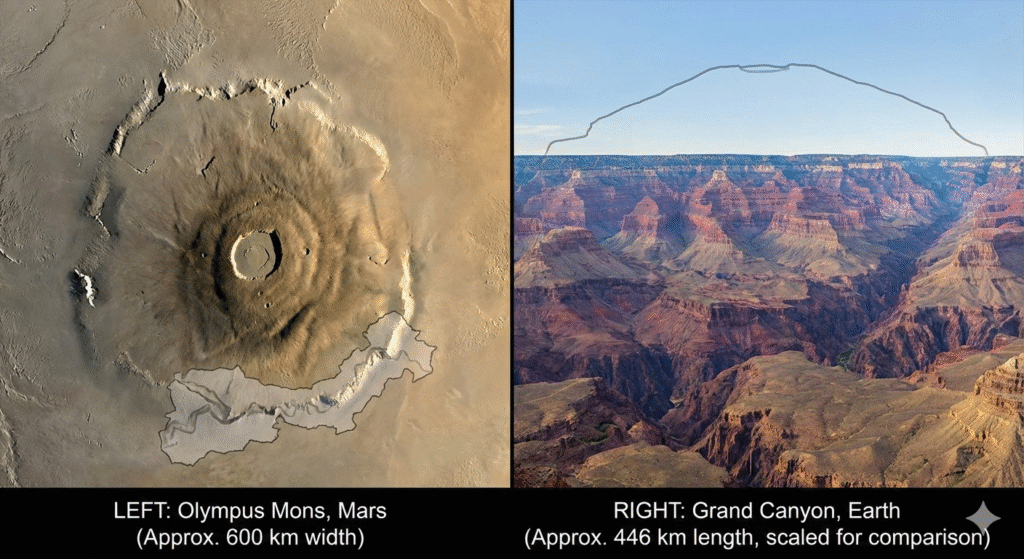
The tallest volcano in the Solar System is Olympus Mons, located on the planet Mars. To put its scale into perspective, it is not just a mountain—it is a geological titan that would cover the entire state of Arizona or the country of Poland if placed on Earth.
1. Physical Dimensions & Scale
Olympus Mons is a shield volcano, a type characterized by a broad, low profile shaped like a warrior’s shield. However, its “low” profile is relative to its massive width.
- Height: It stands approximately 21.9 km (13.6 miles) high. This is nearly 2.5 times the height of Mount Everest above sea level.
- Diameter: It stretches about 600 km (373 miles) across.
- Area: It covers roughly 300,000 km², making its footprint roughly the size of Italy or the Philippines.
- The Summit: The peak features a massive “caldera” (a series of collapsed craters) that is 80 km wide and up to 3.2 km deep, You could fit the entire city of London inside this crater multiple times.
2. Comparison to Earth’s Giants
While Everest is the tallest point on Earth relative to sea level, the better comparison for a volcano is Mauna Kea in Hawaii (measured from the ocean floor).
| Feature | Olympus Mons (Mars) | Mount Everest (Earth) | Mauna Kea (Earth) |
| Height | ~22 km | 8.8 km | 10.2 km (from base) |
| Width | ~600 km | N/A | ~120 km |
| Volume | ~100x Mauna Loa | N/A | 1x |
[Image comparing Olympus Mons, Mount Everest, and Mauna Kea]
3. Why did it grow so large?
On Earth, volcanoes are limited in size. Olympus Mons grew to such “impossible” heights due to three main factors:
- Lack of Plate Tectonics: This is the most critical reason. On Earth, tectonic plates move over “hotspots” (magma plumes), creating chains of smaller volcanoes (like Hawaii). On Mars, the crust is stationary. The lava just keeps piling up in the exact same spot for billions of years.
- Lower Gravity: Mars has only about 38% of Earth’s gravity. This allows the mountain to support its own massive weight without the rock collapsing or “sinking” into the planet’s mantle as easily as it would on Earth.
- Higher Eruption Rates: Geological evidence suggests Martian volcanoes had much higher rates of lava flow, allowing for more rapid building of the volcanic structure.
4. Unique Geological Features
- The Basal Escarpment: One of the most striking features is a massive cliff, or escarpment, that surrounds the base. These cliffs are up to 8 km (5 miles) high—taller than most mountains on Earth. Scientists believe these were formed by enormous landslides.
- The Atmosphere: The summit of Olympus Mons is so high that it actually pokes out of the densest part of the Martian atmosphere. If you stood at the top, you would be in a near-vacuum, looking down at the dust storms below.
- Age and Activity: While the volcano formed billions of years ago, some lava flows on its surface are only 2 to 25 million years old. In geological terms, this is very recent, leading some scientists to believe the volcano might still be “dormant” rather than completely extinct.
5. Is it the tallest mountain in the Solar System?
Technically, Olympus Mons is the tallest volcano. However, it has one rival for the title of “tallest peak”: the central spire of the Rheasilvia crater on the asteroid Vesta. Rheasilvia is estimated to be about 22.5 km tall, which is roughly equal to or slightly taller than Olympus Mons depending on where you measure the base.
Conclusion: A Monument to Martian History
Olympus Mons is more than just a record-breaking statistic; it is a profound testament to the unique geological path Mars took compared to Earth. While our planet is defined by the constant movement and recycling of its crust through plate tectonics, Mars remained rigid, allowing a single volcanic vent to pour lava onto the same spot for hundreds of millions of years.
Key Takeaways:
- A “Invisible” Mountain: Because the volcano is so wide and the curvature of Mars is so pronounced, if you were standing on its slopes, you wouldn’t realize you were on a mountain. The slope is so gentle (only about 5°) that the summit would be over the horizon.
- Geological Time Capsule: By studying its lava flows, scientists can track the volcanic history of Mars, suggesting the planet was geologically active much more recently than we once thought.
- The Future of Exploration: As we look toward human missions to Mars, Olympus Mons remains a primary point of interest. Its unique environment—poking through the atmosphere—could offer a distinct vantage point for studying both the Martian surface and the vacuum of space.
In the grand scale of the Solar System, Olympus Mons reminds us that under the right conditions—low gravity and a stationary crust—nature can build structures that far exceed anything possible on Earth.
For all you betting enthusiasts, Tylekeo188bet is where you need to be. Solid odds and a wide range of sports. Get your bets in! tylekeo188bet
Easy access is a must, and dailyjililogin delivers! Super convenient. Login and play here: dailyjililogin