

Beyond Earth’s Pull: Why Time Flows Faster on the Moon
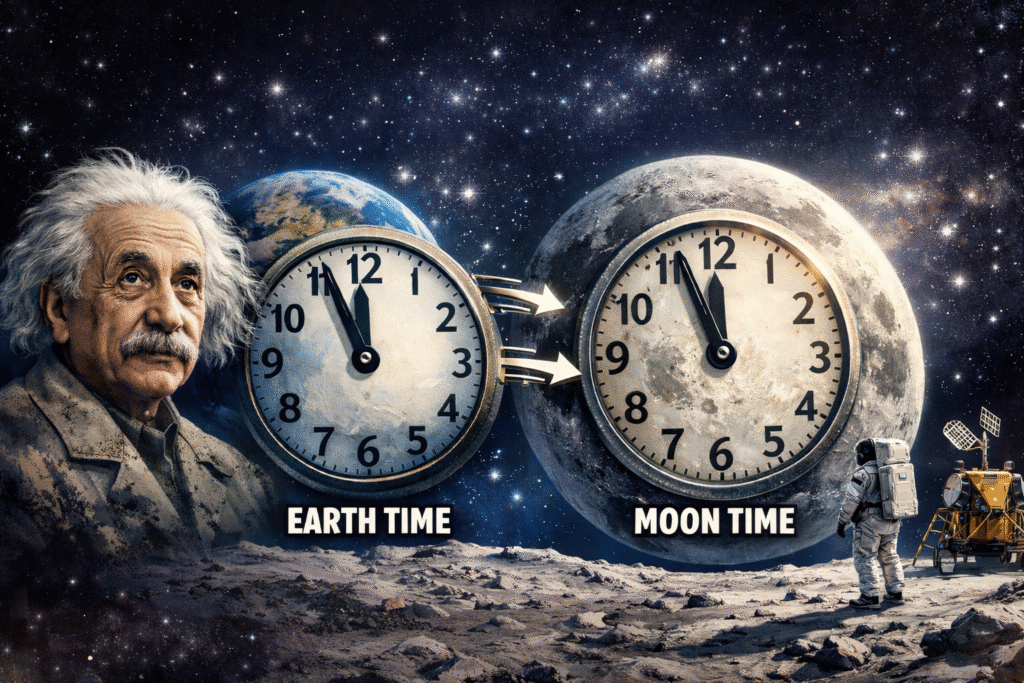
In a fascinating twist of physics, time itself moves slightly faster on the Moon than it does on Earth—a subtle but real effect predicted more than a century ago by Albert Einstein and now confirmed through modern science and precision technology.
The Surprising Truth About Time on the Moon
According to Einstein’s theory of relativity, gravity doesn’t just pull on objects—it also slows down time. This phenomenon is called gravitational time dilation. The stronger the gravity, the slower time moves.
Because the Earth has much stronger gravity than the Moon, clocks on Earth tick slightly slower. On the Moon, where gravity is about one-sixth as strong, time speeds up—by a tiny but measurable amount.
Scientists estimate that:
- Time on the Moon runs about 56 microseconds faster per Earth day
- That’s 0.000056 seconds per day
- Over a year, the difference becomes about 20 milliseconds
While this difference is extremely small, it is very real—and important.
Why Gravity Affects Time
Einstein’s relativity showed that gravity bends not only space but also time. Imagine time as a flowing river:
- Near a massive object like Earth, the river flows more slowly
- Farther away, or near smaller objects like the Moon, it flows faster
This means astronauts standing on the Moon would technically age slightly faster than people on Earth.
Why This Matters for Space Exploration
This effect is not just theoretical—it has practical consequences. Space agencies like NASA must account for time differences when designing navigation systems, lunar bases, and communication networks.
For example:
- Lunar satellites and future Moon colonies will need their own precise time systems
- Navigation errors could occur if time differences aren’t corrected
- Even GPS satellites around Earth must adjust for relativity to stay accurate
Without these corrections, navigation systems could drift by kilometers. A Friendly Way to Understand It.Think of it like two identical clocks:
- One stays on Earth
- One goes to the Moon
After some time, the Moon clock will be slightly ahead, even though both started together. It’s not broken—time itself is moving differently.
A Universe Where Time Isn’t the Same Everywhere
This discovery reminds us that time is not universal—it depends on gravity and motion. The Moon, orbiting quietly above us, is not just a different place in space—it’s also a place where time flows at a different pace.
Einstein’s Revolutionary Idea: Gravity Slows Time
Before Einstein, people believed time was constant and universal. But his theory revealed something astonishing: gravity can stretch and slow time itself.
This concept, known as gravitational time dilation, means:
- Stronger gravity → slower time
- Weaker gravity → faster time
The Earth has much stronger gravity than the Moon. Earth’s greater mass pulls more strongly on space and time, slowing the flow of time slightly.
On the Moon, gravity is about 83% weaker, so time flows a bit faster.
How Much Faster Is Time on the Moon?
Scientists using atomic clocks—the most precise clocks ever built—have calculated the difference very accurately:
- About 56 microseconds faster per Earth day
- About 1.7 milliseconds faster per month
- About 20 milliseconds faster per year
This may seem tiny, but in high-precision science and space navigation, even billionths of a second matter.
Astronauts on the Moon Actually Age Faster
If an astronaut lived on the Moon for one year, they would technically age about 20 milliseconds more than someone on Earth.
This difference is too small to notice physically, but scientifically, it’s real.
For example:
- If two identical twins existed
- One stayed on Earth
- One lived on the Moon for decades
The Moon twin would be slightly older—by tiny fractions of a second.
NASA Must Account for This in Lunar Missions
Space agencies like NASA must carefully adjust for these time differences when operating spacecraft.
Why this matters:
- Lunar satellites depend on precise timing
- Communication signals rely on exact synchronization
- Navigation systems require perfect time accuracy
Even small timing errors can cause spacecraft to drift off course.
NASA is now working on creating a special lunar time system, sometimes called Lunar Standard Time, for future Moon bases.
Proven With Real Experiments
This effect is not just theory—it has been confirmed many times using atomic clocks:
- Atomic clocks placed at higher altitudes on Earth run faster
- GPS satellites experience time differently due to weaker gravity
- Experiments consistently match Einstein’s predictions
These measurements prove relativity is correct.
Why This Discovery Is So Important
This phenomenon reveals a deeper truth: time is flexible, not fixed. It changes depending on gravity and location in space.
It also shows that:
- The universe behaves differently than our everyday intuition
- Gravity shapes not just motion—but time itself
- Even our nearest neighbor, the Moon, experiences time differently
The Moon is more than a silent companion orbiting Earth—it is a place where the very fabric of time flows at a different speed. This small difference, predicted by Einstein and confirmed by modern science, is now shaping the future of human space exploration and our understanding of the universe itself.
Downloaded the 888slotsapp. Plays pretty smoothly on my phone. If you’re on mobile, hit up 888slotsapp.
R777mx – Worth a try! I especially liked the slot games! Visit r777mx
Mxbetlife – It is a part of the routine, I like playing it from time to time. Have fun! Check it out mxbetlife
References:
Best place to buy steroids on the internet
References:
https://robbarnettmedia.com/employer/best-testosterone-booster-expert-recommendations-in-2026/
References:
Natürliche Testobooster
References:
https://rfserial.online/user/spacepants83/
References:
Nährstoffe für Testosteron
References:
https://tennant-kearney-2.thoughtlanes.net/buy-injectable-stanozolol-50mg
References:
Vitamin D Testosteron
References:
http://dubizzle.ca/index.php?page=user&action=pub_profile&id=140517
References:
Testosteron steigern ab 50
References:
https://posteezy.com/clenbuterol-mesh
References:
Anabolic supplements review
References:
http://humanlove.stream//index.php?title=kearneyholdt0695
References:
Best legal supplement for muscle growth
References:
https://skitterphoto.com/photographers/2216730/bunn-workman
References:
Most popular steroids for bodybuilding
References:
https://posteezy.com/complements-alimentaires-bruleur-de-graisses-nhco
References:
Bodybuilding pills steroids
References:
https://peatix.com/user/28723106
References:
Steroid medicine
References:
https://guthrie-barrera-2.federatedjournals.com/buy-clenbuterol-online-trusted-quality-from-certified-providers
References:
Anobolic men
References:
http://lideritv.ge/user/flagfox8/
References:
Average cost of steroids
References:
https://obyavlenie.ru/user/profile/657624
References:
Steroid stack for mass
References:
https://socialisted.org/market/index.php?page=user&action=pub_profile&id=316098
References:
Where are steroids found in the body
References:
https://king-wifi.win/wiki/Sermorelin_Wikipedia
References:
Best steroids on the market
References:
https://wikimapia.org/external_link?url=https://www.verletzten-kinderseelen-helfen.de/articles/abnehmen_tabletten_1.html
References:
What is anabolic chicken
References:
https://stackoverflow.qastan.be/?qa=user/randomsteven8
References:
Bodybuilding top 5
References:
https://newssignet.top/item/599899
References:
Creatine vs steroids
References:
https://myrick-atkins-3.mdwrite.net/clenbuterol-gunstig-online-bestellen-ohne-rezept