
Astronomers Discover Fiery Magma Ocean Planets: A New Class of Exoplanets Revealed
Greetings, Space Explorers!
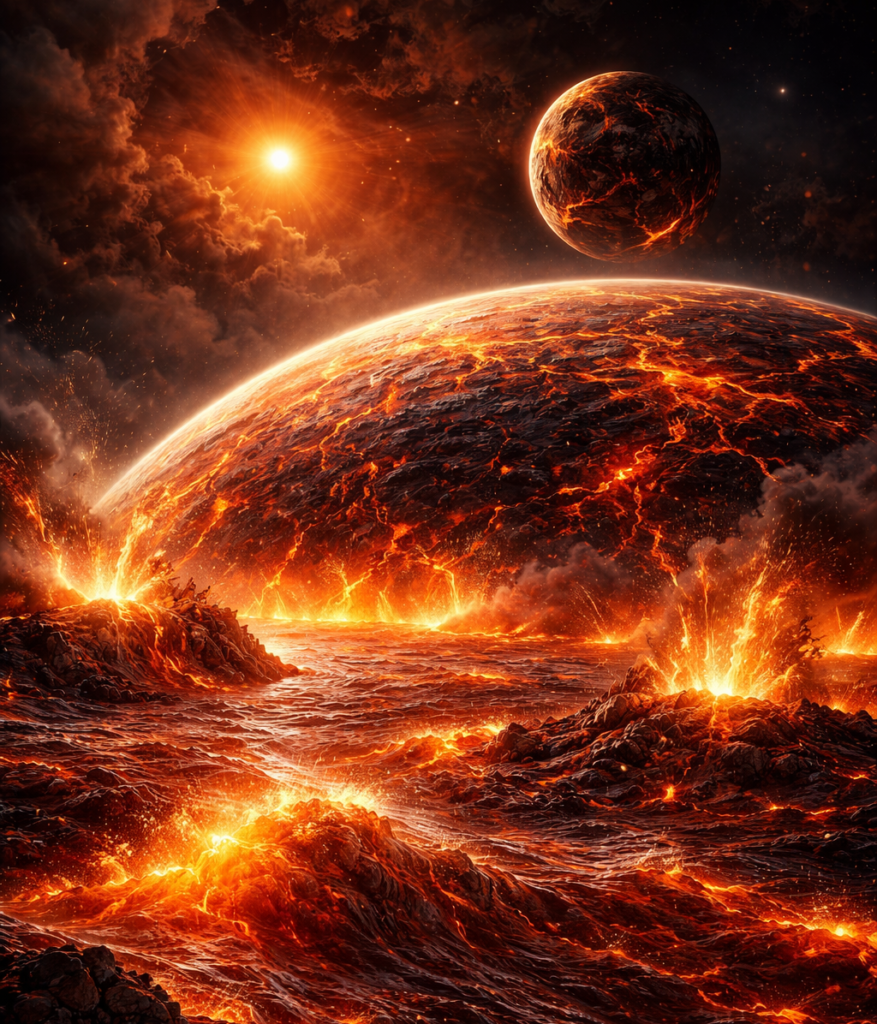
Hello and welcome! Today we’re diving into one of the most exciting and fiery discoveries in modern astronomy a brand-new type of planet that looks like something straight out of a sci-fi movie. Get ready to explore a world where oceans aren’t made of water… but burning molten lava!
The Discovery That Shocked Scientists
Using the powerful James Webb Space Telescope, astronomers closely studied a distant exoplanet named L 98-59 d.
This planet orbits very close to its star, completing a full orbit in just a few days. Because of this, it is constantly blasted with intense heat enough to melt its entire surface into a global magma ocean.
But here’s the twist:
Scientists believe this planet is not just temporarily molten it may be in a permanent “mushy” state, somewhere between solid rock and liquid lava.
Inside a Magma Ocean Planet
Imagine standing on such a planet (if you could survive even a second):
- The ground beneath you is not solid it’s a churning sea of lava
- Temperatures soar to 1,500–2,000°C or higher
- Instead of water waves, there are lava tides and currents
- The sky is filled with toxic gases like sulfur dioxide
- Scientists even predict “rock rain” vaporized rock that cools and falls back down
These planets may also be tidally locked, meaning:
- One side always faces the star → eternal daylight and extreme heat
- The other side remains darker → slightly cooler, but still hellish
The Science Behind the “Mushy State”
What makes this discovery so exciting is the idea of a partially molten interior.
Instead of being:
- Fully solid like Earth
- Or fully liquid like gas giants
These planets exist in between a hybrid state.
Scientists call this a magma ocean regime, where:
- The outer layer is molten
- The interior is a mix of solid crystals + liquid magma
- Heat is trapped efficiently, preventing cooling
This explains why the planet can stay molten for billions of years.
A Strange and Toxic Atmosphere
The atmosphere of these planets is just as wild as their surface:
- Rich in sulfur compounds (like volcanic gases on Earth)
- Possibly contains silicate vapor (rock turned into gas!)
- Thick and hazy, trapping heat like a runaway greenhouse effect
Some scientists even say it could smell like rotten eggs due to hydrogen sulfide.
A Brand-New Planet Category
This discovery suggests a new class of planets:
Magma Ocean Worlds
A category that sits between:
- Rocky planets (Earth-like)
- Gas-rich planets
These worlds are:
- Too hot to solidify
- Too dense to be gas giants
** This fills a missing gap in planetary science.
How Scientists Confirmed It
The breakthrough came from combining:
- Observations from the James Webb Space Telescope
- Advanced climate and interior simulations
- Models of planetary formation
By analyzing light spectra, scientists detected:
- Chemical fingerprints of sulfur gases
- Heat patterns consistent with molten surfaces
This allowed them to “see” the invisible structure of the planet.
What This Means for Earth’s History
Here’s something incredible:
Billions of years ago, Earth itself may have been a magma ocean planet.
After formation:
- Earth was covered in molten rock
- Gradually cooled to form crust, oceans, and atmosphere
Studying these distant worlds is like looking back in time at Earth’s earliest stage.
Why This Discovery Is So Important
This changes everything we thought we knew:
- Planets are more diverse than expected
- Some planets may never cool down
- It reshapes the search for habitable worlds
- It challenges existing models of planet evolution
Scientists now believe that magma ocean planets could be very common in the universe.
The Big Cosmic Question
If planets can exist as:
- Water worlds
- Ice giants
- Gas giants
- Lava oceans
Then what other unknown types are still out there?
The universe is far stranger and more beautiful than we ever imagined.
From calm blue planets to raging oceans of fire, every discovery reminds us how much we still have to learn.
Keep looking up… because the next cosmic surprise might already be on its way.