

A Tale of Two Galaxies: The Invisible Link Between Gas and Dark Matter
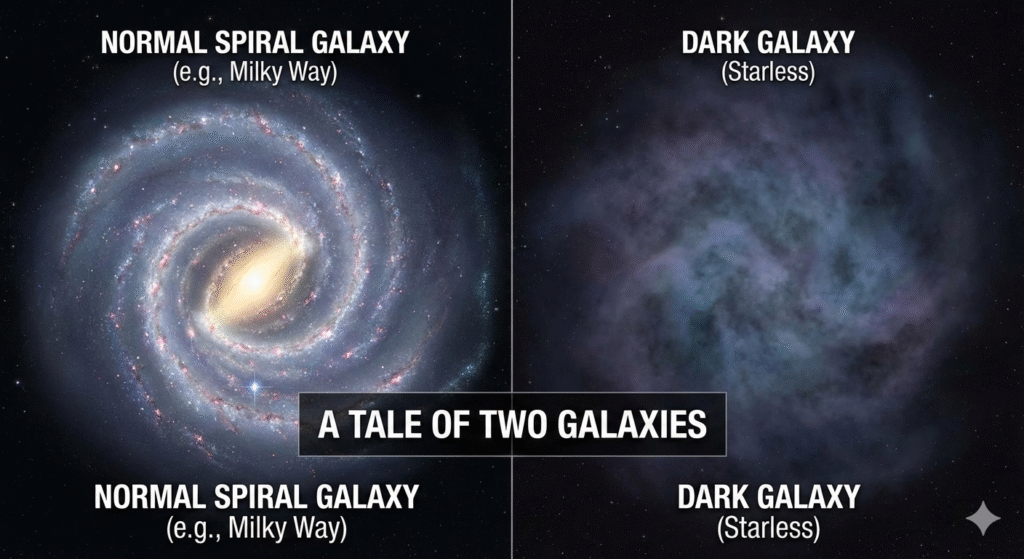
The idea of a galaxy with no stars sounds like a contradiction—after all, we usually define a galaxy by its swirling arms of glowing suns. However, astronomers have recently confirmed the existence of Dark Galaxies. These are massive, rotating clouds of gas and dark matter that have remained “primitive” and never ignited the star-forming process.
As of late 2025, these objects have become a major focus for understanding how the first structures in our universe began. Here is the full detail on how they work, how we find them, and why they stay dark.
1. What is a Dark Galaxy?
A dark galaxy is a “failed” galaxy. It contains all the necessary ingredients to build a galaxy—hydrogen gas, dust, and a massive halo of dark matter—but it lacks the visible stars that make it shine.
- Composition: Primarily neutral atomic hydrogen (HI) and dark matter.
- Mass: They can be as massive as small spiral galaxies but emit almost zero light in the visible spectrum.
- The Paradox: Because they have no stars, they cannot be seen with traditional optical telescopes (like Hubble). They appear as “empty” space until viewed through specialized instruments.
2. How Do We Detect Them?
If they don’t give off light, how do we know they are there? Scientists use two primary “indirect” methods:
The 21-Centimeter Line (Radio Astronomy)
Hydrogen atoms naturally emit a very specific radio signal known as the 21-cm line. Radio telescopes, like the Green Bank Telescope (GBT) or the FAST telescope in China, can “hear” these signals. If they find a massive, rotating cloud of hydrogen in deep space with no stars in the middle, they’ve found a dark galaxy.
Gravitational Effects
Dark galaxies have immense mass due to their dark matter content. This mass exerts gravity, which can:
- Tug on nearby “visible” galaxies, causing them to warp or move strangely.
- Act as a gravitational lens, bending the light of more distant objects behind them.
3. Major Discoveries
In the last few years, a few specific “starless” galaxies have made headlines:
J0613+52: The “Accidental” Discovery (2024)
This is currently the most exciting candidate because it was found by mistake. Astronomers were pointing the Green Bank Telescope (GBT) at a different set of coordinates when they tripped over this massive signal.
- The Technical Details: It is a massive, rotating cloud of hydrogen gas. Scientists estimate its mass is roughly 2 billion times the mass of our Sun.
- The Mystery: Usually, a cloud this massive would have collapsed under its own gravity to form stars long ago. However, J0613+52 is isolated.
- Scientific Importance: It is so far away from other galaxies that no gravitational “tugs” have ever triggered the gas to clump together. It is a “pristine” example of what the universe looked like billions of years ago.
FAST J0139+4328: The Dark Dwarf (2023)
Discovered by the Five-hundred-meter Aperture Spherical radio Telescope (FAST) in China, this galaxy is a “Dark Dwarf.”
- The Composition: It consists almost entirely of dark matter and a small amount of neutral hydrogen gas.
- The Dark Matter Ratio: In a normal galaxy like the Milky Way, dark matter outweighs visible matter by about 5 to 1. In FAST J0139+4328, that ratio is estimated to be over 100 to 1.
- The Detection Method: Scientists used the 21-centimeter line (the “song of hydrogen”) to see it.
Note on the 21-cm Line: Because these galaxies have no stars to emit visible light, we rely on the fact that hydrogen atoms naturally flip their “spin,” emitting a very faint radio wave at exactly 21.1 cm. By mapping these waves, we can “see” the shape and rotation of the gas cloud.
IRGOHI21: The Invisible Anchor (2005)
This was the first “dark galaxy” candidate to gain major scientific traction. It is located within the Virgo Cluster, a massive neighborhood of thousands of galaxies.
- The “Smoking Gun”: Astronomers noticed that a nearby visible galaxy, NGC 4254, was being stretched and distorted as if something huge was pulling on it.
- The Discovery: When they looked at the empty space next to NGC 4254 with radio telescopes, they found a massive cloud of gas (VIRGOHI21) rotating at high speeds—speeds that would only be possible if the cloud contained massive amounts of dark matter to hold it together.
- The Debate: Some scientists argue it might just be a “tail” of gas ripped off another galaxy, but its high rotation speed strongly suggests it is a self-contained dark galaxy.
4. Why Don’t They Have Stars?
There are three main theories as to why these galaxies never “turned on”:
- Low Gas Density: For stars to form, gas must be squeezed together by gravity until it gets hot enough to ignite nuclear fusion. In dark galaxies, the gas is so spread out (diffuse) that it never reaches the “tipping point” needed to collapse into stars.
- Cosmic Isolation: Most star formation is triggered by galaxies bumping into each other or passing close by. Objects like J0613+52 are “too far from their neighbors,” meaning nothing has ever “shaken” the gas enough to start the star-making process.
- Primordial Purity: These galaxies often consist of “primordial” gas (pure hydrogen and helium). Without heavier elements (like carbon or oxygen) created by previous generations of stars, the gas can’t cool down efficiently. If gas can’t cool, it can’t clump; if it can’t clump, it can’t form stars.
5. Why They Matter
Dark galaxies are essentially time capsules. They represent the state of the universe shortly after the Big Bang, before the first stars polluted space with heavy elements.
By studying them, astronomers can test the Lambda CDM model (our current best theory of the universe), which predicts that the universe should be filled with thousands of small dark matter halos that never formed stars. Finding them proves our math about dark matter is likely correct.
Fun Fact: If you were standing in the middle of a dark galaxy like J0613+52, the night sky would be almost pitch black, with only the distant glow of other galaxies visible in the far distance.
Is 9awinlegit legit? From what i see, looks solid. Worth trying your luck here! You can try it out at 9awinlegit
asia slot365 không yêu cầu KYC rườm rà ngay từ đầu. Bạn chỉ cần xác minh khi thực hiện giao dịch rút tiền đầu tiên – quy trình đơn giản, chỉ mất 2-3 phút. TONY01-26
заклепка вытяжная 4 8х12 заклепки вытяжные закрытые
Это настоящий кракен с системой escrow и рейтингами продавцов
дизайн гостиной в доме дизайн ремонта коттеджа
дизайн зала в квартире дизайн проект двухкомнатной квартиры
терминус полотенцесушители полотенцесушитель сталь купить
clickrank site – Found practical insights today; sharing this article with colleagues later.
clicktraffic site – Pages loaded fast, images appeared sharp, and formatting stayed consistent.
traffio site – Color palette felt calming, nothing distracting, just focused, thoughtful design.
ranklio site – Pages loaded fast, images appeared sharp, and formatting stayed consistent.
leadnex site – Loved the layout today; clean, simple, and genuinely user-friendly overall.
nicheninja site – Mobile version looks perfect; no glitches, fast scrolling, crisp text.
reachly site – Found practical insights today; sharing this article with colleagues later.
leadzo site – Bookmarked this immediately, planning to revisit for updates and inspiration.
leadora site – Navigation felt smooth, found everything quickly without any confusing steps.
adster – Found practical insights today; sharing this article with colleagues later.
reacho – Overall, professional vibe here; trustworthy, polished, and pleasantly minimal throughout.
offerorbit – Bookmarked this immediately, planning to revisit for updates and inspiration.
promova – Color palette felt calming, nothing distracting, just focused, thoughtful design.
rankora – Appreciate the typography choices; comfortable spacing improved my reading experience.
trendfunnel – Appreciate the typography choices; comfortable spacing improved my reading experience.
scaleify – Pages loaded fast, images appeared sharp, and formatting stayed consistent.
For those seeking an exceptional online gaming experience, [maxispin.us.com](https://maxispin.us.com/) stands out as a premier destination. At Maxispin Casino, players can enjoy a vast array of pokies, table games, and other thrilling options, all accessible in both demo and real-money modes. The casino offers attractive bonuses, including free spins and a generous welcome offer, along with cashback promotions and engaging tournaments. To ensure a seamless experience, Maxispin provides various payment methods, efficient withdrawal processes, and reliable customer support through live chat. Security is a top priority, with robust safety measures and a strong focus on responsible gambling tools. Players can easily navigate the site, with detailed guides on account creation, verification, and payment methods. Whether you’re interested in high RTP slots, hold and win pokies, or the latest slot releases, Maxispin Casino delivers a user-friendly and secure platform. Explore their terms and conditions, read reviews, and discover why many consider Maxispin a legitimate and trustworthy choice in Australia.
Whether you’re a seasoned copywriter or just starting out, MaxiSpin.us.com provides the resources you need to enhance your content.
**Features of MaxiSpin.us.com**
The platform also provides a strong spin-text generator, letting users easily produce distinct versions of their content.
**Benefits of Using MaxiSpin.us.com**
MaxiSpin.us.com provides businesses with a major advantage by simplifying the content creation process.
stackhq – Navigation felt smooth, found everything quickly without any confusing steps.
cloudhq – Appreciate the typography choices; comfortable spacing improved my reading experience.
bytehq – Pages loaded fast, images appeared sharp, and formatting stayed consistent.
devopsly – Color palette felt calming, nothing distracting, just focused, thoughtful design.
stackops – Found practical insights today; sharing this article with colleagues later.
kubeops – Overall, professional vibe here; trustworthy, polished, and pleasantly minimal throughout.
cloudopsly – Mobile version looks perfect; no glitches, fast scrolling, crisp text.
keywordcraft – Pages loaded fast, images appeared sharp, and formatting stayed consistent.
adscatalyst – Appreciate the typography choices; comfortable spacing improved my reading experience.
clickrevamp – Color palette felt calming, nothing distracting, just focused, thoughtful design.
promoseeder – Bookmarked this immediately, planning to revisit for updates and inspiration.
leadspike – Navigation felt smooth, found everything quickly without any confusing steps.
trafficcrafter – Loved the layout today; clean, simple, and genuinely user-friendly overall.
auditpilot – Overall, professional vibe here; trustworthy, polished, and pleasantly minimal throughout.
leadvero – Bookmarked this immediately, planning to revisit for updates and inspiration.
authoritylab – Found practical insights today; sharing this article with colleagues later.
datadev – Loved the layout today; clean, simple, and genuinely user-friendly overall.
applabs – Content reads clearly, helpful examples made concepts easy to grasp.
dataops – Found practical insights today; sharing this article with colleagues later.
trycloudy – Mobile version looks perfect; no glitches, fast scrolling, crisp text.
gobyte – Overall, professional vibe here; trustworthy, polished, and pleasantly minimal throughout.
getbyte – Loved the layout today; clean, simple, and genuinely user-friendly overall.
getkube – Bookmarked this immediately, planning to revisit for updates and inspiration.
usebyte – Mobile version looks perfect; no glitches, fast scrolling, crisp text.
usekube – Navigation felt smooth, found everything quickly without any confusing steps.
trystack – Found practical insights today; sharing this article with colleagues later.
getstackr – Bookmarked this immediately, planning to revisit for updates and inspiration.
usestackr – Found practical insights today; sharing this article with colleagues later.
cloudster – Content reads clearly, helpful examples made concepts easy to grasp.
deployly – Loved the layout today; clean, simple, and genuinely user-friendly overall.
byteworks – Mobile version looks perfect; no glitches, fast scrolling, crisp text.
stackable – Found practical insights today; sharing this article with colleagues later.
datavio – Loved the layout today; clean, simple, and genuinely user-friendly overall.
devnex – Loved the layout today; clean, simple, and genuinely user-friendly overall.
bytevia – Navigation felt smooth, found everything quickly without any confusing steps.
dataworks – Found practical insights today; sharing this article with colleagues later.
cryptora – Bookmarked this immediately, planning to revisit for updates and inspiration.
kubexa – Navigation felt smooth, found everything quickly without any confusing steps.
cloudiva – Color palette felt calming, nothing distracting, just focused, thoughtful design.
stackora – Mobile version looks perfect; no glitches, fast scrolling, crisp text.
netlance – Navigation felt smooth, found everything quickly without any confusing steps.
devonic – Content reads clearly, helpful examples made concepts easy to grasp.
apponic – Color palette felt calming, nothing distracting, just focused, thoughtful design.
codefuse – Overall, professional vibe here; trustworthy, polished, and pleasantly minimal throughout.
codestackr – Navigation felt smooth, found everything quickly without any confusing steps.
Discover the thrill of real-money live casino action at [url=https://maxispin-au.com/]best Pragmatic Play live tables at Maxispin[/url], where you can enjoy live dealers, top software providers, and exclusive promotions.
The site’s navigation is simple and accessible, helping newcomers get started quickly.
codepushr – Navigation felt smooth, found everything quickly without any confusing steps.
devpush – Content reads clearly, helpful examples made concepts easy to grasp.
gitpushr – Content reads clearly, helpful examples made concepts easy to grasp.
mergekit – Pages loaded fast, images appeared sharp, and formatting stayed consistent.
shipkit – Color palette felt calming, nothing distracting, just focused, thoughtful design.
debugkit – Overall, professional vibe here; trustworthy, polished, and pleasantly minimal throughout.
commitkit – Color palette felt calming, nothing distracting, just focused, thoughtful design.
testkit – Appreciate the typography choices; comfortable spacing improved my reading experience.
flowbot – Mobile version looks perfect; no glitches, fast scrolling, crisp text.
logkit – Navigation felt smooth, found everything quickly without any confusing steps.
promptkit – Navigation felt smooth, found everything quickly without any confusing steps.
modelops – Navigation felt smooth, found everything quickly without any confusing steps.
deploykit – Mobile version looks perfect; no glitches, fast scrolling, crisp text.
databrain – Loved the layout today; clean, simple, and genuinely user-friendly overall.
mlforge – Color palette felt calming, nothing distracting, just focused, thoughtful design.
taskpipe – Navigation felt smooth, found everything quickly without any confusing steps.
smartpipe – Overall, professional vibe here; trustworthy, polished, and pleasantly minimal throughout.
opsbrain – Mobile version looks perfect; no glitches, fast scrolling, crisp text.
patchkit – Found practical insights today; sharing this article with colleagues later.
guardstack – Overall, professional vibe here; trustworthy, polished, and pleasantly minimal throughout.
securekit – Bookmarked this immediately, planning to revisit for updates and inspiration.
authkit – Bookmarked this immediately, planning to revisit for updates and inspiration.
zerotrusty – Pages loaded fast, images appeared sharp, and formatting stayed consistent.
threatlens – Mobile version looks perfect; no glitches, fast scrolling, crisp text.
keyvaulty – Color palette felt calming, nothing distracting, just focused, thoughtful design.
auditkit – Mobile version looks perfect; no glitches, fast scrolling, crisp text.
shieldops – Content reads clearly, helpful examples made concepts easy to grasp.
secstackr – Content reads clearly, helpful examples made concepts easy to grasp.
smartbyte – Appreciate the typography choices; comfortable spacing improved my reading experience.
techsphere – Overall, professional vibe here; trustworthy, polished, and pleasantly minimal throughout.
cyberstack – Pages loaded fast, images appeared sharp, and formatting stayed consistent.
nanotechhub – Navigation felt smooth, found everything quickly without any confusing steps.
keyvaulty – Navigation felt smooth, found everything quickly without any confusing steps.
clicktechy – Navigation felt smooth, found everything quickly without any confusing steps.
bytetap – Appreciate the typography choices; comfortable spacing improved my reading experience.
quickbyte – Overall, professional vibe here; trustworthy, polished, and pleasantly minimal throughout.
techvertex – Mobile version looks perfect; no glitches, fast scrolling, crisp text.
pixelengine – Bookmarked this immediately, planning to revisit for updates and inspiration.
futurestack – Color palette felt calming, nothing distracting, just focused, thoughtful design.
logicforge – Mobile version looks perfect; no glitches, fast scrolling, crisp text.
bytelab – Navigation felt smooth, found everything quickly without any confusing steps.
zyrotech – Bookmarked this immediately, planning to revisit for updates and inspiration.
omegabyte – Bookmarked this immediately, planning to revisit for updates and inspiration.
techdock – Bookmarked this immediately, planning to revisit for updates and inspiration.
bitzone – Appreciate the typography choices; comfortable spacing improved my reading experience.
codehive – Loved the layout today; clean, simple, and genuinely user-friendly overall.
tronbyte – Content reads clearly, helpful examples made concepts easy to grasp.
futurebyte – Content reads clearly, helpful examples made concepts easy to grasp.
cyberpulse – Appreciate the typography choices; comfortable spacing improved my reading experience.
codenova – Bookmarked this immediately, planning to revisit for updates and inspiration.
bytenova – Content reads clearly, helpful examples made concepts easy to grasp.
zybertech – Content reads clearly, helpful examples made concepts easy to grasp.
vortexbyte – Navigation felt smooth, found everything quickly without any confusing steps.
zenixtech – Color palette felt calming, nothing distracting, just focused, thoughtful design.
technexus – Appreciate the typography choices; comfortable spacing improved my reading experience.
veloxtech – Pages loaded fast, images appeared sharp, and formatting stayed consistent.
byterise – Found practical insights today; sharing this article with colleagues later.
quantumforge – Content reads clearly, helpful examples made concepts easy to grasp.
techcatalyst – Found practical insights today; sharing this article with colleagues later.
devbyte – Navigation felt smooth, found everything quickly without any confusing steps.
Sprawdz poradnik [url=https://jaka-kamera-do-drona-fpv.neocities.org/]kamera fpv na poczatek[/url], jesli szukasz najlepszych wskazowek przy wyborze kamery FPV na start.
Kamery z wysoka czuloscia matrycy lepiej radza sobie przy niedostatecznym oswietleniu.
dataforge – Mobile version looks perfect; no glitches, fast scrolling, crisp text.
logicbyte – Color palette felt calming, nothing distracting, just focused, thoughtful design.
bytecore – Loved the layout today; clean, simple, and genuinely user-friendly overall.
bitcore – Appreciate the typography choices; comfortable spacing improved my reading experience.
binaryforge – Overall, professional vibe here; trustworthy, polished, and pleasantly minimal throughout.
seovault – Bookmarked this immediately, planning to revisit for updates and inspiration.
seoshift – Overall, professional vibe here; trustworthy, polished, and pleasantly minimal throughout.
seonexus – Found practical insights today; sharing this article with colleagues later.
clickrly – Found practical insights today; sharing this article with colleagues later.
seoradar – Overall, professional vibe here; trustworthy, polished, and pleasantly minimal throughout.
reachrocket – Found practical insights today; sharing this article with colleagues later.
scalewave – Appreciate the typography choices; comfortable spacing improved my reading experience.
convertcraft – Navigation felt smooth, found everything quickly without any confusing steps.
boostsignals – Bookmarked this immediately, planning to revisit for updates and inspiration.
ranktarget – Pages loaded fast, images appeared sharp, and formatting stayed consistent.
searchmetrics – Overall, professional vibe here; trustworthy, polished, and pleasantly minimal throughout.
rankstrategy – Bookmarked this immediately, planning to revisit for updates and inspiration.
searchsignals – Color palette felt calming, nothing distracting, just focused, thoughtful design.
adzio – Loved the layout today; clean, simple, and genuinely user-friendly overall.
devwave – Pages loaded fast, images appeared sharp, and formatting stayed consistent.
xyrotech – Bookmarked this immediately, planning to revisit for updates and inspiration.
cybernexus – Content reads clearly, helpful examples made concepts easy to grasp.
nexonbyte – Found practical insights today; sharing this article with colleagues later.
zentrotech – Bookmarked this immediately, planning to revisit for updates and inspiration.
techwave – Color palette felt calming, nothing distracting, just focused, thoughtful design.
vynextech – Loved the layout today; clean, simple, and genuinely user-friendly overall.
zylotech – Color palette felt calming, nothing distracting, just focused, thoughtful design.
techsnap – Loved the layout today; clean, simple, and genuinely user-friendly overall.
bytecraft – Mobile version looks perfect; no glitches, fast scrolling, crisp text.
growthmarketing – Found practical insights today; sharing this article with colleagues later.
socialmarketing – Loved the layout today; clean, simple, and genuinely user-friendly overall.
convertio – Loved the layout today; clean, simple, and genuinely user-friendly overall.
adlify – Content reads clearly, helpful examples made concepts easy to grasp.
ranksignal – Navigation felt smooth, found everything quickly without any confusing steps.
signaltrack – Overall, professional vibe here; trustworthy, polished, and pleasantly minimal throughout.
admark – Found practical insights today; sharing this article with colleagues later.
Bitcoin News – Navigation felt smooth, found everything quickly without any confusing steps.
marketingautomation – Pages loaded fast, images appeared sharp, and formatting stayed consistent.
reachriver – Color palette felt calming, nothing distracting, just focused, thoughtful design.
analyticsreport – Bookmarked this immediately, planning to revisit for updates and inspiration.
viralshift – Loved the layout today; clean, simple, and genuinely user-friendly overall.
netamplify – Loved the layout today; clean, simple, and genuinely user-friendly overall.
leadcircuit – Pages loaded fast, images appeared sharp, and formatting stayed consistent.
searchengineers – Mobile version looks perfect; no glitches, fast scrolling, crisp text.
marketingengine – Loved the layout today; clean, simple, and genuinely user-friendly overall.
leadnest – Pages loaded fast, images appeared sharp, and formatting stayed consistent.