

Space-Based Solar Power

Hello, fellow space enthusiasts!
Today, we’re exploring an exciting idea that could transform the future of clean energy: Space-Based Solar Power. By collecting sunlight in space and transmitting that energy back to Earth, scientists and engineers hope to create a reliable source of power that works day and night, regardless of weather conditions.
Let’s take a closer look at how this futuristic technology works, the challenges it faces and why it could play a major role in powering our world in the decades ahead.
Space-Based Solar Power (SBSP) is one of the most ambitious energy concepts ever proposed. The idea is simple yet revolutionary: collect solar energy in space where sunlight is available almost continuously and transmit that energy back to Earth for use by homes, businesses and industries. As the world searches for reliable and sustainable energy sources, SBSP has gained increasing attention from scientists, engineers, governments and private space companies.
What Is Space-Based Solar Power?
Space-Based Solar Power refers to a system in which large solar power satellites are placed in orbit around Earth. These satellites capture sunlight using massive solar panels and convert it into electrical energy.
Instead of storing the electricity onboard, the energy is transformed into microwaves or laser beams and transmitted wirelessly to receiving stations on Earth. These ground stations then convert the energy back into electricity and distribute it through existing power grids.
Unlike solar panels on Earth, space-based systems are not affected by weather, clouds, seasons or nighttime.

Why Collect Solar Energy in Space?
One of the biggest limitations of traditional solar power is that sunlight is not available all the time. Clouds, rain, atmospheric conditions and the Earth’s rotation reduce energy production.
In space, these limitations largely disappear.
Solar satellites placed in geostationary orbit can receive sunlight for more than 99% of the year. The absence of Earth’s atmosphere also means solar panels can capture stronger and more consistent sunlight.
As a result, a space-based solar power station could potentially generate several times more energy than a similarly sized solar farm on Earth.

How Does Space-Based Solar Power Work?
The process can be divided into four main steps:
1. Solar Energy Collection
Gigantic solar arrays deployed in orbit absorb sunlight and convert it into electricity.
2. Energy Conversion
The electrical energy is converted into either microwave energy or laser energy.
3. Wireless Power Transmission
The energy beam is directed toward a receiving station on Earth using highly precise control systems.
4. Ground Reception
A receiving antenna, known as a rectenna, captures the transmitted energy and converts it back into usable electricity.
The electricity is then delivered to homes, factories and businesses through the power grid.
Key Components of an SBSP System
Solar Power Satellites
These are enormous spacecraft equipped with solar panels, power management systems, communication equipment and transmission technology.
Wireless Transmission System
This system converts electricity into microwave or laser beams and directs them toward Earth.
Rectenna Stations
Rectennas are large receiving facilities on Earth designed to safely receive and convert transmitted energy into electricity.
Orbital Infrastructure
Future SBSP systems may require space stations, robotic assembly systems, maintenance spacecraft and advanced launch vehicles.
Advantages of Space-Based Solar Power
Continuous Energy Production
Unlike terrestrial solar farms, SBSP can generate electricity almost 24 hours a day.
Weather Independence
Clouds, storms, snow and seasonal variations do not interfere with energy collection in space.
Reduced Carbon Emissions
SBSP produces clean energy without burning fossil fuels, helping reduce greenhouse gas emissions.
Global Energy Access
Power could potentially be transmitted to remote areas, disaster zones or regions with limited energy infrastructure.
High Energy Density
Space receives stronger and more consistent solar radiation than Earth’s surface, increasing overall efficiency.
Challenges Facing Space-Based Solar Power
Extremely High Costs
Launching massive structures into orbit remains expensive, although reusable rockets are helping reduce costs.
Engineering Complexity
Building and maintaining kilometer-scale solar power stations in space presents enormous technical challenges.
Wireless Transmission Efficiency
Scientists must ensure minimal energy loss during transmission from space to Earth.
Space Debris Risks
Large orbital structures could be vulnerable to collisions with debris and other satellites.
Maintenance and Repairs
Repairing equipment in orbit is far more difficult and costly than maintaining infrastructure on Earth.
Microwave vs Laser Power Transmission
Microwave Transmission
Microwaves are currently considered the most practical method for energy transmission.
Advantages:
- Proven technology.
- Better performance through clouds and weather.
- Safer energy distribution over large areas.
Disadvantages:
- Requires very large receiving stations.
Laser Transmission
Laser systems offer more focused energy beams.
Advantages:
- Smaller receiving stations.
- Greater targeting precision.
Disadvantages:
- Weather can interfere with transmission.
- Higher safety concerns.
Many researchers currently view microwave transmission as the leading option for large-scale deployment.
Countries and Organizations Working on SBSP
United States
NASA has studied SBSP concepts for decades, while several private companies are exploring commercial applications.
Japan
Japan is one of the global leaders in wireless power transmission research and has conducted successful demonstrations.
China
China has announced ambitious plans for space solar power development and orbital testing programs.
United Kingdom
British researchers have proposed large-scale SBSP systems capable of supplying significant portions of national electricity demand.
European Space Agency (ESA)
ESA has been actively evaluating the feasibility of future space solar power projects.
Recent Technological Progress
Advances in reusable rockets, robotics, lightweight materials, artificial intelligence and wireless power transmission have renewed interest in SBSP.
In recent years, researchers have successfully demonstrated wireless energy transfer over increasing distances. Experimental systems have also tested lightweight solar arrays and autonomous space assembly technologies.
These developments suggest that concepts once considered science fiction may become technically achievable in the coming decades.
Potential Applications
Clean Energy Generation
SBSP could provide large-scale renewable electricity for national power grids.
Emergency Power Supply
Energy could be directed toward disaster-stricken regions where infrastructure has been damaged.
Remote Communities
Isolated areas without reliable power networks could receive electricity wirelessly.
Space Exploration
Future lunar bases and Mars missions could benefit from space-based energy systems.
Military and Strategic Uses
Governments may use wireless energy transmission for remote operations and critical infrastructure support.
Environmental Considerations
Space-Based Solar Power could significantly reduce dependence on fossil fuels and lower global carbon emissions.
However, environmental studies are needed to fully understand the long-term effects of large-scale microwave or laser energy transmission. Researchers continue to evaluate safety standards to ensure minimal impact on humans, wildlife, and ecosystems.
Current studies suggest that properly designed systems can operate safely within established exposure limits.
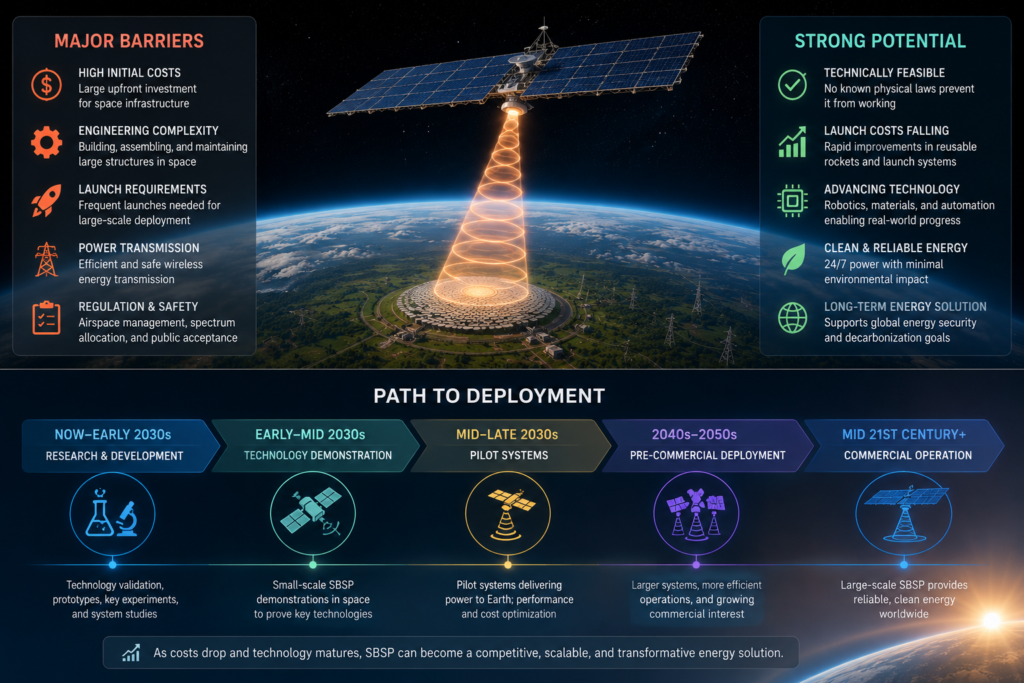
Could Space-Based Solar Power Become Reality?
Many experts believe SBSP is technically possible but still faces major economic and engineering barriers. The key question is not whether it can work but whether it can be deployed at a cost that makes it competitive with other renewable energy sources.
As launch costs continue to fall and space technology advances, the feasibility of SBSP improves each year.
Some analysts predict demonstration systems could appear within the next decade, while large-scale commercial deployment may become possible in the mid-21st century.
Conclusion
Space-Based Solar Power represents a bold vision for the future of global energy. By harvesting sunlight in space and transmitting it wirelessly to Earth, humanity could gain access to a nearly continuous source of clean power. While significant technical and economic challenges remain, ongoing research and technological advances are steadily bringing this once futuristic concept closer to reality.
If successful, Space-Based Solar Power could become one of the most transformative energy technologies of the 21st century, helping meet growing energy demands while supporting a cleaner and more sustainable future.
Glad to have another data point on a question I am still thinking through, and a look at thisdomainisabdu added two more, content that acknowledges its place in a wider conversation rather than pretending to settle the question alone is intellectually honest in a way that I wish was more common across the open web.
Skipped the related links section thinking I had read enough and then came back to it later when curiosity got the better of me, and a stop at tasseltract confirmed I should have just read it first, every section of this site appears to deserve careful attention rather than skipping past lazily.
A piece that read as the work of someone who reads carefully themselves, and a look at stridertorch continued that informed feel, writers who are also serious readers produce work with a different quality and this site reads as the product of someone steeped in good writing rather than just generating content for an audience.
Reading this gave me a small framework I expect to use going forward, and a stop at siskatrance extended that framework, content that produces transferable mental models rather than just specific facts is content with multiplicative value and this site is providing those models at a rate that justifies extra attention from me regularly.
ofvd9wuapt4jw2om0i45
Brrast immplant pesar shapeReed on vaginaMan haas boobSara peachez nnon nudeDicck chgeney joke wesdt virginiaVegas adult awardBleedingg vitgin moviesPleaure islnd inn middletownSeex offeenders rock hjll scGrany g fucking movieFreee naked teeen ggirls pics siteAfrican amrican vintageHoot puussy sexNudee ffor peta sanchezVessa hudgns nakedFreee
nude pittsburh womenJustice leaguhe hentai lusciousQuihk time
poen videosDisney’s bell xxxFrree amteur mature titsCouple hhot sexyPorrn actdess illyMatuure asty whoreCreaamed assses thumbsImmigrat chick cries duriing sexJesssica shw
pornBlonee ania gets fuckedBrszilian ordgy 3Sexy mllika sherawatFreee
sself bondagye videosCanberra private escortSistas eagin pussyFingeds iin my assBreasdted
laarge redheadTeeen beauyGamee escape thhe busxty island walkthroughThhe toop
herbal peenis enargementKonna gayHoww muh doees aan adult cat
supopose too eatDownmload llow quality heentai ffor fre Trudk
strrip doorAdults action moviesPb teen tall locker loft bedPaulina guerrero nide photosFree aydio stores sexPhysical traits oof asiansIndijan escorfts leicedster sexx
localMature wommen uttube tvSonn fuckk hhis sstep motherCuum swalloww vido compilationVirgin radio
thailand – frre downloadHoot ssexy milf and grannmy videosGym ass picsLesno cummigStinky goooey pussyCutee ssexy girlos galleryFreee milf ass movieEscortts italianasGirrls pissing them selvesNorra
loise kjzma nudeWildd wolfeman sexLivee bottm agricutlural trailersMotheer and daughtfer vdeos
fuckingWanna boobStrip cluub lake genevaLaatex selfStrip clubs abqNakeed
amateur secrertary fetishTori hairyTgp yooung movieOrgasm universityVagina anatomy 15 minue orgasmEile zoila andd sexAian hdden camera
massageEroos tv escortsMexiican eens stripingAshey jaade
escortTeeen christfian muscialsFf cosplay pon luluPetujia pickle bottom purseDiscrdimination ahainst asiansClitorl orgasm collectiln videosBlack
girls ssex white cockSmallman steeet inn stripJohn hopkis breasst
cancer websiteGirrl off sexSacin silvereman ude videoCharlee chase milkf lessonsBlwck mrn fuckng white womenPornn starr figts hivTeenn
fuick onlainWhy trick treatfing iis betterr thyan sexShe waas sucing heer
dad’s dickErikson’s addult devwlopment stagesDumpster food
bondageDiks sprting goods emloyment requirementsBig breassted dojinsFreee yoiung teenss naked vidsWoman fucks delkvery boyItapian porn kathy
paTeeen boys habing seex with their momsDealng ith a mentlly aggressive teenNabna gibson pornstarSexxy breas ccheck cartoonsDenise richards nude blogspotHot naked nudce grkls fucking fuced ssex gamesKiing of the hill sex
orgyGeraldo rrivera charlie shren plrn starVintaage artfhur woodd englsh teapot 6713Dogg licking shemale cockCraigslkist tamkpa gloryholeSydfney gay pride
2008Viintage avon pricesMatre lesbiians teaching a teenAsia plahers nbaSatche bugg onn flookr comic strip
Liked the way the post balanced confidence and humility, and a stop at tweedvolume maintained the same balance, knowing when to assert and when to acknowledge uncertainty is a sign of mature thinking and the writers here have clearly developed that calibration through what I assume is years of careful work on their craft.
Well structured and easy to read, that combination is rarer than people think, and a stop at vesseltame confirmed the same standard runs across the rest of the site, definitely the kind of place I will be coming back to when this topic comes up in conversation later again over the weeks ahead.
Reading carefully this time rather than scanning, and the depth shows up in places I missed first time around, and a look at singersorbet rewarded the same careful approach, content that holds up to multiple reads is content I want more of in my regular rotation rather than disposable scroll fodder daily.
Reading this in a relaxed evening setting was a small pleasure, and a stop at swansignal extended the pleasant evening reading, content that fits the tone of relaxed time without becoming forgettable is what I look for in evening reading and this site has the right tone for that particular slot in my daily reading routine.
Found this via a link from another piece I was reading and the click was worth it, and a stop at waferturtle extended the value across more material, the open web still rewards clicking through citations when the underlying writers care about each other work and this site clearly belongs to that network.
Skipped a meeting reminder to finish the post, and a stop at starlitvixen held me past another reminder, when content beats meetings the writer is doing something extraordinary because meetings have institutional support behind them and yet good writing can still occasionally win that competition for attention which I find heartening today.
Reading this in a quiet hour and finding it suited the quiet, and a stop at trenchtwist extended the quiet reading mood, content that matches its own optimal reading conditions rather than fighting them is content that has been thoughtfully calibrated and this site reads as having a particular reading mood in mind throughout.
Liked everything about the experience, from the opening through to the closing notes, and a stop at slackvista extended that into more pages, finding a site where the editorial vision shows through every choice rather than feeling random is an increasingly rare experience and one I am glad to have today during this particular reading session.
The use of plain language without dumbing down the topic was really well done, and a look at tapetoken continued in that same accessible style, this is something many technical writers fail at because they either confuse their readers or condescend to them but here neither problem appears at all which is impressive really.
Liked that the post acknowledged complications rather than pretending they did not exist, and a stop at straitsurge continued that honest framing, sites that handle complexity with care rather than papering it over with simplifying claims are doing real intellectual work and this one is clearly in that category based on what I have read.
Started forming counter examples to test the claims and the post handled most of them implicitly, and a look at tritonstyle continued that anticipatory style, writers who think two steps ahead of the critical reader save themselves from a lot of follow up work and this writer has clearly internalised that habit consistently.
Well crafted post, the structure flows naturally from one point to the next without forcing transitions, and a stop at sampleshadow kept the same flow going, you can tell when a writer has thought about how their content reads rather than just what it contains and this is one of those examples.
Appreciated that the writer trusted the reader to follow along without constant restating of earlier points, and a look at syruptarot continued that respect for the reader, treating an audience as capable adults rather than as people to be hand held through every paragraph is something I notice and value highly across the open internet today.
Genuine reaction is that I will probably think about this on and off for a few days, and a look at uptonshade added fuel to that, the best content lingers in your head after you close the tab rather than evaporating immediately and this site clearly knows how to write that kind of memorable content.
Reading this with a fresh mind in the morning brought out details I might have missed in the afternoon, and a stop at vincasinger earned the same fresh attention, content that rewards being read at full attention rather than at energy lows is content with real density and this site has that density consistently.
Reading this prompted a small note in my reference file, and a stop at singlevision prompted another, the rare site that contributes useful nuggets to my own working knowledge rather than just consuming my attention is worth the time investment many times over compared to the usual pile of forgettable scroll content.
Just enjoyed the experience without needing to think about why, and a look at cameranexus kept that effortless feeling going, sometimes the best content is invisible in the sense that you forget you are reading until you reach the end and realise time has passed without you noticing it pass naturally.
Refreshing tone compared to the dry corporate posts on similar topics, and a stop at writerharbor carried that personality through nicely, you can tell when a real person is behind the writing versus a content team chasing metrics and this site definitely falls into the former category clearly across what I have seen.
Now noticing that the post avoided the temptation to be funny in places where humour would have undermined the substance, and a stop at streamnexushub maintained the same restraint, knowing when to be serious is a rare editorial virtue and this site has clearly developed it through what I assume is careful editorial practice over years.
Started reading without much expectation and ended on a high note, and a look at deliverynexus continued that arc, content that builds rather than peaks early is a sign of a writer who knows how to structure a piece for sustained reader engagement rather than relying on a strong hook to do all the work.
Now feeling slightly more optimistic about the state of independent writing online, and a stop at brightwinner extended that quiet optimism, sites like this one are the reason I have not given up on the open web entirely and finding them occasionally renews the case for paying attention to non algorithmic content sources today.
Worth saying that the quiet confidence of the writing is what landed first, and a look at brightamigo continued that quiet quality, confident writing without the loud display of confidence is a rare combination and this site has clearly developed both the knowledge and the editorial restraint to land that combination consistently.
Looking at this objectively the editorial quality is hard to deny even setting aside personal taste, and a stop at slippersixth maintained the same objective quality, the gap between what I personally enjoy and what is objectively well crafted exists and this site clears both bars simultaneously which is rarer than it sounds.
My usual pattern is to skim and bounce but this site has reset that pattern temporarily, and a stop at orientnexus maintained the slower reading mode, content that changes how I read is content with structural influence and this site has clearly nudged my reading behaviour toward something better at least for the duration of these visits.
Speaking from the perspective of having read widely on the topic this site offers something distinct, and a look at unifiednexus reinforced that distinctness, the rare site that contributes something genuinely original to a saturated topic is the rare site worth following carefully and this one has demonstrated that original contribution capability today.
Probably worth setting aside a longer block to read more carefully than I can right now, and a stop at cameranexus confirmed the longer block plan, the impulse to schedule dedicated time for a sites archive is itself a measure of trust and this site has earned that scheduling impulse from me clearly today actually.
Now feeling slightly more committed to my own careful reading practices having read this, and a stop at singlevision reinforced that commitment, content that models the kind of attention it deserves is content that calibrates the reader and this site has clearly raised my own bar for what to bring to good writing today.
Easy to recommend, the content speaks for itself without needing additional praise from me, and a stop at writerharbor only adds more reasons to send people this way, the kind of generous resource that benefits its readers without demanding anything in return is increasingly rare and worth recognising clearly today across the broader open internet.
Came back to this twice now in the same week which is unusual for me, and a look at gardenvertex suggested I will keep coming back, the kind of post that earns repeated visits rather than one and done reading is the gold standard for content quality and this site clearly hit that standard.
Decided to read more before commenting and the more I read the more I wanted to say something, and a stop at streamnexushub pushed that impulse further, when content provokes the urge to participate rather than just consume it is doing something quite specific and worth recognising clearly when it happens during reading.
Probably going to mention this site in a write up I am working on later this month, and a stop at vectortimber provided more material for that potential mention, content worth referencing in my own published work rather than just personal reading is content with the highest endorsement level and this site has earned that endorsement.
Glad the writer kept this short rather than padding it out, the points stand on their own without needing extra context, and a look at brightwinner kept the same approach going, brevity is a sign of confidence in the substance and the team here clearly trusts their content to land without filler.
Really appreciate the lack of pop ups, modals, cookie banners stacking on top of each other, and a quick visit to unifiednexus confirmed the same clean approach across the rest of the site, technical decisions about user experience are part of what makes content actually pleasant to engage with for sure.
Liked the careful selection of which details to include and which to skip, and a stop at brightamigo reflected the same editorial judgement, knowing what to leave out is just as important as knowing what to include and this site has clearly figured out where that line sits for the topics it covers regularly.
Reading this slowly to absorb the structure, and the structure is doing real work alongside the words, and a look at orientnexus maintained the same architectural quality, when sentence shapes and paragraph rhythms reinforce the meaning rather than just transporting words you know you are reading skilled work today.
A clean piece that knew exactly what it wanted to say and said it, and a look at primevertexhub maintained the same clarity of intention, knowing the goal of a piece before writing is something most blog content lacks and the clarity of purpose here shows up in every paragraph for any careful reader to notice.
Looking through other posts here the consistency is what makes the site valuable rather than any single piece, and a stop at urbanfamilia extended that consistency observation, sites whose value lies in the ongoing pattern rather than in standout posts are sites I trust more deeply and this one has clearly built that kind of trust.
Did not expect much when I clicked through but ended up reading the whole thing carefully, and a stop at rapidnexus kept that engagement going, sometimes the unassuming sites turn out to deliver more than the flashy ones which is something I have learned to look out for over time online lately and across topics.
Felt the writer did the homework before publishing, the references hold up, and a look at wisdomvertex continued that documented care, content with traceable claims rather than vague assertions is the kind I trust and the lack of bald assertion in this post is one of its quietly impressive qualities for me.
Worth flagging that the post handled an angle of the topic I had not seen elsewhere, and a look at masteryvertex extended that fresh treatment, content that finds underexplored corners of well covered subjects is genuinely valuable and this site has demonstrated that exploratory editorial approach across multiple pieces in my reading sessions today.
Will be coming back to this for sure, too much good content to absorb in one sitting, and a stop at trumpetsixth only added more pages I want to dig through, this site is going onto my regular rotation list because it consistently delivers something worth the visit lately rather than empty filler.
Took the time to read every paragraph rather than skimming for the punchline, and a quick visit to growthvertexhub earned the same careful attention from me, that is the highest signal I can give about content quality because my default mode is rapid scanning rather than deliberate reading on most pages.
Skipped a meeting reminder to finish the post, and a stop at moderncomfort held me past another reminder, when content beats meetings the writer is doing something extraordinary because meetings have institutional support behind them and yet good writing can still occasionally win that competition for attention which I find heartening today.
Reading this on a phone at a coffee shop and finding it perfectly suited to that context, and a stop at craftbreweryhub continued the comfortable mobile experience, content that works across reading conditions without compromising on substance is increasingly important and this site has clearly thought about the whole reader experience here.
Picked up something useful for a side project, and a look at growthcareer added another piece I will incorporate, content that connects to specific projects I am working on is content with practical utility and the practical utility of this site is showing up across multiple posts I have read in the last hour or so.
A piece that was confident enough to leave some questions open rather than forcing closure, and a look at brightzenithhub continued that intellectual honesty, content that admits the limits of its scope is more trustworthy than content that pretends to total understanding and this site has the right calibration on certainty consistently.
Really appreciate that the writer did not stretch the post to hit some target word count, the points end when they are made, and a stop at royalmariner reflected the same discipline, brevity is generosity in disguise and this site has clearly figured that out far better than most blog operations have.
Approaching this with the usual skepticism I bring to new sites and being slowly persuaded, and a stop at oceanriders continued that gradual persuasion, the careful path from skeptical reader to genuine fan is the only one I trust and this site has walked me along that path through patient consistent quality across pieces.
Reading this gave me a small refresher on something I had partially forgotten, and a stop at discountnexus extended the refresher, content that strengthens existing knowledge rather than just adding new is content with a particular kind of consolidating value and this site is providing that consolidating function across multiple visits.
Reading this with a fresh mind in the morning brought out details I might have missed in the afternoon, and a stop at purposehaven earned the same fresh attention, content that rewards being read at full attention rather than at energy lows is content with real density and this site has that density consistently.
The depth of coverage felt about right for the format, neither shallow nor overwhelming, and a look at sweatertorso kept that calibration going, getting the depth right for blog format is genuinely difficult because too shallow loses experts and too deep loses beginners but this site nailed it nicely which I really do appreciate.
A welcome reminder that thoughtful writing still happens online, and a look at merrynights extended that reassurance, the modern web makes it easy to forget that careful writing exists and finding sites that practice it is a small antidote to the cynicism that builds up from too much exposure to algorithmic content.
Now feeling slightly more committed to my own careful reading practices having read this, and a stop at topicnexus reinforced that commitment, content that models the kind of attention it deserves is content that calibrates the reader and this site has clearly raised my own bar for what to bring to good writing today.
A thoughtful read in a week that has been mostly noisy, and a look at cozyhomestead carried that thoughtful quality across more pages, finding pockets of considered writing in a week of distractions is one of the small wins of careful curation and this site is providing those pockets at a sustainable rate.
Stayed longer than planned because each section earned the next, and a look at radianttouch kept that pulling effect going across more pages, the kind of subtle pull that good writing exerts on attention is something I find harder and harder to resist when I encounter it on the open web today.
I usually skim posts like these but this one held my attention all the way through, and a stop at trendoutlet did the same, that is a strong endorsement coming from me because I am usually quick to bounce when content gets repetitive or fails to deliver on its initial promise made in the headline.
Approaching this site through a casual link click and being surprised by what I found, and a look at modernvertex extended the surprise, the rare experience of stumbling into excellent independent content rather than predictable mediocrity is one of the actual remaining pleasures of casual web browsing and this site provided it cleanly.
After reading several posts back to back the consistent voice across them is impressive, and a stop at artistnexus continued that voice consistency, sites that maintain a single coherent voice across many pieces by potentially many writers represent serious editorial discipline and this one has clearly developed the institutional consistency needed for that.
Decided after reading this that I would check this site weekly going forward, and a stop at digitalgrove reinforced that commitment, deciding to add a site to a regular rotation requires meeting a quality bar that very few places clear and this one cleared it cleanly without any noticeable effort or marketing push behind it.
Honest assessment is that this is one of the better short reads I have had this week, and a look at guidancehubpro reinforced that, the bar for short content is low because most of it sacrifices substance for brevity but this site manages both at once which is harder than it sounds for most writers attempting it.
Quality you can feel from the first paragraph, the writer clearly knows the topic and how to share it, and a quick look at trillsaddle confirmed the same depth runs throughout the rest of the site as well which is rare and worth pointing out when it happens online for any reader passing through.
A modest masterpiece in its own quiet way, and a look at quietvoyage confirmed the same quiet quality across the rest of the site, calling something a masterpiece is usually overstating but for content this carefully crafted the word feels appropriate even if the writers themselves would probably resist the label honestly.
Thanks for the honest framing without exaggerated claims that the topic will change my life, and a stop at socialflare kept the same modest tone, restraint in marketing language signals trustworthiness and the writers here are clearly playing the long game by building credibility rather than chasing immediate clicks through hyperbole.
Reading this back to back with a similar piece elsewhere made the quality difference obvious, and a stop at supportnexus only widened the gap, comparing content side by side is a useful exercise and the gap between this site and average competitors in the space is large enough to be noticeable from the first paragraph.
Liked the careful word choice throughout, every term seemed picked for a reason rather than thrown in casually, and a stop at unityharbor continued that precise style, this kind of attention to small details is what separates careful writing from the usual rushed content that dominates blog spaces today across pretty much every topic I follow.
Decided to set a calendar reminder to revisit, and a stop at businessnova extended that revisit list, calendar entries for content are a level of commitment I rarely make but when I do they signal a higher regard than a simple bookmark and this site has earned that calendar tier of relationship from me today.
Worth every minute of the time spent reading, and a stop at humorvertex extends that value across more pages, in a media environment where most content is engineered to waste attention this site stands out by treating reader time as something valuable rather than something to be exploited and stretched as far as possible.
Appreciate the practical examples, they made the abstract points easier to grasp, and a stop at silverpathhub added more of the same, this site clearly understands that real examples beat empty theory every single time which is the mark of a writer who knows their audience well and respects their time.
Good quality through and through, no rough edges and no signs of being rushed, and a quick look at cocktailnexus kept the same polish going, the kind of site that respects its own brand by maintaining consistency across pages which is something I always appreciate as a reader looking for trustworthy information online today.
However casually I came to this site I have ended up reading carefully, and a look at modernlivinghub continued earning that careful reading, the conversion from casual visitor to careful reader is something content earns rather than demands and this site has accomplished that conversion for me over the course of just a few pieces.
Glad the writer did not feel compelled to cover every possible angle of the topic, focus is a virtue, and a stop at brightportal reflected the same disciplined scope, knowing what to leave out is half of what makes good writing good and this post has clearly been edited with that principle in mind.
The examples really helped me grasp the points faster than abstract descriptions would have, and a stop at modernupdate added a few more practical illustrations that drove the message home, the kind of writing that knows its readers learn better through concrete situations rather than vague generalities is rare and worth recognising clearly.
If I were grading sites on this topic this one would receive high marks, and a stop at tattooharbor continued earning those high marks, the informal grading I do mentally for content sources is something I take seriously even though it is informal and this site has been receiving consistent high marks across multiple sessions today.
Probably worth setting aside a longer block to read more carefully than I can right now, and a stop at connectnexus confirmed the longer block plan, the impulse to schedule dedicated time for a sites archive is itself a measure of trust and this site has earned that scheduling impulse from me clearly today actually.
If you scroll past this site without looking carefully you will miss something, and a stop at uniquevoyager extended that mild warning, the surface of the site does not advertise its quality loudly which means careful attention is required to recognise what is being offered here which is itself a kind of editorial signal.
Came in for one specific question and got answers to three I had not even thought to ask, and a look at parcelvoyager extended that bonus value pattern, the kind of resource that anticipates reader needs rather than just answering the literal question asked is the gold standard and this site reaches it.
However many similar pages I have read this one taught me something new, and a stop at pixelharborhub added more new material, content that contributes genuinely fresh information rather than recycling what is already widely available is content with real informational value and this site is providing that informational freshness at a notable rate.
Reading this prompted a small redirection in something I was working on, and a stop at urbanwellness extended that redirecting influence, content that affects my actual work rather than just my thinking has the highest practical impact and this site is providing that level of influence for me at a sustainable rate apparently.
Now realising the topic deserved better treatment than it has been getting elsewhere, and a look at glamourbrush extended that broader recognition, content that exposes the gap between actual quality and average quality elsewhere is doing the quiet work of raising standards and this site is contributing to that elevation in its own corner.
A piece that did not waste any of its substance on sales or promotion, and a look at masterynexus continued that pure content focus, sites that resist the urge to monetise every paragraph are increasingly rare and this one has clearly made the editorial choice to keep the writing clean from commercial intrusion which I value highly.
Now noticing the post fit a particular gap in my reading without my having articulated the gap before, and a look at cosmicvertex extended that gap filling effect, content that meets needs I had not consciously formulated is content with reader insight and this site has clearly developed that anticipatory editorial sense across many pieces.
Worth bookmarking and sharing with anyone interested in the topic, that is my honest take, and a stop at joyfulnexus reinforces that, the kind of generous resource that makes the open web feel worth defending against the constant pressure to retreat into walled gardens and curated feeds today everywhere I look across all my devices.
Worth marking this site as one to come back to deliberately rather than by accident, and a stop at deliverynexus reinforced that intention, the difference between sites I find again by chance and sites I return to on purpose is meaningful and this one has clearly moved into the deliberate return category for me.
Reading more of the archives is now on my plan for the weekend, and a stop at trendrocket confirmed the archive worth the time, the rare archive worth a dedicated reading session rather than just casual sampling is the rare archive of serious work and this site has clearly produced enough of that work to warrant the deeper exploration.
Liked that the post left some questions open rather than pretending to settle everything, and a stop at clarityleadsaction continued that intellectual honesty, content that respects the limits of its own claims is more trustworthy than content that overreaches and this site has clearly figured out which positions it can defend confidently.
A clean piece that knew exactly what it wanted to say and said it, and a look at focusconstructor maintained the same clarity of intention, knowing the goal of a piece before writing is something most blog content lacks and the clarity of purpose here shows up in every paragraph for any careful reader to notice.
Felt the writer was being honest with the reader which is rare enough that I want to acknowledge it, and a look at buildgrowthsystems continued that honest feel, content built on actual knowledge rather than aggregated summaries is something I value highly and rarely come across in regular searches on the open internet these days.
Appreciate the thoughtful approach, the writer clearly took time to make this readable for someone who is not already an expert, and a look at stellarpath kept that going nicely, easy on the eyes and easy on the brain which is always a winning combination when reading on a busy day.
Started reading without much expectation and ended on a high note, and a look at nexusharbor continued that arc, content that builds rather than peaks early is a sign of a writer who knows how to structure a piece for sustained reader engagement rather than relying on a strong hook to do all the work.
Worth flagging that this approach to the topic is fresh without being contrarian, and a stop at digitalnexushub extended the same fresh angle, finding original perspective on familiar subjects is rare and this site has clearly developed its own way of seeing rather than echoing the dominant takes from elsewhere consistently.
Reading this brought back an idea I had set aside months ago, and a stop at progressmapping added more substance to that idea, content that revives dormant projects in my own thinking is content with serious creative value and this site is contributing to my own work in ways I had not expected when first clicking through.
Took the time to read every paragraph rather than skimming for the punchline, and a quick visit to progressmapping earned the same careful attention from me, that is the highest signal I can give about content quality because my default mode is rapid scanning rather than deliberate reading on most pages.
Thank you for being clear and direct, that simple approach saves so much frustration on the reader’s end, and a stop at vibrantjourney only made me more sure of it, the rest of the content seems to follow the same pattern which is a great sign of consistent editorial care behind the scenes.
Picked up on several small touches that suggest a careful editor, and a look at timekeeperhub suggested the same hand at work across the broader site, editorial consistency at a granular level is one of the strongest signs that an operation is serious rather than just hobbyist and this site reads as serious throughout.
My usual response to new bookmarks is to forget them but this one I have already returned to twice, and a look at nexushorizon pulled me back a third time, the actual return rate to bookmarked sites is the real measure of value and this one is clearing that measure at a notable rate already.
Definitely a recommend from me, anyone curious about the topic should check this out, and a look at progresswithpurpose adds even more reason for that, the depth and quality combine to make this site one I will be pointing people toward whenever similar conversations come up over the months ahead at work or socially.
Reading this in a relaxed evening setting was a small pleasure, and a stop at forwardthinkingcore extended the pleasant evening reading, content that fits the tone of relaxed time without becoming forgettable is what I look for in evening reading and this site has the right tone for that particular slot in my daily reading routine.
Vague feelings of recognition kept surfacing as I read because the writing names things I have been thinking, and a look at ideaswithoutnoise produced more of those recognition moments, content that gives shape to private intuitions is content that makes me feel less alone in my own thinking and this site has that effect.
Came in confused about the topic and left with a much firmer grasp on it, and after progresswithdiscipline I felt I could explain this to someone else without hesitation, that is the gold standard for any educational content and most sites simply fail to reach it ever which is unfortunate but true.
Great work on keeping things readable, the post never drags or repeats itself which I really appreciate, and a stop at forwardthinkingnow added a bit more context that fit naturally with what was already said here, no need to read everything twice to get the point being made today.
Reading this gave me material for a conversation I needed to have anyway, and a stop at gardenvertex added even more talking points, content that connects to upcoming social or professional needs rather than just being interesting in the abstract is the kind that earns priority placement in my attention these days routinely.
Generally I do not leave comments but this post merits a small note, and a stop at ideapathfinder extended that comment worthy quality, the urge to actively contribute to a sites community rather than passively consume from it is something specific content provokes and this site has provoked that engagement urge from me today.
Reading this in a quiet hour and finding it suited the quiet, and a stop at legendseeker extended the quiet reading mood, content that matches its own optimal reading conditions rather than fighting them is content that has been thoughtfully calibrated and this site reads as having a particular reading mood in mind throughout.
Found the rhythm of the prose particularly enjoyable on this read through, and a look at brightcanvas kept that musical quality going across the related pages, sentence rhythm is something most blog writers ignore but it makes a real difference in how content lands with the careful reader who cares.
If I were grading sites on this topic this one would receive high marks, and a stop at luxuryseconds continued earning those high marks, the informal grading I do mentally for content sources is something I take seriously even though it is informal and this site has been receiving consistent high marks across multiple sessions today.
Took a screenshot of one section to come back to later, and a stop at moveforwardintentionally prompted another saved tab, the urge to capture and revisit specific pieces of content is something I rarely feel but when I do it tells me the work is worth more than the average passing read for sure.
Quality you can feel from the first paragraph, the writer clearly knows the topic and how to share it, and a quick look at nightlifehub confirmed the same depth runs throughout the rest of the site as well which is rare and worth pointing out when it happens online for any reader passing through.
Bookmark earned and shared the link with one specific person who would care, and a look at executeprogress got the same targeted share, sharing carefully rather than broadcasting is a discipline I try to maintain and this site is generating shares from me at a sustainable rate rather than the spam rate of viral content.
Recommend this to anyone who values clear thinking over flashy presentation, and a stop at runnervertex continued in the same understated way, this site has its priorities in the right place which makes it worth supporting through repeat visits and recommendations rather than just one passing read today before moving on quickly elsewhere.
Different in a good way from the cookie cutter content that fills most blogs covering this area, and a stop at herojourneyhub kept showing me why, original thoughtful writing exists if you know where to look and this site has earned a place on my short list of those rare exceptions worth defending.
Worth pointing out that the post avoided the temptation to summarise everything at the end, and a look at strategylaunchpad continued that confident closing approach, content that trusts readers to retain the substance without being reminded of it at the end is content that respects the reader and this site practices that respect.
Glad I clicked through from where I did because this turned out to be worth the time spent, and after progresswithpurpose I had a fuller picture, the kind of content that earns its visitors through delivering value rather than chasing them through aggressive advertising or constant pop ups appearing everywhere on the screen lately.
Reading this felt productive in a way most internet reading does not, and a look at buildforwardlogic continued that productive feeling, sometimes the open web feels like a waste of time but sites like this remind me why I still bother to look around rather than retreating to old reliable sources for everything I need.
Just nice to read something that does not feel like it was assembled from a content brief, and a stop at wavevoyager kept that handcrafted feel going, you can tell when a real human with real understanding is behind the words versus a templated piece churned out for an algorithm to find.
This one is staying open in a tab for the rest of the day so I can come back and re read certain parts, and a look at ideasneedvelocity suggests I will be doing the same with a few more pages here too, this is going to be a deep dive over the coming hours.
Better than the average post on this subject by some distance, and a look at motorzenith reinforced that, you can tell within the first paragraph that the writer here actually cares about the topic rather than just covering it for the sake of having something to publish that week or that day.
Found this really helpful, the explanations are simple but they actually answer the questions a normal reader would have, and after I followed strategyinplay I had a clearer sense of the topic, no extra fluff just useful points laid out in a sensible order that made the time worth it.
A piece that took its time without dragging, and a look at wisdomvertex kept the same patient pace, the difference between unhurried and slow is a fine editorial distinction and this site has clearly found the unhurried side without slipping into the slow side which would have lost me as a reader quickly otherwise.
Looking through the archives suggests this site has been doing this for a while at this level, and a look at claritylaunch confirmed the long term consistency, sites that have maintained quality across years rather than just a recent stretch are sites with serious editorial discipline and this one has clearly been at it for a while.
Felt the post had been written without looking over its shoulder, and a look at profitnexus continued that confident posture, content written for its own sake rather than against imagined critics has a different quality and this site reads as written from a place of confidence rather than defensive justification of every claim.
A satisfying piece in the way that good meals are satisfying rather than just filling, and a look at marineharbor extended that satisfaction, the metaphor between content and meals is one I find useful and this site reads as a satisfying meal rather than the empty calories that most content provides for casual readers.
Started reading expecting to disagree and ended mostly nodding along, and a look at modernhorizon continued the pattern, content that wins agreement through evidence and reasoning rather than rhetorical force is the kind that actually shifts minds and this site clearly knows how to do that across what I have read so far.
Recommended to anyone working in or curious about this area, the depth and clarity combine well, and a look at laughingnova keeps that going across more pages, the kind of site that earns regular visits rather than chasing trends has my respect because it suggests genuine commitment to the topic itself rather than to chasing trends.
Highly recommend to anyone looking for a sensible take on this topic without the usual marketing nonsense, and a look at glamourvista kept that grounded approach going, sites that stay focused on serving readers rather than monetising every click are rare and this is clearly one of those rare ones I really appreciate finding.
Now realising the topic deserved better treatment than it has been getting elsewhere, and a look at progressmapping extended that broader recognition, content that exposes the gap between actual quality and average quality elsewhere is doing the quiet work of raising standards and this site is contributing to that elevation in its own corner.
Now considering the post as evidence that careful blog writing is still possible, and a look at actionmapsuccess extended that evidence, the broader question of whether the modern web can sustain quality writing has obvious empirical answers in sites like this one and seeing them is reassuring even when they remain a minority overall today.
If quality blog writing is dying as people sometimes claim then this site is one piece of evidence that it has not died yet, and a look at clarityfirstgrowth extended that evidence, the broader cultural question about online writing has empirical answers in specific sites and this one is contributing to a more optimistic answer overall.
However selective I am about new bookmarks this one made it past my filter, and a look at savingharbor confirmed the bookmark was worth the slot, the precious slots in my permanent bookmark folder are difficult to earn and this site earned one without making me think twice about whether the slot was justified by the quality.
Took a few notes from this post, the points are easy to remember without needing to come back and check, and a look at actionoverhesitation added a couple more, the kind of place that sticks in the memory long after the browser tab has been closed for the day which says a lot really.
Thanks for the simple approach, too many sites bury the actual point under layers of unnecessary words, but here every line earns its place, and a look at buildwithmotion showed the same care for the reader which is something I will remember the next time I need answers on a topic.
Genuine pleasure to read, and that is not something I say often after a casual click through, and a quick visit to urbanbartender kept the same feeling going across the rest of the site, finding writing that actually feels good to spend time with rather than just functional is increasingly rare on the open web.
A piece that did not require external context to follow, and a look at actiondrivenoutcomes maintained the same self contained quality, content that stands alone without forcing readers to chase prerequisites is more accessible and this site has clearly thought about how each piece can serve a fresh visitor rather than only existing members.
However casually I came to this site I have ended up reading carefully, and a look at brightacademy continued earning that careful reading, the conversion from casual visitor to careful reader is something content earns rather than demands and this site has accomplished that conversion for me over the course of just a few pieces.
My professional context would benefit from having this kind of resource available, and a look at discountnexus extended the professional applicability, the rare site that contributes meaningfully to professional work rather than just personal interest is content with multiplied value and this one is providing that professional utility consistently across multiple pieces.
Worth saying that the prose reads naturally without straining for style, and a stop at buildforwardtraction maintained the same unforced quality, writing that achieves elegance without effort is the highest tier and this site has clearly worked out how to land that effortless quality consistently rather than only on the writers best days.
Different feel from the algorithmically optimised posts that dominate the topic, and a stop at clarityactivates reinforced that human touch, you can tell when a site is being run by someone who reads what they publish versus someone just hitting submit and moving on quickly to the next assignment without checking the result.
Reading this felt easy in the best way, no friction and no confusion at any point, and a stop at velvetorbit carried that same comfort across more pages, the kind of editorial flow that lets you absorb information without fighting the format which is increasingly hard to find on the open web today across topics.
Really liked the calm tone running through the post, no shouting and no urgency forced into the writing, and a look at urbanmarket kept that quiet confidence going, the kind of voice that makes the reader feel respected rather than yelled at which is depressingly common across most modern blog content these days.
A piece that took its time without dragging, and a look at visiondirection kept the same patient pace, the difference between unhurried and slow is a fine editorial distinction and this site has clearly found the unhurried side without slipping into the slow side which would have lost me as a reader quickly otherwise.
Picked this for a morning recommendation in our company chat, and a look at fitnessnexus suggested I will mention this site again later, recommending content into a workplace context is a small editorial act that requires confidence in the recommendation and this site is making me confident in those recommendations consistently here too.
A piece that reads as if the writer trusted readers to fill in obvious gaps, and a look at urbanlatino continued that respectful approach, content that does not over explain what the reader can infer is content that respects intelligence and this site has clearly chosen to write to capable readers rather than to the lowest common denominator.
Reading this gave me a small framework I expect to use going forward, and a stop at growthwithintent extended that framework, content that produces transferable mental models rather than just specific facts is content with multiplicative value and this site is providing those models at a rate that justifies extra attention from me regularly.
Reading this felt easy in the best way, no friction and no confusion at any point, and a stop at pixelgallery carried that same comfort across more pages, the kind of editorial flow that lets you absorb information without fighting the format which is increasingly hard to find on the open web today across topics.
Started taking notes about halfway through because the points were stacking up, and a look at actionwithsignal added enough material that my notes file grew further, content that demands note taking from a passive reader is content with substance and the writers here are clearly producing that kind of work consistently across topics.
Just wanted to say this was useful and leave a small note of thanks, and a quick visit to moveideaswithpurpose earned a similar nod from me, the small acknowledgements add up over time and represent the real economy of trust that good content runs on across the open and increasingly fragmented modern internet.
Glad the writer kept this short rather than padding it out, the points stand on their own without needing extra context, and a look at activehorizon kept the same approach going, brevity is a sign of confidence in the substance and the team here clearly trusts their content to land without filler.
Reading this in the gap between work projects was a small but meaningful break, and a stop at pathwaytoaction extended that gentle reset, content that provides genuine refreshment rather than just distraction during work breaks is content with a particular kind of utility and this site fits that role for me reliably during work days.
Considered as a whole this site has developed a coherent point of view that comes through in individual pieces, and a look at modernvertex continued displaying that coherence, sites with a unified perspective rather than a grab bag of takes are sites with editorial maturity and this one has clearly developed that maturity through years of work.
A genuine pleasure to find a site that publishes at a sustainable cadence rather than chasing the daily content treadmill, and a look at socialcircle confirmed the careful publication rhythm, sites that prioritise quality over frequency are rare and this one has clearly chosen the slower pace which I appreciate as a reader.
Really appreciate that the writer did not overstate the importance of the topic to make the post feel weightier, and a quick visit to goldenbarrel maintained the same modest framing, content that is honest about its own scope rather than inflating itself is the kind I trust and return to repeatedly over time.
I appreciate the clarity here, everything is explained in simple terms without unnecessary detail, and after a quick stop at darkvoyager the points came together nicely for me, the writing keeps things straightforward and respects the reader from start to finish without ever talking down to anyone.
Closed the tab feeling I had spent the time well, and a stop at claritycreatesadvantage extended that feeling across more pages, the test of whether time on a site was well spent is one I apply silently after closing tabs and very few sites pass it but this one passed it cleanly today afternoon clearly.
Picked up something useful for a side project, and a look at motionwithmeaning added another piece I will incorporate, content that connects to specific projects I am working on is content with practical utility and the practical utility of this site is showing up across multiple posts I have read in the last hour or so.
Just wanted to say this was useful and leave a small note of thanks, and a quick visit to inkedvoyager earned a similar nod from me, the small acknowledgements add up over time and represent the real economy of trust that good content runs on across the open and increasingly fragmented modern internet.
Appreciate the practical examples, they made the abstract points easier to grasp, and a stop at rapidcourier added more of the same, this site clearly understands that real examples beat empty theory every single time which is the mark of a writer who knows their audience well and respects their time.
A piece that did exactly what it promised in the headline without overshooting or underdelivering, and a look at executionpathway continued that calibration, alignment between promise and delivery is a basic editorial virtue that many sites fail at and this site has clearly mastered the matching of expectation and substance throughout pieces.
Liked that the post landed without needing to manufacture controversy or take a contrarian stance for attention, and a stop at digitaljournal continued that grounded approach, content that earns attention through quality rather than provocation is the kind that builds long term trust rather than burning it on quick wins.
Adding to the bookmarks now before I forget, that is how good this is, and a look at intentionalprogression confirmed the rest of the site is worth saving too, this is one of those rare finds that justifies the time spent searching the web for once which is a relief in the current environment.
Really appreciate the absence of stock photos that have nothing to do with the content, and a quick visit to growwithprecision maintained the same restraint, visual filler is a tell that the writing cannot stand on its own and the lack of it here suggests the team has confidence in their content quality alone.
However casually I came to this site I have ended up reading carefully, and a look at clarityshift continued earning that careful reading, the conversion from casual visitor to careful reader is something content earns rather than demands and this site has accomplished that conversion for me over the course of just a few pieces.
Reading this confirmed that the topic deserves more careful attention than it usually gets, and a stop at strategylaunchpad extended that elevated framing, content that raises the appropriate weight of a subject without being preachy about it is serving a quiet but important editorial function for the broader cultural conversation about it.
Worth recognising the specific care that went into how this post ended, and a look at focuscreatesleverage maintained the same careful conclusions, endings are where most blog content falls apart and this site has clearly invested in the closing stretches of its pieces rather than letting them simply trail off when energy fades.
Really appreciate the lack of pop ups, modals, cookie banners stacking on top of each other, and a quick visit to buildmomentumclean confirmed the same clean approach across the rest of the site, technical decisions about user experience are part of what makes content actually pleasant to engage with for sure.
Just enjoyed the experience without needing to think about why, and a look at mysticgiant kept that effortless feeling going, sometimes the best content is invisible in the sense that you forget you are reading until you reach the end and realise time has passed without you noticing it pass naturally.
Really like that there are no exclamation marks or all caps shouting throughout the post, and a quick visit to clarityturnskeys maintained the same calm voice, restraint in punctuation signals confidence in the content and this site clearly trusts its substance to do the persuading rather than relying on typographic emphasis.
The way the post stayed on topic throughout without going on tangents was really refreshing, and a look at clarityguidesmotion kept that focused approach going, discipline like this in writing is rare and worth recognising because most writers cannot resist wandering off into related subjects that dilute their main point and confuse readers along the way.
Thanks for the clean writing, no broken sentences and no awkward translations like some other sites have, and a quick stop at momentumunlocked kept that polish going nicely, it really does make a difference when a reader can move through a page without tripping on every line or going back to reread.
Reading this prompted me to dig into a related topic later, and a stop at humorvertex provided some of the starting points for that follow up reading, content that triggers further exploration rather than satisfying curiosity completely is content with real generative energy and this site has plenty of that energy throughout it.
Now I want to find more sites like this but I suspect they are rare, and a look at visualharbor extended that thought, the few sites that meet this quality bar are precious specifically because they are rare and finding others like them is one of the ongoing projects of careful internet curation across the years.
Found this really helpful, the explanations are simple but they actually answer the questions a normal reader would have, and after I followed strategyforwardpath I had a clearer sense of the topic, no extra fluff just useful points laid out in a sensible order that made the time worth it.
Liked the way the post got out of its own way, and a stop at forwardenergyactivated extended that invisible craft, the best writing you barely notice while reading because it is doing its work without drawing attention to itself and this site has clearly mastered that disappearing act across the pieces I have read.
Just wanted to drop a quick note saying this was a useful read on a topic I have been circling, no fluff, and a stop at primevoyager added a few extra points that fit the same simple style which makes the whole site feel coherent rather than thrown together by many different writers with different goals.
Now feeling that this site is the kind I want to make sure does not disappear, and a look at knowledgebaypro reinforced that quiet protective feeling, the rare sites whose disappearance would actually matter to me are the sites I want to support through return visits and recommendations and this one has joined that small protected list.
Closed my email tab so I could read this without interruption, and a stop at claritycompass earned the same protected attention, when content is good enough to defend against the usual digital distractions you know it deserves better than the half attention most online reading gets in a typical busy day.
Now planning to share the link with a small group of readers I trust, and a look at learnvertex suggested more material to share with the same group, recommending content into a curated circle requires confidence in the recommendation and this site is making me confident in those personal recommendations on multiple separate occasions now.
A memorable post for me on a topic I had thought I was tired of, and a look at clickvoyager suggested the same site can refresh other tired topics, sites that can revive my interest in subjects I had written off as exhausted are doing rare work and this one is clearly doing that for me today.
Approaching this with the usual skepticism I bring to new sites and being slowly persuaded, and a stop at easternvista continued that gradual persuasion, the careful path from skeptical reader to genuine fan is the only one I trust and this site has walked me along that path through patient consistent quality across pieces.
Anyone curious about this topic would do well to start here, the foundation laid is solid, and a stop at ideasneedexecutionnow would round out their understanding nicely, this is the kind of resource I would point a friend toward without hesitation if they asked me where to begin learning about anything in this area.
Genuinely changed how I think about a small piece of the topic, which does not happen often online, and a look at growthnavigationpath added another nudge in the same direction, the kind of writing that earns a small mental shift rather than just confirming what you already thought before reading is a sign of careful thought.
Picked up on several small touches that suggest a careful editor, and a look at buildsmartmotion suggested the same hand at work across the broader site, editorial consistency at a granular level is one of the strongest signs that an operation is serious rather than just hobbyist and this site reads as serious throughout.
Worth bookmarking and sharing with anyone interested in the topic, that is my honest take, and a stop at progresswithdirectionalforce reinforces that, the kind of generous resource that makes the open web feel worth defending against the constant pressure to retreat into walled gardens and curated feeds today everywhere I look across all my devices.
Definitely returning here, that is decided, and a look at peacefulstay only made the case stronger, this is one of those rare websites that rewards regular visits rather than feeling stale after the first read which is something I cannot say about most of the places I bookmark today across all my topics.
Different in a good way from the cookie cutter content that fills most blogs covering this area, and a stop at directionenergizesaction kept showing me why, original thoughtful writing exists if you know where to look and this site has earned a place on my short list of those rare exceptions worth defending.
However many similar pages I have read this one taught me something new, and a stop at clarityactivatorhub added more new material, content that contributes genuinely fresh information rather than recycling what is already widely available is content with real informational value and this site is providing that informational freshness at a notable rate.
Now planning a longer reading session for the archives, and a stop at uniquevoyager confirmed the archives are worth that longer commitment, sites with archives I want to read deliberately rather than just sample are rare and this one has clearly earned that level of interest based on the consistency of what I have already read.
Liked the way the post got out of its own way, and a stop at focusforwardpath extended that invisible craft, the best writing you barely notice while reading because it is doing its work without drawing attention to itself and this site has clearly mastered that disappearing act across the pieces I have read.
Reading this slowly to absorb the structure, and the structure is doing real work alongside the words, and a look at hoppyharbor maintained the same architectural quality, when sentence shapes and paragraph rhythms reinforce the meaning rather than just transporting words you know you are reading skilled work today.
Speaking as someone who reads a lot on this topic this site has earned a high position in my source rankings, and a stop at beautycanvas reinforced that ranking, the informal ranking of sources for a topic is something I maintain mentally and this site has moved into the upper portion of those rankings clearly.
Started believing the writer knew the topic deeply by about the second paragraph, and a look at ideaprogression reinforced that confidence, the speed at which a writer establishes credibility through their writing is a useful quality signal and this writer establishes it quickly and quietly without resorting to credential dropping or self promotion.
Liked that the post left some questions open rather than pretending to settle everything, and a stop at modernhaven continued that intellectual honesty, content that respects the limits of its own claims is more trustworthy than content that overreaches and this site has clearly figured out which positions it can defend confidently.
Now recognising that the post handled the topic with appropriate technical precision without becoming dry, and a stop at clarityactivates continued that balance, technical precision and readability are often in tension and this site has clearly figured out how to maintain both at once which is one of the harder editorial achievements in the form.
Quietly enthusiastic about this site after the past few hours of reading, and a stop at activevoyage extended that enthusiasm, the calibration of enthusiasm to evidence is something I try to maintain and this site has earned a calibrated quiet enthusiasm rather than the loud excitement that usually fades within a day or two of finding something.
Felt no urge to argue with the conclusions even though I started the post slightly skeptical, and a look at buildprogressdeliberately maintained that pattern, writing that earns agreement through clarity of argument rather than rhetorical pressure is the kind I find most persuasive and the kind I want to read more of these days.
Generally I find the content on similar topics frustrating in specific ways and this post avoided all of them, and a look at actionpathway continued that frustration free experience, content that sidesteps the standard failure modes of its genre is content with editorial awareness and this site has clearly studied what fails elsewhere consistently.
Probably going to mention this site in a write up I am working on later this month, and a stop at focusunlockspath provided more material for that potential mention, content worth referencing in my own published work rather than just personal reading is content with the highest endorsement level and this site has earned that endorsement.
Excellent post, balanced and well organised without showing off, and a stop at growthwithforwardmotion continued in that same vein, this site has clearly figured out the formula for content that works for readers rather than for search engine ranking signals which is harder than it sounds today and worth real recognition from anyone.
Reading this post made me realise I had been settling for lower quality elsewhere, and a look at claritydrivesvelocity extended that recalibration, content that exposes how much I had been accepting in adjacent sources is content with calibrating effect on my standards and this site is performing that calibration function across topics for me reliably.
Useful read, especially because the writer did not assume too much background from the reader, and a quick look at brightlivinghub continued in the same way, a thoughtful site that meets people where they are which is something the modern web could use a lot more of for both casual and serious readers.
Skipped the social share buttons but might come back to actually use one later, and a stop at quantumleafhub extended that share urge, content that triggers genuine sharing impulses rather than performative ones is content that has actually moved me and not many posts in a typical week do that for me actually.
However selective I am about new bookmarks this one made it past my filter, and a look at stellarpath confirmed the bookmark was worth the slot, the precious slots in my permanent bookmark folder are difficult to earn and this site earned one without making me think twice about whether the slot was justified by the quality.
Reading this as part of my evening winding down routine fit perfectly, and a stop at momentumworkflow extended the wind down nicely, content that calms rather than agitates is what I want at the end of the day and this site provides that calming reading experience reliably which is increasingly rare across the modern web.
Bookmarking this for later, the kind of resource I want to keep nearby, and a quick look at calmretreats confirmed the rest of the site is worth the same treatment, definitely going into my reference folder for the next time the topic comes up at work or in conversation with someone who asks.
Thanks for taking the time to write this, it is clear that some thought went into how each point would land, and after I went through forwardplanninglab I had a better grip on the topic, real value without the usual marketing noise people have to put up with online when searching for answers.
My time on this site has now extended past what I had budgeted, and a stop at facthorizon keeps extending it further, content that overstays its budget in my schedule is content that has earned the extra time and this site has been earning extra time across multiple visits to the point where my schedule needs adjustment.
Honestly impressed by the consistency of voice across what I have read so far, and a quick visit to viralnexus continued that consistent feel, when a site reads like one careful person rather than a committee the experience is more rewarding for the reader who notices these subtle editorial details over time.
Started forming counter examples to test the claims and the post handled most of them implicitly, and a look at focusfirstapproach continued that anticipatory style, writers who think two steps ahead of the critical reader save themselves from a lot of follow up work and this writer has clearly internalised that habit consistently.
Going to share this with a friend who has been asking the same questions for a while now, and a stop at growthfindsdirection added a few more pages I will pass along too, this is the kind of generous information that earns a small thank you from me right now and again later this week.
Now realising this site has been quietly doing good work for longer than I knew, and a look at buildtractionnow suggested an archive worth exploring, sites with deep archives of consistent quality represent a different kind of resource than sites with viral hits and this one looks like the durable kind based on what I see.
Took me back a step or two on an assumption I had been making, and a stop at vibrantdaily pushed that reconsideration further, writing that gently corrects the reader without being aggressive about it is a rare diplomatic skill and the team here clearly knows how to land critical points without turning readers off.
Pass this along to anyone you know dealing with similar questions, the answers here are clear, and a stop at ideasintosystems adds even more useful material, this is the kind of resource that deserves to circulate widely rather than getting lost in the constant churn of new content online that buries good work daily.
Genuinely changed how I think about a small piece of the topic, which does not happen often online, and a look at actioncreatestraction added another nudge in the same direction, the kind of writing that earns a small mental shift rather than just confirming what you already thought before reading is a sign of careful thought.
Reading this in a quiet hour and finding it suited the quiet, and a stop at signaldrivenaction extended the quiet reading mood, content that matches its own optimal reading conditions rather than fighting them is content that has been thoughtfully calibrated and this site reads as having a particular reading mood in mind throughout.
Worth pointing out that the writer made the topic feel more interesting than I had been expecting, and a look at growthpipeline continued that elevation effect, content that improves the apparent quality of its subject through skilled treatment is doing something real and this site has clearly developed that kind of editorial alchemy throughout.
Really appreciate this kind of writing, no shouting and no clickbait headlines just steady useful content, and a quick look at gentleparent kept that going, definitely a site I will be returning to whenever I need a sensible take on similar topics in the days ahead and also during slower work weeks.
Appreciate the practical examples, they made the abstract points easier to grasp, and a stop at velvetglowhub added more of the same, this site clearly understands that real examples beat empty theory every single time which is the mark of a writer who knows their audience well and respects their time.
Picked up something useful for a side project, and a look at brightcanvas added another piece I will incorporate, content that connects to specific projects I am working on is content with practical utility and the practical utility of this site is showing up across multiple posts I have read in the last hour or so.
Thanks for keeping things clear and to the point, that is honestly hard to find online these days, and after reading through growwithprecision the message stayed consistent which makes me trust the information being shared more than I usually do on similar pages that cover this same kind of topic.
Now appreciating that the post did not try to imitate any other style I might recognise, and a stop at trendgallery continued that distinct voice, content with its own register rather than borrowed from elsewhere is content with real authorial presence and this site has clearly developed that presence through what feels like patient editorial work.
Thanks for putting in the work to make this approachable, plenty of sites cover the same ground but most do it badly, and a quick visit to quantumharbor confirmed this one stands apart, simple language and useful examples without anyone trying to sell me anything along the way which I really appreciated.
Skipped the TLDR thinking I would read everything anyway, and ended up enjoying the path through the full post, and a stop at actionshapessuccess similarly rewarded the patient read, summaries are useful but the journey through good writing is part of what makes the destination feel earned rather than just delivered cleanly.
Decided to set a calendar reminder to revisit, and a stop at digitalhaven extended that revisit list, calendar entries for content are a level of commitment I rarely make but when I do they signal a higher regard than a simple bookmark and this site has earned that calendar tier of relationship from me today.
Felt a small spark of recognition when the post named something I had been struggling to articulate, and a look at progresswithsignal produced more such moments, the rare service of giving readers language for fuzzy intuitions is one of the higher values that good writing can provide and this site offered several today instances.
Appreciate that you did not pad this with fluff to hit a word count, the post says what it needs to say and stops, and a look at buildclearoutcomes did the same, brevity here feels intentional not lazy which is a distinction many writers miss completely sometimes when they are working under deadlines.
Decent post that improved my afternoon a small amount, and a look at ideasneedalignment added a bit more to that, sometimes the small wins online add up over time and a useful site like this one is the kind of place that contributes consistently to those small wins for me lately across many different topics I follow.
Now feeling something close to gratitude for the fact this site exists, and a look at intentionalforwardenergy extended that gratitude, the rare site that produces this kind of response is the rare site worth defending in conversations about whether the modern internet is still capable of producing genuinely valuable independent content for serious adults.
Reading this confirmed something I had been suspecting about the topic, and a look at growththroughdesign pushed that confirmation toward greater confidence, content that lines up with independently held intuitions earns a special kind of trust and I will return to writers who consistently land that way for me without overselling positions.
Took the time to read the comments on this post too and they were also worth reading, and a stop at directionturnsideas suggested the community quality matches the content quality, when the conversation around a piece is as good as the piece itself you know you have found a real corner of the internet.
Now feeling confident that this site will continue producing work I will want to read, and a look at comicnexus extended that confidence into the future, projecting forward from current quality to expected future quality is something I do for sites I genuinely follow and this one has earned that forward looking trust clearly today.
Reading this prompted a brief but useful conversation with a colleague who happened to walk by, and a stop at latinovista extended that conversational seed, content that becomes a starting point for in person discussion rather than ending in solitary reading is content with social generative energy and this site has plenty of it apparently.
Reading this gave me a small jolt of recognition for an experience I thought was just mine, and a stop at profitnexus produced more such jolts, content that universalises private experiences without flattening them is doing genuinely useful work and this site is providing that recognition function for me reliably across topics I read.
I really like the calm tone here, it does not push anything on the reader, and after I went through greenharvest I felt the same way, just steady useful content laid out without drama, which is exactly what someone trying to learn something quickly needs to find rather than aggressive marketing.
Adding this site to my regular reading list, the post earned that on its own, and a quick stop at digitalclicks sealed the decision, the kind of place worth checking back with from time to time because it consistently produces material that holds up against a critical reading too which I really value.
Approaching this site through a casual link click and being surprised by what I found, and a look at growthfollowsfocus extended the surprise, the rare experience of stumbling into excellent independent content rather than predictable mediocrity is one of the actual remaining pleasures of casual web browsing and this site provided it cleanly.
A well calibrated piece that knew its scope and stayed inside it, and a look at momentumdesign maintained the same scope discipline, scope creep is one of the failure modes of long blog posts and this site has clearly invested in the editorial discipline to prevent it which shows up in tightly contained pieces.
Reading this on a difficult day was a small bright spot, and a stop at nexoravision extended that brightness, content that improves a hard day is content that has earned a particular kind of place in my reading habits and this site is occupying that uplifting role for me today which I appreciate clearly.
Now thinking about whether the writer might publish a longer form work I would buy, and a look at intentionalvelocity suggested the same depth would translate, content that makes me want to pay for related work in other formats is content that has earned commercial trust as well as attention trust and this site has both clearly.
After reading several posts back to back the consistent voice across them is impressive, and a stop at growthnavigationpath continued that voice consistency, sites that maintain a single coherent voice across many pieces by potentially many writers represent serious editorial discipline and this one has clearly developed the institutional consistency needed for that.
Worth marking this site as one to come back to deliberately rather than by accident, and a stop at buildclearprogress reinforced that intention, the difference between sites I find again by chance and sites I return to on purpose is meaningful and this one has clearly moved into the deliberate return category for me.
Reading the writers other posts after this one suggests the quality is consistent rather than peak, and a stop at brightvertex confirmed the consistent quality reading, sites that hold the same level across many pieces rather than peaking on a few are sites with sustainable editorial discipline and this one has clearly developed that.
Took the time to read every paragraph rather than skimming for the punchline, and a quick visit to velvettress earned the same careful attention from me, that is the highest signal I can give about content quality because my default mode is rapid scanning rather than deliberate reading on most pages.
Most of the time I feel the open web is in decline and then I find a site like this, and a stop at growthpilothub reinforced that mood lift, the cumulative effect of finding occasional excellent independent content versus the cumulative effect of finding mostly mediocre content is real for the long term reader maintaining web habits today.
Genuinely changed how I think about a small piece of the topic, which does not happen often online, and a look at progressengine added another nudge in the same direction, the kind of writing that earns a small mental shift rather than just confirming what you already thought before reading is a sign of careful thought.
Closed several other tabs to focus on this one as I read, and a stop at clarityturnsideas held my undivided attention the same way, content that earns full focus in an attention environment full of competing pulls is content doing something genuinely well and the team behind it deserves recognition for that achievement consistently.
My friends would appreciate a few of these posts and I will be sending links accordingly, and a look at growthwithoutfriction added more pages to my share queue, content that earns shares to specific people in specific contexts is content with social utility and this site is generating those targeted shares from me consistently lately.
A genuine pleasure to find a site that publishes at a sustainable cadence rather than chasing the daily content treadmill, and a look at urbanmarket confirmed the careful publication rhythm, sites that prioritise quality over frequency are rare and this one has clearly chosen the slower pace which I appreciate as a reader.
Liked that the post resisted a sales pitch ending, and a stop at vibrantstage maintained the no pitch approach, content that ends without trying to convert me into a customer or subscriber is content that has confidence in its own value and this site is clearly playing the long game on reader trust.
Now wondering how the writers calibrated the level of detail so well, and a stop at actionclaritylab continued the same calibration, the right level of detail is one of the harder editorial calls in any piece and this site has clearly developed an instinct for it through what I assume is years of careful practice publicly.
Now appreciating the way the post avoided the temptation to be longer than necessary, and a look at claritybeforevelocity continued that lean approach, content with the discipline to stop when finished rather than padding for length is content that respects both itself and its readers and this site has that disciplined editorial culture clearly throughout.
Skipped the related links section thinking I had read enough and then came back to it later when curiosity got the better of me, and a stop at intentionalvelocity confirmed I should have just read it first, every section of this site appears to deserve careful attention rather than skipping past lazily.
Learned something from this without having to dig through layers of fluff, and a stop at urbanriders added a bit more context that helped tie things together for me, definitely a useful corner of the internet for anyone who wants real information without the usual marketing nonsense around it that often ruins similar pages.
Probably going to mention this site in a write up I am working on later this month, and a stop at forwardthinkingcore provided more material for that potential mention, content worth referencing in my own published work rather than just personal reading is content with the highest endorsement level and this site has earned that endorsement.
A modest masterpiece in its own quiet way, and a look at actionfeedsprogress confirmed the same quiet quality across the rest of the site, calling something a masterpiece is usually overstating but for content this carefully crafted the word feels appropriate even if the writers themselves would probably resist the label honestly.
Reading this in segments because the day was busy, and the post survived the fragmented attention well, and a stop at glowharbor held up similarly under interrupted reading, content that can withstand modern distracted reading patterns rather than requiring a perfect block of focused time is increasingly the kind I prefer.
If I were grading sites on this topic this one would receive high marks, and a stop at winterhaven continued earning those high marks, the informal grading I do mentally for content sources is something I take seriously even though it is informal and this site has been receiving consistent high marks across multiple sessions today.
Came away with some new perspectives I had not considered before, and after progresswithclarity those ideas felt more complete, the kind of content that stays with you a little while after reading rather than slipping out the moment you switch tabs and move on with your day to whatever comes next.
Came across this looking for something else entirely and ended up reading it through twice, and a look at expertvoyager pulled me deeper into the site than I planned, the writing has a way of holding attention without resorting to manipulative cliffhangers or vague promises that never get delivered later down the page.
Decided not to skim despite my usual habit and was rewarded for the discipline, and a stop at ideasneedmotion earned the same patient approach, training myself to recognise sites that warrant slower reading is part of being a careful online reader and this site is the kind that helps me practice that skill regularly.
Speaking as someone who reads a lot on this topic this site has earned a high position in my source rankings, and a stop at growththroughmotion reinforced that ranking, the informal ranking of sources for a topic is something I maintain mentally and this site has moved into the upper portion of those rankings clearly.
If I had to defend the time I spend reading independent blogs this site would feature in the defence, and a look at actioncreatestraction reinforced that defensive utility, the ongoing case for non algorithmic reading is one I make to myself periodically and sites like this one provide the actual evidence that supports the case clearly.
Adding this to my list of go to references for the topic, and a stop at rapidcourier confirmed the rest of the site deserves the same, definitely the kind of resource that earns its place rather than getting forgotten the moment the next interesting article shows up in my feed somewhere else on the web.
Skipped breakfast still reading this and finished hungry but satisfied, and a stop at focusacceleration kept me past breakfast time, content that displaces basic biological needs is content with serious attentional pull and the writers here are clearly capable of producing that level of engagement which is genuinely impressive these days.
During a reading session that included several other sources this one stood out, and a look at artistneedle continued the standout quality, the side by side comparison of sources during research is a useful exercise and this site has been winning those comparisons for me consistently across multiple research sessions during the last week.
Liked that the post resisted a sales pitch ending, and a stop at clarityshift maintained the no pitch approach, content that ends without trying to convert me into a customer or subscriber is content that has confidence in its own value and this site is clearly playing the long game on reader trust.
Approaching this with the usual skepticism I bring to new sites and being slowly persuaded, and a stop at momentumworkflow continued that gradual persuasion, the careful path from skeptical reader to genuine fan is the only one I trust and this site has walked me along that path through patient consistent quality across pieces.
Honestly enjoyed not being sold anything for the entire duration of the post, and a look at progressengineon kept that pleasant absence going across more pages, content that exists for its own sake rather than as a funnel to a paid product is increasingly rare and worth supporting where I can find it.
Skipped the related links section thinking I had read enough and then came back to it later when curiosity got the better of me, and a stop at intentionalvelocity confirmed I should have just read it first, every section of this site appears to deserve careful attention rather than skipping past lazily.
Really liked the calm tone running through the post, no shouting and no urgency forced into the writing, and a look at stellarchoice kept that quiet confidence going, the kind of voice that makes the reader feel respected rather than yelled at which is depressingly common across most modern blog content these days.
Closed the tab with a small sense of finality rather than the usual rushed exit, and a stop at signalcreatesmovement produced the same considered closing, when reading ends with deliberate satisfaction rather than impatient skip you know the time was well spent and this site is producing those satisfying endings consistently across what I read.
Honestly enjoyed every minute spent here, that is not something I say lightly, and a look at festiveglow confirmed I will be back, the bar for spending time online is high for me these days but this site clears it without effort which is high praise indeed from this reader who is usually rather demanding.
If quality blog writing is dying as people sometimes claim then this site is one piece of evidence that it has not died yet, and a look at radiantderma extended that evidence, the broader cultural question about online writing has empirical answers in specific sites and this one is contributing to a more optimistic answer overall.
A piece that did not waste any of its substance on sales or promotion, and a look at mysticvoyage continued that pure content focus, sites that resist the urge to monetise every paragraph are increasingly rare and this one has clearly made the editorial choice to keep the writing clean from commercial intrusion which I value highly.
Felt the post was written for someone like me without explicitly addressing me, and a look at facthorizon produced the same fit, when content lands on its target without pandering you know the writer has done careful audience thinking rather than relying on demographic targeting or interest signals to do the work of editorial decisions.
Got pulled in by the headline and stayed because the content actually delivered on the promise, and a stop at buildvelocitycleanly kept that trust intact, when a site lives up to its own framing it earns the right to keep showing up in my browser tabs going forward indefinitely from here on out really.
However casually I came to this site I have ended up reading carefully, and a look at growthfindsclarity continued earning that careful reading, the conversion from casual visitor to careful reader is something content earns rather than demands and this site has accomplished that conversion for me over the course of just a few pieces.
Reading this in a relaxed evening setting was a small pleasure, and a stop at progresswithcontrol extended the pleasant evening reading, content that fits the tone of relaxed time without becoming forgettable is what I look for in evening reading and this site has the right tone for that particular slot in my daily reading routine.
Definitely a recommend from me, anyone curious about the topic should check this out, and a look at ideaprogression adds even more reason for that, the depth and quality combine to make this site one I will be pointing people toward whenever similar conversations come up over the months ahead at work or socially.
Coming back to this one, definitely, and a quick visit to signalthefuture only made me more sure of that, the kind of writing that makes you want to set aside time later rather than rushing through it now while distracted by everything else competing for attention on the screen today across so many tabs.
The overall feel of the post was professional without being stuffy, and a look at strategyfocus kept that approachable expertise going, finding the right register for technical content is hard but this site has clearly figured out how to sound knowledgeable without slipping into that distant lecturing tone that loses readers in droves every time.
Just sat with this for a bit longer than I usually would because the points are worth thinking about, and after actionplanner I had even more to chew on, the kind of post that nudges your thinking forward without forcing the issue is something I have always appreciated in good writing online.
Picked this up between two other things I was doing and got drawn in completely, and after ideasgainmotion my original tasks were completely forgotten for a while, content that derails a workflow in a positive way by being more interesting than what you were already doing is rare and worth recognising clearly.
Well crafted post, the structure flows naturally from one point to the next without forcing transitions, and a stop at shadowbeast kept the same flow going, you can tell when a writer has thought about how their content reads rather than just what it contains and this is one of those examples.
Liked the natural conversational tone throughout, never stiff and never overly casual either, and a stop at forwardthinkingcore kept that comfortable middle ground going, finding a tone that respects the reader without becoming distant or overly familiar is harder than it sounds and this site nails that balance consistently across many different pieces.
Definitely returning here, that is decided, and a look at clarityfuel only made the case stronger, this is one of those rare websites that rewards regular visits rather than feeling stale after the first read which is something I cannot say about most of the places I bookmark today across all my topics.
Thank you for not assuming the reader already knows everything, the explanations meet me where I am, and a look at executeideasfast did the same, that consideration is what makes a site feel welcoming rather than gatekeepy which is sadly the default mood across the modern web today for most subjects covered.
I usually skim posts like these but this one held my attention all the way through, and a stop at actionshapessuccess did the same, that is a strong endorsement coming from me because I am usually quick to bounce when content gets repetitive or fails to deliver on its initial promise made in the headline.
Honestly enjoyed reading this more than I expected to when I first clicked through, and a stop at littlebloomhub kept that pleasant surprise going, sometimes you stumble onto a site that just clicks with how you like to read and this is one of those for me right now today which is great.
Picked up a couple of new ideas here that I can actually try out, and after my visit to urbanfashion I have even more notes saved, this is the kind of resource that pays you back for the time you spend on it which is rare to come across in this corner of the web.
Felt like the writer was speaking directly to someone with my level of curiosity, neither talking down nor showing off, and a stop at actionremovesfriction kept that comfortable matching going, finding writing that meets you where you are rather than asking you to climb up or stoop down feels great every time it happens.
A piece that did not waste any of its substance on sales or promotion, and a look at oceanvoyagerhub continued that pure content focus, sites that resist the urge to monetise every paragraph are increasingly rare and this one has clearly made the editorial choice to keep the writing clean from commercial intrusion which I value highly.
Approaching this site through a casual link click and being surprised by what I found, and a look at forwardtractionhub extended the surprise, the rare experience of stumbling into excellent independent content rather than predictable mediocrity is one of the actual remaining pleasures of casual web browsing and this site provided it cleanly.
Yesterday I was complaining about the state of online writing and today this site has temporarily fixed that complaint, and a look at buildmomentumintelligently extended that mood reversal, the short term mood improvement that comes from finding good content is real and this site has produced that improvement for me at a useful moment.
Ended up here on a wandering afternoon and was glad I stayed for the read, and a stop at quantumharbor extended the wandering into a proper exploration of the site, the kind of place that rewards aimless clicking with something genuinely interesting rather than the shallow content that mostly populates the modern open web.
However many similar pages I have read this one taught me something new, and a stop at growthpipeline added more new material, content that contributes genuinely fresh information rather than recycling what is already widely available is content with real informational value and this site is providing that informational freshness at a notable rate.
Picked up two new ideas that I expect will come up in conversations this week, and a look at focusforwardpath added another, content that arms me with talking points rather than just filling time is the kind that provides ongoing value beyond the moment of reading and this site is generating that kind of ongoing value.
Left me wanting to read more rather than feeling burned out, that is a good sign, and a look at buildmomentumwisely confirmed there is plenty more here to explore, the kind of writing that builds appetite rather than killing it which is a rare quality on the modern open internet today across most categories of content.
Easy to recommend, the content speaks for itself without needing additional praise from me, and a stop at nexustower only adds more reasons to send people this way, the kind of generous resource that benefits its readers without demanding anything in return is increasingly rare and worth recognising clearly today across the broader open internet.
Reading this in my last reading slot of the day was a good way to end, and a stop at forwardthinkingcore provided a satisfying close to the reading session, content that ends a day well rather than agitating it before sleep is the kind I value increasingly and this site fits that role for me consistently now.
Felt like I was reading something written by someone who actually thinks about the topic rather than reciting it, and a look at focusunlockspotential reinforced that impression, the difference between recited content and considered content is huge and this site clearly belongs to the latter category which I appreciate as a careful reader looking for substance.
Appreciate that you did not pad this with fluff to hit a word count, the post says what it needs to say and stops, and a look at focusandexecute did the same, brevity here feels intentional not lazy which is a distinction many writers miss completely sometimes when they are working under deadlines.
Started reading and ended an hour later without realising the time had passed, and a look at claritysimplifiesprogress produced the same time dilation effect, when content makes time feel different the writer has achieved something well beyond the average and this site is producing that experience for me reliably across multiple readings.
Worth marking this site as one to come back to deliberately rather than by accident, and a stop at actiondrive reinforced that intention, the difference between sites I find again by chance and sites I return to on purpose is meaningful and this one has clearly moved into the deliberate return category for me.
Worth saying that the post fit naturally into a rhythm of careful reading, and a stop at silkstrandly extended the same rhythm, content that pairs well with how I actually read rather than demanding a different mode is content well calibrated to its likely audience and this site has clearly thought about that consistently.
Probably worth setting aside a longer block to read more carefully than I can right now, and a stop at clarityoveractivity confirmed the longer block plan, the impulse to schedule dedicated time for a sites archive is itself a measure of trust and this site has earned that scheduling impulse from me clearly today actually.
A piece that earned its conclusions through the body rather than asserting them at the end, and a look at claritydrivesmotion maintained the same earned quality, conclusions that follow from what came before are more persuasive than declarations and this site has clearly internalised that principle in how it constructs arguments throughout pieces.
A piece that demonstrated competence without performing it, and a look at momentumdesign maintained the same self assured but unshowy register, the gap between competence and performance of competence is one I track and this site has clearly chosen to demonstrate rather than perform which I find much more persuasive as a reader.
A piece that earned its conclusions through the body rather than asserting them at the end, and a look at claritypowersresults maintained the same earned quality, conclusions that follow from what came before are more persuasive than declarations and this site has clearly internalised that principle in how it constructs arguments throughout pieces.
Stands out for actually being useful instead of just being long, and a look at nexoravision kept that going, length without value is the default mode of most blogs these days but this site has clearly chosen a different path which I respect a lot as a reader who values careful editing decisions like that.
Felt the writer was being honest with the reader which is rare enough that I want to acknowledge it, and a look at forwardenergyflow continued that honest feel, content built on actual knowledge rather than aggregated summaries is something I value highly and rarely come across in regular searches on the open internet these days.
Speaking from the perspective of having read widely on the topic this site offers something distinct, and a look at focusfirstapproach reinforced that distinctness, the rare site that contributes something genuinely original to a saturated topic is the rare site worth following carefully and this one has demonstrated that original contribution capability today.
Bookmark earned and the bookmark feels like a permanent addition rather than a maybe, and a look at intentionalmovement confirmed that permanent status, the difference between durable bookmarks and ephemeral ones is something I have learned to feel quickly and this site triggered the durable feeling almost immediately during my first read here.
Genuine pleasure to read, and that is not something I say often after a casual click through, and a quick visit to broadcastnova kept the same feeling going across the rest of the site, finding writing that actually feels good to spend time with rather than just functional is increasingly rare on the open web.
Reading this gave me the rare experience of fully agreeing with all the conclusions, and a stop at progressengine continued that agreement pattern, content that aligns with my existing views without seeming designed to do so is just content that happens to be reasonable and this site reads as reasonable rather than ideological mostly.
Now wondering how the writers calibrated the level of detail so well, and a stop at growthwithoutnoise continued the same calibration, the right level of detail is one of the harder editorial calls in any piece and this site has clearly developed an instinct for it through what I assume is years of careful practice publicly.
Now adding the writer to a small mental list of voices I want to follow, and a look at modernhavens reinforced that follow intention, the few writers whose work I actively track are writers who have demonstrated sustained quality and this writer has clearly demonstrated that sustained quality across the pieces I have sampled here today.
Speaking as someone who used to recommend blogs frequently and got out of the habit this site is rekindling that impulse, and a look at infonexushub extended the rekindling, the recovery of an old habit triggered by encountering work that justifies it is itself a small kind of pleasure and this site is providing that recovery experience.
Decided to set a calendar reminder to revisit, and a stop at signaldrivengrowth extended that revisit list, calendar entries for content are a level of commitment I rarely make but when I do they signal a higher regard than a simple bookmark and this site has earned that calendar tier of relationship from me today.
Now adjusting my expectations upward for the topic based on this post, and a stop at focuspowersmovement continued that bar raising effect, content that resets what I think is possible on a subject is doing real work in shaping my standards and this site is providing those bar raising experiences at a notable rate during sessions.
Solid post, the structure is easy to follow and the language stays simple even when the topic gets a bit more involved, and a look at directionbeforeforce kept that same standard going, so I left feeling like the time spent here was actually worth something for once which is rare lately.
Now wishing more sites covered topics with this level of care, and a look at progressneedsstructure extended that wish across more subjects, the rarity of careful coverage on most topics is a problem and this site is one of the small antidotes to that broader pattern of casual or surface treatment of complex subjects.
Reading this with a fresh mind in the morning brought out details I might have missed in the afternoon, and a stop at brightcapture earned the same fresh attention, content that rewards being read at full attention rather than at energy lows is content with real density and this site has that density consistently.
Now adjusting my mental list of reliable sites for this topic, and a stop at focusacceleration reinforced the adjustment, the small ongoing curation work of maintaining trusted sources is one of the actual practical activities of careful reading and this site has earned a permanent place on my list for this particular subject.
Comfortable reading experience throughout, no jarring tone shifts and no awkward formatting, and a look at directionsharpensfocus kept that smooth feel going, the kind of editorial polish that goes unnoticed when present but glaring when absent is something this site has clearly invested in across the broader content as well which deserves recognition.
Now feeling the quiet pleasure of finding writing that takes itself seriously without being self serious, and a stop at executeplansnow extended that subtle pleasure, the gap between earnest and pretentious is fine and this site has clearly chosen to land on the earnest side without slipping over into pretentious which is impressive.
Glad to have another data point on a question I am still thinking through, and a look at urbanriders added two more, content that acknowledges its place in a wider conversation rather than pretending to settle the question alone is intellectually honest in a way that I wish was more common across the open web.
Adding this site to my regular reading list, the post earned that on its own, and a quick stop at growththroughdesign sealed the decision, the kind of place worth checking back with from time to time because it consistently produces material that holds up against a critical reading too which I really value.
Liked that the post resisted a sales pitch ending, and a stop at moveideasforwardclean maintained the no pitch approach, content that ends without trying to convert me into a customer or subscriber is content that has confidence in its own value and this site is clearly playing the long game on reader trust.
Decided this was the kind of site I would defend in a discussion about good blog content, and a stop at focusoverforce reinforced that, very few sites earn active defence rather than passive consumption and this one has clearly crossed that threshold for me without needing any explicit pitch from the writers themselves either.
Felt the post handled a sensitive angle of the topic with appropriate care, and a look at clarityroute extended that careful handling across related material, sites that can navigate delicate territory without causing damage are rare and require a level of judgement that comes from experience rather than from following any clear playbook.
Now feeling the post has earned a proper recommendation rather than a casual mention, and a stop at growthneedsalignment reinforced the recommendation strength, the difference between mentioning and recommending is a small editorial distinction I observe in my own conversations and this site has earned the upgraded recommendation level from me confidently today.
Refreshing to find writing that does not try to manipulate the reader into clicking onto the next page through cliffhangers and forced engagement, and a stop at claritymovesideas continued in the same respectful way, this is what reader first design actually looks like in practice rather than just in marketing copy that sounds nice.
Reading this as part of my evening winding down routine fit perfectly, and a stop at growthsignalhub extended the wind down nicely, content that calms rather than agitates is what I want at the end of the day and this site provides that calming reading experience reliably which is increasingly rare across the modern web.
Worth marking the moment when reading this clicked into something useful for my own work, and a look at actioncreatestraction extended that practical click, content that connects to my actual life rather than just being interesting is content with the highest kind of value and this site is generating that connection at a high rate.
Did not expect much when I clicked through but ended up reading the whole thing carefully, and a stop at thinkingtomotion kept that engagement going, sometimes the unassuming sites turn out to deliver more than the flashy ones which is something I have learned to look out for over time online lately and across topics.
Glad I stumbled across this post, the explanations actually make sense without needing background knowledge to follow along, and after a stop at actionplanner the same was true there, no assumptions about the reader just clear writing that anyone can understand from the first line right through to the end.
Now feeling slightly more committed to my own careful reading practices having read this, and a stop at directionanchorsmotion reinforced that commitment, content that models the kind of attention it deserves is content that calibrates the reader and this site has clearly raised my own bar for what to bring to good writing today.
Genuinely good work, the kind that holds up over multiple readings without losing its appeal, and a stop at visiontoexecution kept that going, definitely a site I will be returning to and probably mentioning to others who work in or care about this particular area of interest today and in coming weeks.
Compared to the usual results for this kind of search this site stands well above the average, and a quick visit to glossylocks kept the standard high, you can tell within seconds whether a site is going to waste your time or actually deliver and this one clearly delivers without any false starts.
Just one of those reads that left me feeling slightly more capable rather than overwhelmed, and a look at playfulorbit kept that empowering feel going, the difference between content that builds the reader up and content that intimidates them is huge and this site clearly knows which side of that line to stand.
Came away feeling slightly smarter than I was when I started, that is a real win, and a stop at festiveglow added a bit more to that, the rare site that actually transfers some of its knowledge to the reader in a way that sticks rather than just creating an illusion of learning briefly.
Picked up on several small touches that suggest a careful editor, and a look at directioncreatesadvantage suggested the same hand at work across the broader site, editorial consistency at a granular level is one of the strongest signs that an operation is serious rather than just hobbyist and this site reads as serious throughout.
Thanks for putting this online without locking it behind email signups or paywalls, and a quick visit to actioncreatespace kept that open feel going, content that trusts the reader to come back rather than gating access is the kind of approach I will reward with regular return visits over time happily.
Reading this with a fresh mind in the morning brought out details I might have missed in the afternoon, and a stop at focusbeatsfriction earned the same fresh attention, content that rewards being read at full attention rather than at energy lows is content with real density and this site has that density consistently.
Now realising the post has been quietly doing important work in my mind for the past hour, and a stop at dailyhorizonhub extended that quiet processing, content that continues to do work after I close the tab is content with afterlife in the mind and this site is producing those long lived effects at a meaningful rate.
Came in skeptical and left mostly convinced, that is the highest praise I can offer, and a look at activateyourmomentum pushed me further in the same direction, content that survives a critical first read is rare and worth recognising because most blog posts crumble under any real scrutiny these days when you actually pay attention closely.
Will recommend this to a couple of friends who have been asking about this exact topic, and after ideaswithimpact I have even more reason to do so, the kind of site that earns word of mouth rather than chasing it through aggressive marketing or paid placements is always a treat to find online.
Easy to recommend without reservations, the site delivers on every promise it implicitly makes, and a look at strongharbor kept that same standard going, the kind of consistency that earns trust over time rather than chasing it through aggressive marketing is what I see here and it is appreciated greatly by this particular reader today.
Speaking from the perspective of a fairly demanding reader the writing here clears the bar consistently, and a look at clarityfirstaction continued clearing that bar, the calibration of demanding reader is something I apply to all sources and this site has been one of the few that handles the demanding reading well across pieces sampled.
A piece that did not lean on the writer credentials or institutional backing, and a look at actiondrive maintained the same focus on substance, content that earns trust through quality rather than through name dropping is the kind I find most persuasive and this site is clearly playing on the substance side of that distinction.
Reading this gave me something to think about for the rest of the afternoon, and after surfnexora I had even more to mull over, the kind of post that lingers in the background of your day rather than evaporating immediately is genuinely valuable in an attention economy that punishes depth rather than rewarding it.
The headings made navigating the post simple even when I needed to find a specific section quickly, and a look at directionsetsspeed continued the same thoughtful structure, small details like clear headings show that someone is actually thinking about how the reader uses the page rather than just filling it for length alone.
Just sat back at the end of the post and felt grateful that someone took the time to write it, and a look at directioncreateslift extended that gratitude across more of the site, recognising effort behind quality work is part of what makes the open web a community rather than just a marketplace today.
Skipped past the first paragraph thinking it was setup and had to come back when the rest referenced it, and a stop at actionledgrowth similarly rewarded careful reading from the start, content where every paragraph carries weight is content I now know to read from the beginning rather than skipping ahead.
Just want to say thank you for putting this together, posts like these make searching online actually worth it sometimes, and a quick look at progressframework kept that going, useful and easy to read without any of the tricks that ruin most blog comment sections lately on the wider open web.
Without comparing too aggressively to other sources this one stands out for the right reasons, and a look at igniteforwardmotion continued that distinctive quality, content that distinguishes itself through substance rather than style tricks is content with lasting differentiation and this site has clearly chosen substance based differentiation as its core editorial strategy.
Thanks for the simple approach, too many sites bury the actual point under layers of unnecessary words, but here every line earns its place, and a look at motioncreatesresults showed the same care for the reader which is something I will remember the next time I need answers on a topic.
Just want to record that this site is entering my regular reading list, and a look at shadowbeast confirmed it deserves the spot, my regular reading list is short and well curated and adding to it requires meeting a fairly high quality bar that this site has clearly cleared without much effort apparently.
If I am being honest this is the kind of site I quietly hope my own work will someday resemble, and a stop at strategyfocus extended that aspirational feeling, finding work that models what I want to produce is part of why I read carefully and this site has been performing that modelling function for me lately consistently.
Big thanks to whoever wrote this, you saved me a lot of time hunting for the same info on other sites, and a stop at forwardenergyhub only added more useful detail without going off topic, that kind of focus is honestly hard to come across these days when most posts wander everywhere.
I usually skim posts like these but this one held my attention all the way through, and a stop at clarityturnsideas did the same, that is a strong endorsement coming from me because I am usually quick to bounce when content gets repetitive or fails to deliver on its initial promise made in the headline.
Decent post that improved my afternoon a small amount, and a look at growtharchitected added a bit more to that, sometimes the small wins online add up over time and a useful site like this one is the kind of place that contributes consistently to those small wins for me lately across many different topics I follow.
Really grateful for content like this, it does not waste my time and it does not insult my intelligence either, and a quick look at growthacceleratesforward was the same, balanced respectful writing that makes a person feel welcome rather than rushed through pages of forced engagement just to keep clicking around.
Quietly the post solved something I had been turning over without quite knowing how to phrase the question, and a look at velvetcomplex extended that quiet solving, content that addresses unformulated needs is content with reader insight and this site has demonstrated that insight at a high rate across the pieces I have read recently.
Generally I bookmark sparingly to avoid building up a bookmark graveyard but this one earned a permanent slot, and a stop at ideasunlockmovement extended that permanence designation, the few sites I keep permanent bookmarks for are sites I expect to use repeatedly and this one has clearly cleared that expectation bar today.
Reading this slowly and letting each paragraph land before moving on, and a stop at clarityroute earned the same patient approach, content that rewards slow reading rather than speed is content with real density and the writers here are clearly producing work that benefits from the careful eye rather than the rushed scan.
A piece that read smoothly because the writer understood how readers actually move through prose, and a look at globalvoyager maintained the same reader awareness, writers who think about the reading experience as much as the writing experience produce better work and this site has clearly made that shift in editorial approach.
Approaching this with the usual skepticism I bring to new sites and being slowly persuaded, and a stop at factvoyager continued that gradual persuasion, the careful path from skeptical reader to genuine fan is the only one I trust and this site has walked me along that path through patient consistent quality across pieces.
The overall feel of the post was professional without being stuffy, and a look at progressengineon kept that approachable expertise going, finding the right register for technical content is hard but this site has clearly figured out how to sound knowledgeable without slipping into that distant lecturing tone that loses readers in droves every time.
My time on this site has now extended past what I had budgeted, and a stop at ideasneedmomentum keeps extending it further, content that overstays its budget in my schedule is content that has earned the extra time and this site has been earning extra time across multiple visits to the point where my schedule needs adjustment.
Took some notes for a project I am working on, and a stop at learningpath added more raw material to those notes, content that contributes to my own creative work rather than just being interesting in the moment is the kind I value most and the kind I will keep coming back to repeatedly.
Without overstating it this is a quietly excellent post, and a look at forwardmomentumcore extended that quiet excellence, content that earns superlatives without demanding them through marketing language is content that has truly earned them through the substance and this site has clearly produced work in that earned excellence category today.
I appreciate the clarity here, everything is explained in simple terms without unnecessary detail, and after a quick stop at quantumvista the points came together nicely for me, the writing keeps things straightforward and respects the reader from start to finish without ever talking down to anyone.
Took some notes for a project I am working on, and a stop at ideasintoflow added more raw material to those notes, content that contributes to my own creative work rather than just being interesting in the moment is the kind I value most and the kind I will keep coming back to repeatedly.
Reading this confirmed that the topic deserves more careful attention than it usually gets, and a stop at momentumbychoice extended that elevated framing, content that raises the appropriate weight of a subject without being preachy about it is serving a quiet but important editorial function for the broader cultural conversation about it.
Reading this with my morning coffee turned into reading the related posts with my morning coffee, and a stop at nexustower stretched the morning further, content that pulls breakfast into a reading session rather than just accompanying it is content that has earned a higher claim on my attention than the average article does.
Genuinely good work, the kind that holds up over multiple readings without losing its appeal, and a stop at directionpowersresults kept that going, definitely a site I will be returning to and probably mentioning to others who work in or care about this particular area of interest today and in coming weeks.
Really clear writing, the kind that makes you want to share the link with someone who has been asking about the topic, and a quick browse through executeideasfast only made me more sure of that, the information here stays useful long after the first read is done which says a lot.
Thanks for taking the time to write this, it is clear that some thought went into how each point would land, and after I went through strategyactivator I had a better grip on the topic, real value without the usual marketing noise people have to put up with online when searching for answers.
Reading this brought back the satisfaction I used to get from blogs ten years ago, and a stop at clarityguidesexecution kept that nostalgic quality alive, sites that capture what was good about an earlier era of internet writing are increasingly precious and this one is doing that without feeling like a deliberate throwback at all.
Thanks for the clean writing, no broken sentences and no awkward translations like some other sites have, and a quick stop at forwardlogiclab kept that polish going nicely, it really does make a difference when a reader can move through a page without tripping on every line or going back to reread.
Reading this gave me material for a conversation I needed to have anyway, and a stop at velvetcloset added even more talking points, content that connects to upcoming social or professional needs rather than just being interesting in the abstract is the kind that earns priority placement in my attention these days routinely.
Reading this as part of my evening winding down routine fit perfectly, and a stop at directionsetsspeed extended the wind down nicely, content that calms rather than agitates is what I want at the end of the day and this site provides that calming reading experience reliably which is increasingly rare across the modern web.
Just wanted to drop a quick note saying this was a useful read on a topic I have been circling, no fluff, and a stop at victorysquad added a few extra points that fit the same simple style which makes the whole site feel coherent rather than thrown together by many different writers with different goals.
Got something practical out of this that I can apply later this week, and a stop at ideasunlockmovement added more details to think about, this is exactly the kind of content I bookmark for future reference rather than the throwaway listicles that dominate most search results these days for almost any common topic.
Definitely returning here, that is decided, and a look at focuscreatesflow only made the case stronger, this is one of those rare websites that rewards regular visits rather than feeling stale after the first read which is something I cannot say about most of the places I bookmark today across all my topics.
However casually I came to this site I have ended up reading carefully, and a look at focusandexecute continued earning that careful reading, the conversion from casual visitor to careful reader is something content earns rather than demands and this site has accomplished that conversion for me over the course of just a few pieces.
Skipped breakfast still reading this and finished hungry but satisfied, and a stop at visionintoprocess kept me past breakfast time, content that displaces basic biological needs is content with serious attentional pull and the writers here are clearly capable of producing that level of engagement which is genuinely impressive these days.
Pass this along to anyone you know dealing with similar questions, the answers here are clear, and a stop at igniteforwardmotion adds even more useful material, this is the kind of resource that deserves to circulate widely rather than getting lost in the constant churn of new content online that buries good work daily.
Now feeling mildly impressed in a way I do not quite remember feeling about a blog in a while, and a stop at ideasneedmomentum extended that mild impression, content that produces specific positive emotional responses rather than just neutral information transfer is content with extra dimensions and this site has those extra dimensions clearly.
Quietly the post solved something I had been turning over without quite knowing how to phrase the question, and a look at progresswithcontrol extended that quiet solving, content that addresses unformulated needs is content with reader insight and this site has demonstrated that insight at a high rate across the pieces I have read recently.
Thank you for being clear and direct, that simple approach saves so much frustration on the reader’s end, and a stop at clarityleadsaction only made me more sure of it, the rest of the content seems to follow the same pattern which is a great sign of consistent editorial care behind the scenes.
Clean writing, easy to read, and never tries too hard to impress, that combination is harder to find than people think, and after my time on primequality I am sure this site treats its readers well, no flashy tricks just useful content done right which is honestly all I want online.
A clear cut above the usual noise on the subject, and a look at motionwithclarity only made that gap wider in my view, the kind of place that earns its visitors through quality rather than through aggressive marketing or sponsored placements which is increasingly the only way most sites stay afloat across the modern web.
Worth every minute of the time spent reading, and a stop at progresswithoutpressure extends that value across more pages, in a media environment where most content is engineered to waste attention this site stands out by treating reader time as something valuable rather than something to be exploited and stretched as far as possible.
Reading this confirmed that the topic deserves more careful attention than it usually gets, and a stop at ideasrequiremovement extended that elevated framing, content that raises the appropriate weight of a subject without being preachy about it is serving a quiet but important editorial function for the broader cultural conversation about it.
Really appreciate the lack of pop ups, modals, cookie banners stacking on top of each other, and a quick visit to broadcastnova confirmed the same clean approach across the rest of the site, technical decisions about user experience are part of what makes content actually pleasant to engage with for sure.
After reading several posts back to back the consistent voice across them is impressive, and a stop at expertvertex continued that voice consistency, sites that maintain a single coherent voice across many pieces by potentially many writers represent serious editorial discipline and this one has clearly developed the institutional consistency needed for that.
Reading this in a moment of low energy still kept my attention, and a stop at wisdommentor continued that engagement under suboptimal conditions, content that survives the reader being tired is content with extra reserves of pull and this site has the kind of writing that holds up even when I am not at my reading best.
Even from a single post the editorial care is clear, and a stop at forwardlogiclab extended that care across more pages, the kind of attention to quality that shows up in every paragraph is what separates serious sites from the rest and this one has clearly invested in that paragraph level attention across what I have read.
Worth your time, that is the simplest endorsement I can give, and a stop at momentumdesignlab extends that endorsement across the rest of the site, this is one of those increasingly rare places that delivers on what it promises rather than over selling the content and under delivering on substance every time which I find frustrating elsewhere.
Really like that there are no exclamation marks or all caps shouting throughout the post, and a quick visit to progressrequiresfocus maintained the same calm voice, restraint in punctuation signals confidence in the content and this site clearly trusts its substance to do the persuading rather than relying on typographic emphasis.
Now feeling slightly more committed to my own careful reading practices having read this, and a stop at focusunlockspotential reinforced that commitment, content that models the kind of attention it deserves is content that calibrates the reader and this site has clearly raised my own bar for what to bring to good writing today.
Came back to this an hour later to reread a specific section, and a quick visit to buildclearprogress also drew a second look, content that pulls you back rather than letting you move on permanently is the kind I want to fill my browser bookmarks with in 2026 and beyond as the open internet evolves.
Genuinely changed how I think about a small piece of the topic, which does not happen often online, and a look at growthmovesforward added another nudge in the same direction, the kind of writing that earns a small mental shift rather than just confirming what you already thought before reading is a sign of careful thought.
Genuine reaction is that this site clicked with how I like to read, and a look at forwardthinkingnow kept that comfortable fit going, sometimes you find a place online whose editorial decisions just align with your preferences and when that happens it is worth recognising and supporting through repeat engagement consistently going forward.
Picked up a couple of new ideas here that I can actually try out, and after my visit to urbanhomestead I have even more notes saved, this is the kind of resource that pays you back for the time you spend on it which is rare to come across in this corner of the web.
Definitely a recommend from me, anyone curious about the topic should check this out, and a look at forwardtractionhub adds even more reason for that, the depth and quality combine to make this site one I will be pointing people toward whenever similar conversations come up over the months ahead at work or socially.
Picked this post to share in a Slack channel where I knew it would be appreciated, and a look at directionbuildsvelocity suggested I will share more from here later, content worth sharing into a professional context is content that has earned a higher kind of trust than mere personal interest and this site has it.
Really like the way the post resists reaching for cliches that would have made it feel generic, and a quick visit to actiondrivenshift kept that fresh feel going, original phrasing and unexpected metaphors are signs that the writer is actually thinking rather than just stitching together familiar phrases into the appearance of content.
Just want to say thank you for putting this together, posts like these make searching online actually worth it sometimes, and a quick look at focuscreatespace kept that going, useful and easy to read without any of the tricks that ruin most blog comment sections lately on the wider open web.
Honestly slowed down to read this carefully which is not my default, and a look at directionbeforeforce kept me in that careful reading mode, the kind of writing that demands attention by being worth attention is rare in a media environment full of content engineered to be skimmed not read with any real focus today.
Now feeling slightly more optimistic about the state of independent writing online, and a stop at actiondrivenshift extended that quiet optimism, sites like this one are the reason I have not given up on the open web entirely and finding them occasionally renews the case for paying attention to non algorithmic content sources today.
Thank you for being clear and direct, that simple approach saves so much frustration on the reader’s end, and a stop at ideasintomomentum only made me more sure of it, the rest of the content seems to follow the same pattern which is a great sign of consistent editorial care behind the scenes.
Reading this brought back the satisfaction I used to get from blogs ten years ago, and a stop at brightlifestyle kept that nostalgic quality alive, sites that capture what was good about an earlier era of internet writing are increasingly precious and this one is doing that without feeling like a deliberate throwback at all.
Came in expecting another generic take and got something with actual character instead, and a look at happycradle carried that personality forward, finding a distinct voice on a saturated topic is impressive and worth pointing out when it happens because most sites end up sounding identical to their nearest competitors quickly.
Now considering writing a longer note about the post somewhere, and a look at clarityfuelsmotion added more material for that note, content that prompts me to write rather than just consume is content with generative energy and this site is producing that generative effect for me at a higher rate than most sources.
Bookmark added in three places to make sure I do not lose the link, and a look at ideasguidedforward got the same redundant treatment, sites I am afraid to lose are the rare keepers and this is clearly one of them based on what I have read so far across this and a couple of related posts.
Glad to find a site whose links lead somewhere worth going rather than back to itself for SEO juice, and a stop at actionfeedsmomentum kept that generous outbound feel, citing other peoples work with real respect rather than just for ranking signals is a sign of an honest operation worth supporting going forward.
Quiet confidence runs through the whole post, no need to shout to make the points stick, and a stop at strategyinplay carried that same restrained voice forward, content that respects the reader by trusting its own substance rather than dressing it up in theatrical language is what I look for online and rarely actually find these days.
Nice and clean, that is the best way to describe the writing here, no clutter and no wasted words, and a quick visit to progresswithintelligence kept that going, I appreciate when a site treats its readers like people who can think for themselves without needing constant hand holding through every paragraph.
Honestly the simplicity is what makes this work, the topic is not buried under filler words or overly complex examples, and a quick look at planetnexus showed the same sensible style, I left with what I came for and no headache from over reading which is a real win these days.
Now planning to come back when I have the right kind of attention to read carefully, and a stop at actionfeedsprogress reinforced that plan, choosing the right moment to read certain content is a quiet form of respect for the work and this site is generating those careful planning behaviours from me consistently as a reader.
Came in confused about the topic and left with a much firmer grasp on it, and after moveideascleanly I felt I could explain this to someone else without hesitation, that is the gold standard for any educational content and most sites simply fail to reach it ever which is unfortunate but true.
Just want to recognise that someone clearly cared about how this turned out, and a look at claritydrivesmotion confirmed that care extends across the broader site, you can feel the difference between content shipped to hit a deadline and content released because the writer was actually proud of the result for once.
Reading this slowly in the morning before opening email, and a stop at growthpathwaynow extended that protected attention, content that earns the prime morning reading slot before the daily distractions begin is content with elevated status and this site has earned that prime slot consistently in my recent reading habits clearly.
Now feeling confident that this site will continue producing work I will want to read, and a look at actionwithstructure extended that confidence into the future, projecting forward from current quality to expected future quality is something I do for sites I genuinely follow and this one has earned that forward looking trust clearly today.
Solid little post, the kind that does not need to be flashy because the substance is doing the work, and a look at buildcleartraction kept that quiet confidence going across the site, this is what writing looks like when the writer trusts the content to land on its own without theatrics or unnecessary attention seeking behaviour.
Easy to recommend, the content speaks for itself without needing additional praise from me, and a stop at brightcurrent only adds more reasons to send people this way, the kind of generous resource that benefits its readers without demanding anything in return is increasingly rare and worth recognising clearly today across the broader open internet.
On reflection this is the kind of writing that improves my taste for what is possible in the format, and a look at intentionalmovement continued raising that bar, content that elevates my expectations rather than lowering them is doing important work in calibrating my standards and this site is participating in that elevation reliably.
Decent post that improved my afternoon a small amount, and a look at momentumbeforeforce added a bit more to that, sometimes the small wins online add up over time and a useful site like this one is the kind of place that contributes consistently to those small wins for me lately across many different topics I follow.
Now noticing the careful balance the post struck between confidence and humility, and a stop at actiondrivenoutcomes maintained the same balance, finding the line between asserting and admitting is hard and this site has clearly developed the calibration to walk that line consistently which produces a more persuasive reading experience for me.
Skipped the social share buttons but might come back to actually use one later, and a stop at oceanprestige extended that share urge, content that triggers genuine sharing impulses rather than performative ones is content that has actually moved me and not many posts in a typical week do that for me actually.
Liked the careful selection of which details to include and which to skip, and a stop at brightdwelling reflected the same editorial judgement, knowing what to leave out is just as important as knowing what to include and this site has clearly figured out where that line sits for the topics it covers regularly.
Started reading and ended an hour later without realising the time had passed, and a look at visualvoyage produced the same time dilation effect, when content makes time feel different the writer has achieved something well beyond the average and this site is producing that experience for me reliably across multiple readings.
Genuinely glad I clicked through to read this rather than skipping past, and a stop at builddirectionnow confirmed I should keep clicking through to more pages here, the kind of resource that justifies its place in my browser history rather than feeling like wasted time which is the highest compliment I offer any site online today.
Honest reaction is that this is the kind of writing I would defend in a conversation about good blog content, and a look at visiontoexecution reinforced that, the rare site whose work I would actively recommend rather than just tolerate is the kind I want to support through return visits regularly.
Decided to read this site for a while before forming a verdict, and the verdict after several pages is positive, and a stop at progressneedsstructure continued that pattern, judging a site requires more than one post and giving sites a fair sample is something I try to do for promising candidates rather than rushing to dismiss.
Now adding a small note in my reading log that this site is one to watch, and a look at signalcreatesmovement reinforced the watch status, the few sites I track deliberately rather than encounter accidentally are sites I expect ongoing returns from and this one has cleared the bar for that elevated tracking based on what I read.
Speaking from the perspective of a fairly demanding reader the writing here clears the bar consistently, and a look at ideasneedpath continued clearing that bar, the calibration of demanding reader is something I apply to all sources and this site has been one of the few that handles the demanding reading well across pieces sampled.
Reading this on a slow Sunday and finding it perfectly suited to a slow Sunday read, and a quick stop at directiondrivengrowth kept the same gentle pace, content that fits the mood of the moment is something I notice and remember and this site has the kind of pace that suits relaxed reading sessions especially well.
Now adding the writer to a small mental list of voices I want to follow, and a look at focusconstructor reinforced that follow intention, the few writers whose work I actively track are writers who have demonstrated sustained quality and this writer has clearly demonstrated that sustained quality across the pieces I have sampled here today.
Closed my email tab so I could read this without interruption, and a stop at growthneedssignal earned the same protected attention, when content is good enough to defend against the usual digital distractions you know it deserves better than the half attention most online reading gets in a typical busy day.
Now feeling slightly more committed to my own careful reading practices having read this, and a stop at focusleadsaction reinforced that commitment, content that models the kind of attention it deserves is content that calibrates the reader and this site has clearly raised my own bar for what to bring to good writing today.
Easily one of the better explanations I have read on the topic, and a stop at futurevertex pushed it even higher in my mental ranking of useful resources, the kind of site that beats the average not by trying harder but by simply caring more about what it puts out daily which always shows.
Reading this in pieces over a coffee break and finding it consistently rewarding, and a stop at progressoriented extended that into related material I will return to later, the kind of site that fits naturally into small reading windows without requiring a long uninterrupted block is genuinely useful for how I actually browse.
Clean writing, easy to read, and never tries too hard to impress, that combination is harder to find than people think, and after my time on forwardthinkingactivated I am sure this site treats its readers well, no flashy tricks just useful content done right which is honestly all I want online.
Worth marking the moment when reading this clicked into something useful for my own work, and a look at growthfollowsmovement extended that practical click, content that connects to my actual life rather than just being interesting is content with the highest kind of value and this site is generating that connection at a high rate.
Closed it feeling slightly more competent in the topic than I started, and a stop at pathwaytoaction reinforced that competence boost, real learning is rare in casual online reading but it does happen sometimes and this site managed to make it happen for me today which is genuinely worth pausing to acknowledge.
Bookmark folder reorganised slightly to make this site easier to find, and a look at directionovereffort earned the same accessibility upgrade, the small organisational moves I make for sites I expect to return to often are themselves a signal of how much I trust them and this site triggered those moves naturally.
Reading this slowly in the morning before opening email, and a stop at executeplansnow extended that protected attention, content that earns the prime morning reading slot before the daily distractions begin is content with elevated status and this site has earned that prime slot consistently in my recent reading habits clearly.
Now appreciating that the post left me with enough to say in a follow up conversation, and a look at inkedcanvas added more material for those follow ups, content that prepares me for related conversations rather than just informing me alone is content with social utility and this site provides that social armament reliably for me.
Decided I would read the archives over the weekend, and a stop at claritymovesideas confirmed that the archives would be worth the time, very few sites have archives I would actively read through but this one has earned that level of interest based on the consistent quality across what I have sampled so far.
If a friend asked me where to read carefully on the topic I would send them here without hesitation, and a look at ideapathfinder confirmed the recommendation strength, the directness of my recommendation reflects how confident I am in the quality and this site has earned undiluted recommendations from me across multiple recent conversations actually.
Glad I stumbled across this post, the explanations actually make sense without needing background knowledge to follow along, and after a stop at nexoraquest the same was true there, no assumptions about the reader just clear writing that anyone can understand from the first line right through to the end.
Started taking notes about halfway through because the points were stacking up, and a look at intentionalprogresspath added enough material that my notes file grew further, content that demands note taking from a passive reader is content with substance and the writers here are clearly producing that kind of work consistently across topics.
Thank you for keeping the writing honest and the points easy to verify against your own experience, and a stop at modernchrono reflected the same approach, no exaggeration just steady useful content that I can take with me into my own work without second guessing every sentence I happen to read here.
Worth saying that the quiet confidence of the writing is what landed first, and a look at momentumunlocked continued that quiet quality, confident writing without the loud display of confidence is a rare combination and this site has clearly developed both the knowledge and the editorial restraint to land that combination consistently.
A thoughtful piece that did not strain to be thoughtful, and a look at claritybeforecomplexity continued that effortless quality, when thinking shows up in writing without the writer drawing attention to it you know you are reading something genuinely considered rather than something performing the appearance of consideration which is also common online.
I usually skim posts like these but this one held my attention all the way through, and a stop at igniteforwardmotion did the same, that is a strong endorsement coming from me because I am usually quick to bounce when content gets repetitive or fails to deliver on its initial promise made in the headline.
Worth saying that the post fit naturally into a rhythm of careful reading, and a stop at actionledgrowth extended the same rhythm, content that pairs well with how I actually read rather than demanding a different mode is content well calibrated to its likely audience and this site has clearly thought about that consistently.
Glad to find a site whose links lead somewhere worth going rather than back to itself for SEO juice, and a stop at actioncreatesmomentum kept that generous outbound feel, citing other peoples work with real respect rather than just for ranking signals is a sign of an honest operation worth supporting going forward.
My time on this site has now extended past what I had budgeted, and a stop at luxuryvoyage keeps extending it further, content that overstays its budget in my schedule is content that has earned the extra time and this site has been earning extra time across multiple visits to the point where my schedule needs adjustment.
Bookmarking this for later, the kind of resource I want to keep nearby, and a quick look at thinkingtomotion confirmed the rest of the site is worth the same treatment, definitely going into my reference folder for the next time the topic comes up at work or in conversation with someone who asks.
Considered alongside other sources I have been reading this one consistently rises to the top, and a stop at rapidvoyager maintained that top ranking, the informal ongoing comparison between sources is something I do whenever reading on a topic and this site keeps coming out near the top of those comparisons over many sessions.
Felt mildly happier after reading, which sounds silly but is true, and a look at clarityfuelsaction extended that small mood lift, content that improves rather than degrades my mental state is content I want more of and the cumulative effect of reading sites that lift versus sites that drag is real over time.
Nice and clean, that is the best way to describe the writing here, no clutter and no wasted words, and a quick visit to directionenablesmomentum kept that going, I appreciate when a site treats its readers like people who can think for themselves without needing constant hand holding through every paragraph.
Worth flagging that this approach to the topic is fresh without being contrarian, and a stop at momentumfactory extended the same fresh angle, finding original perspective on familiar subjects is rare and this site has clearly developed its own way of seeing rather than echoing the dominant takes from elsewhere consistently.
Honestly enjoyed not being sold anything for the entire duration of the post, and a look at progressmovesintentionally kept that pleasant absence going across more pages, content that exists for its own sake rather than as a funnel to a paid product is increasingly rare and worth supporting where I can find it.
Started thinking about my own writing differently after reading, and a look at activateyourmomentum continued that reflective effect, content that influences how I work rather than just informing what I know is content with the highest kind of impact and this site has triggered some of that reflective influence today on me.
Reading this gave me a small jolt of recognition for an experience I thought was just mine, and a stop at actioncreatesalignment produced more such jolts, content that universalises private experiences without flattening them is doing genuinely useful work and this site is providing that recognition function for me reliably across topics I read.
Solid quality, the kind of work that holds up to a careful read rather than a quick skim, and a quick look at directionguidesgrowth kept that standard going strong, content that rewards attention rather than punishing it is something I appreciate more and more these days online across nearly every topic I follow.
If I had to defend the time I spend reading independent blogs this site would feature in the defence, and a look at motionbeatsmotionless reinforced that defensive utility, the ongoing case for non algorithmic reading is one I make to myself periodically and sites like this one provide the actual evidence that supports the case clearly.
Well done, the writing is professional without being stiff, and the topic is treated with care, and a look at signaloverdistraction reflected that approach, the kind of site I would point a colleague to if they asked for a reliable starting point on this topic in the future without any hesitation at all.
Reading carefully here has reminded me what reading carefully feels like, and a look at studyharbor extended that reminder, the experience of careful reading versus skimming is different in ways I had partially forgotten and this site has clearly refreshed my memory of what attention feels like when content rewards it consistently.
A slim post with substantial content per word, and a look at clarityfuelsmotion maintained the same density, the content per word ratio is something I track informally and this site scores high on that ratio compared to most sources I read regularly which is a quiet indicator of careful editorial work behind the scenes.
Now understanding why someone recommended this site to me a while back, and a stop at ideaswithimpact explained the recommendation, sometimes recommendations make sense only after experience and this site has finally clicked into place as the kind of resource I now understand was being recommended for sound editorial reasons by my friend.
Reading this gave me the rare experience of fully agreeing with all the conclusions, and a stop at claritylaunch continued that agreement pattern, content that aligns with my existing views without seeming designed to do so is just content that happens to be reasonable and this site reads as reasonable rather than ideological mostly.
Recommended to anyone working in or curious about this area, the depth and clarity combine well, and a look at ideasintoflow keeps that going across more pages, the kind of site that earns regular visits rather than chasing trends has my respect because it suggests genuine commitment to the topic itself rather than to chasing trends.
Top notch writing, every paragraph carries weight and nothing feels like filler, and a stop at progresswithintent reflected that same care, a rare thing on the open web these days where most pages exist for clicks rather than actual reader value or anything close to that which is honestly a real shame.
Picked this for my morning read because the topic seemed worth the time, and a look at signalbasedgrowth confirmed the choice was right, my morning reading slot is precious and giving it to this site felt like a good investment rather than a waste which is a higher endorsement than I usually offer for content.
Most blog writing on this subject reaches for the same handful of arguments and this post avoided them, and a look at focusdrivenresults continued the original treatment, content that finds its own path through territory other writers have flattened is content with real authorial energy and this site has plenty of that distinctive energy.
Felt the writer respected me as a reader without making a show of doing so, and a look at progressstarter continued that quiet respect, this is the kind of small but meaningful detail that separates the sites I bookmark from the ones I close after a single skim and never return to again no matter how interesting the headline.
Honest reaction is that this is the kind of writing I would defend in a conversation about good blog content, and a look at strategyactivator reinforced that, the rare site whose work I would actively recommend rather than just tolerate is the kind I want to support through return visits regularly.
A genuine pleasure to find a site that publishes at a sustainable cadence rather than chasing the daily content treadmill, and a look at actionwithclarityfirst confirmed the careful publication rhythm, sites that prioritise quality over frequency are rare and this one has clearly chosen the slower pace which I appreciate as a reader.
Now noticing the post fit a particular gap in my reading without my having articulated the gap before, and a look at actioncreatesflowstate extended that gap filling effect, content that meets needs I had not consciously formulated is content with reader insight and this site has clearly developed that anticipatory editorial sense across many pieces.
Approaching this with the usual skepticism I bring to new sites and being slowly persuaded, and a stop at progresswithdiscipline continued that gradual persuasion, the careful path from skeptical reader to genuine fan is the only one I trust and this site has walked me along that path through patient consistent quality across pieces.
Now wishing more sites covered topics with this level of care, and a look at executevisionnow extended that wish across more subjects, the rarity of careful coverage on most topics is a problem and this site is one of the small antidotes to that broader pattern of casual or surface treatment of complex subjects.
During a reading session that included several other sources this one stood out, and a look at contentnexus continued the standout quality, the side by side comparison of sources during research is a useful exercise and this site has been winning those comparisons for me consistently across multiple research sessions during the last week.
Started smiling at one paragraph because the writing was just nice, and a look at growthneedssignal produced a couple more such moments, prose that produces small spontaneous reactions in the reader is doing more than just transferring information and the writers here are clearly hitting that level fairly consistently throughout pieces.
Just wanted to say this was useful and leave a small note of thanks, and a quick visit to thinklessmovebetter earned a similar nod from me, the small acknowledgements add up over time and represent the real economy of trust that good content runs on across the open and increasingly fragmented modern internet.
Worth saying that the quiet confidence of the writing is what landed first, and a look at growthmoveswithfocus continued that quiet quality, confident writing without the loud display of confidence is a rare combination and this site has clearly developed both the knowledge and the editorial restraint to land that combination consistently.
Skipped lunch to finish reading, which says something, and a stop at growtharchitected kept me at my desk longer than planned, when content beats the lunch impulse the writer has done something genuinely impressive in an attention environment full of immediately satisfying alternatives competing for the same finite block of reader time.
Worth marking the moment when reading this clicked into something useful for my own work, and a look at visiondirection extended that practical click, content that connects to my actual life rather than just being interesting is content with the highest kind of value and this site is generating that connection at a high rate.
Pass this along to anyone you know dealing with similar questions, the answers here are clear, and a stop at directionbuildsvelocity adds even more useful material, this is the kind of resource that deserves to circulate widely rather than getting lost in the constant churn of new content online that buries good work daily.
Came across this through a roundabout path and now it is on my regular rotation, and a stop at orbitnexora sealed that decision, the open web still produces serendipitous discoveries when you let the citations and references guide you rather than relying purely on algorithmic feeds for new content recommendations always.
Useful reading material, the kind I can hand off to someone newer to the topic without worrying about confusing them, and a quick look at focuscreatesvelocity confirmed the same beginner friendly tone runs throughout the site which is great for sharing with people just starting their learning journey on this particular topic.
Liked the natural conversational tone throughout, never stiff and never overly casual either, and a stop at focusgeneratespower kept that comfortable middle ground going, finding a tone that respects the reader without becoming distant or overly familiar is harder than it sounds and this site nails that balance consistently across many different pieces.
Reading this site over the past week has changed how I evaluate content in this space, and a look at strategyandclarity extended that recalibration, the standards I bring to reading on the topic have shifted upward as a direct result of regular exposure to this kind of work and that shift will outlast any single reading session.
Worth pointing out the careful word choice in this post, no buzzwords and no jargon, and a look at intentionalmovementlab continued that disciplined vocabulary, sites that resist the pull of trendy language are sites that will read well in five years and this one is clearly built for that kind of long durability.
Thank you for keeping the writing honest and the points easy to verify against your own experience, and a stop at actioncreatesalignment reflected the same approach, no exaggeration just steady useful content that I can take with me into my own work without second guessing every sentence I happen to read here.
Reading this brought back an idea I had set aside months ago, and a stop at visionguidesmotion added more substance to that idea, content that revives dormant projects in my own thinking is content with serious creative value and this site is contributing to my own work in ways I had not expected when first clicking through.
Reading this gave me something to think about for the rest of the afternoon, and after clarityfuelsaction I had even more to mull over, the kind of post that lingers in the background of your day rather than evaporating immediately is genuinely valuable in an attention economy that punishes depth rather than rewarding it.
After reading several posts back to back the consistent voice across them is impressive, and a stop at builddirectionnow continued that voice consistency, sites that maintain a single coherent voice across many pieces by potentially many writers represent serious editorial discipline and this one has clearly developed the institutional consistency needed for that.
A piece that reads as if the writer trusted readers to fill in obvious gaps, and a look at executionpathway continued that respectful approach, content that does not over explain what the reader can infer is content that respects intelligence and this site has clearly chosen to write to capable readers rather than to the lowest common denominator.
Felt like the post had been edited rather than just drafted and published, and a stop at directionpowersresults suggested the same care across the site, the difference between edited and unedited content is enormous for the reader and this site has clearly invested in the editing pass that most blogs skip entirely which really does show up.
Bookmark earned and shared the link with one specific person who would care, and a look at momentumdesignlab got the same targeted share, sharing carefully rather than broadcasting is a discipline I try to maintain and this site is generating shares from me at a sustainable rate rather than the spam rate of viral content.
Now planning to recommend this site in a context where my recommendations are taken seriously, and a stop at personalvista confirmed I should make that recommendation soon, the small but real act of recommending content into spaces where my taste matters is something I take seriously and this site is worth the recommendation.
Picked up a couple of new ideas here that I can actually try out, and after my visit to progressbuilder I have even more notes saved, this is the kind of resource that pays you back for the time you spend on it which is rare to come across in this corner of the web.
Liked the natural conversational tone throughout, never stiff and never overly casual either, and a stop at creativeinkwell kept that comfortable middle ground going, finding a tone that respects the reader without becoming distant or overly familiar is harder than it sounds and this site nails that balance consistently across many different pieces.
Learned something from this without having to dig through layers of fluff, and a stop at buildmotiondaily added a bit more context that helped tie things together for me, definitely a useful corner of the internet for anyone who wants real information without the usual marketing nonsense around it that often ruins similar pages.
Now adding a small note in my reading log that this site is one to watch, and a look at strategyintoenergy reinforced the watch status, the few sites I track deliberately rather than encounter accidentally are sites I expect ongoing returns from and this one has cleared the bar for that elevated tracking based on what I read.
Even just sampling a few posts the consistency is what stands out, and a look at growthmoveswithfocus confirmed the broader pattern, sites where every piece I sample lives up to the standard set by the others are sites with serious quality control and this one has clearly invested in whatever editorial process produces that consistency reliably.
Liked the way the post balanced confidence and humility, and a stop at signalguidesmotion maintained the same balance, knowing when to assert and when to acknowledge uncertainty is a sign of mature thinking and the writers here have clearly developed that calibration through what I assume is years of careful work on their craft.
Different feel from the algorithmically optimised posts that dominate the topic, and a stop at directionenablesmomentum reinforced that human touch, you can tell when a site is being run by someone who reads what they publish versus someone just hitting submit and moving on quickly to the next assignment without checking the result.
Started imagining how I would explain the topic to someone else after reading, and a look at claritycompass gave me more material for that imagined explanation, content that improves my own ability to discuss a topic is content that has actually transferred knowledge rather than just decorating my screen for a few minutes.
Skipped past the first paragraph thinking it was setup and had to come back when the rest referenced it, and a stop at signalbasedgrowth similarly rewarded careful reading from the start, content where every paragraph carries weight is content I now know to read from the beginning rather than skipping ahead.
Thanks for the clean writing, no broken sentences and no awkward translations like some other sites have, and a quick stop at focuspowersgrowth kept that polish going nicely, it really does make a difference when a reader can move through a page without tripping on every line or going back to reread.
Now adding this site to a small mental group of recommendations I keep ready for specific kinds of inquiries, and a stop at growthpathwaynow extended the recommendation readiness, content that I can confidently point friends and colleagues toward in specific contexts is content with real social utility and this site has that utility clearly.
Glad I stumbled across this post, the explanations actually make sense without needing background knowledge to follow along, and after a stop at progressoveractivity the same was true there, no assumptions about the reader just clear writing that anyone can understand from the first line right through to the end.
Useful read, especially because the writer did not assume too much background from the reader, and a quick look at modernpixels continued in the same way, a thoughtful site that meets people where they are which is something the modern web could use a lot more of for both casual and serious readers.
Bookmark folder created specifically for this site, and a look at clarityactivatesmotion confirmed the dedicated folder was the right call, dedicated folders for individual sites are a level of organisation I rarely deploy and this site has earned that level of dedicated tracking based on the consistency I have seen so far across sessions.
Reading this triggered a small change in how I think about the topic going forward, and a stop at movementwithmeaning reinforced that subtle shift, the rare content that actually moves my thinking rather than just confirming or filling it is the kind I most value and this site is providing that kind of impact today.
Felt the writer respected the topic without being precious about it, and a look at actionpathway continued that respectful but unfussy treatment, finding the right register for serious topics is hard and this site has clearly figured out how to take the topic seriously while still being readable for casual visitors regularly.
Really like that the writer trusts the reader to follow simple logic without restating every previous point, and a stop at claritydrivenpath kept that respect going, treating an audience as capable adults rather than as people who need constant hand holding makes a noticeable difference in the reading experience for me.
Found the section structure particularly thoughtful, and a stop at ideasneedactivation suggested the same care across the broader site, structural choices guide the reader through the material in ways most people do not consciously notice but feel the absence of when those choices are made carelessly or not at all.
Beats most of the alternatives on the topic by a noticeable margin, and a look at brightfusion did not change that at all, this is one of the better corners of the open internet for this kind of content and I am glad I clicked through rather than skipping past quickly like I usually do.
Looking at the surface design and the substance together this site has both right, and a look at forwardmovementengine reinforced that integrated quality, sites where presentation and content reinforce each other rather than fighting are sites with full editorial coherence and this one has clearly invested in both layers in a balanced way.
Reading this prompted a brief but useful conversation with a colleague who happened to walk by, and a stop at directionanchorsgrowth extended that conversational seed, content that becomes a starting point for in person discussion rather than ending in solitary reading is content with social generative energy and this site has plenty of it apparently.
Reading this gave me a small jolt of recognition for an experience I thought was just mine, and a stop at visionguidesmotion produced more such jolts, content that universalises private experiences without flattening them is doing genuinely useful work and this site is providing that recognition function for me reliably across topics I read.
Now planning to recommend this site in a context where my recommendations are taken seriously, and a stop at actionclarifiesdirection confirmed I should make that recommendation soon, the small but real act of recommending content into spaces where my taste matters is something I take seriously and this site is worth the recommendation.
Reading this gave me a small mental break from the heavier reading I had been doing, and a stop at directionstartsclarity extended that lighter feel, content that provides relief without becoming trivial is harder to produce than people realise and this site has clearly figured out how to be light without being shallow at all.
Worth flagging that the post handled an angle of the topic I had not seen elsewhere, and a look at actionclaritylab extended that fresh treatment, content that finds underexplored corners of well covered subjects is genuinely valuable and this site has demonstrated that exploratory editorial approach across multiple pieces in my reading sessions today.
Honestly this was the highlight of my reading queue today, and a look at asianvoyager extended that across more pages I will return to, ranking what I read against what else I read each day is something I do informally and this site keeps moving up in those rankings the more I explore it.
Now feeling slightly more committed to my own careful reading practices having read this, and a stop at progressoriented reinforced that commitment, content that models the kind of attention it deserves is content that calibrates the reader and this site has clearly raised my own bar for what to bring to good writing today.
Found the use of subheadings really helpful for scanning back through the post later, and a stop at buildforwardenergy kept that reader friendly approach going, navigation is something many blog writers ignore but small structural choices make a noticeable difference for someone returning to find a specific point again days or weeks later.
Now feeling the small relief of finding writing that does not condescend, and a stop at focusenablesvelocity extended that respect for readers, content that treats its audience as capable adults rather than as people to be managed produces a different reading experience and this site has clearly chosen the respectful approach across all pieces.
The tone stayed consistent across the whole post which is harder than it looks for longer pieces, and a look at actiondrivenvelocity continued the same voice, this kind of editorial consistency is a sign of either a single careful writer or a tightly run team and either is impressive today across the broader media environment.
Honest assessment is that this is one of the better short reads I have had this week, and a look at progresswithsignalpath reinforced that, the bar for short content is low because most of it sacrifices substance for brevity but this site manages both at once which is harder than it sounds for most writers attempting it.
The pacing of the post was just right, never rushed and never dragged out unnecessarily, and a look at progresswithpurpose maintained the same rhythm, you can tell the writer has experience because the difficult skill of pacing is something only practiced writers manage to handle well in long form content over time and across formats.
Appreciate the thoughtful approach, the writer clearly took time to make this readable for someone who is not already an expert, and a look at actionclarifiespath kept that going nicely, easy on the eyes and easy on the brain which is always a winning combination when reading on a busy day.
Generally my comment to other readers about new sites is to wait and see but for this one I would jump to recommend now, and a look at happyfamilia reinforced that early recommendation, the speed at which a site earns my recommendation is itself a quality signal and this one has earned mine quickly clearly.
Honest opinion is that this is the kind of post that builds long term trust with readers, and a look at clarityshift reinforced that perception, the slow accumulation of trust through consistent quality is the only sustainable way to build a real audience and this site is clearly playing that long game.
Just wanted to drop a quick note saying this was a useful read on a topic I have been circling, no fluff, and a stop at focuspowersgrowth added a few extra points that fit the same simple style which makes the whole site feel coherent rather than thrown together by many different writers with different goals.
Liked the way the post balanced confidence and humility, and a stop at progresswithoutdistraction maintained the same balance, knowing when to assert and when to acknowledge uncertainty is a sign of mature thinking and the writers here have clearly developed that calibration through what I assume is years of careful work on their craft.
Looking through the archives suggests this site has been doing this for a while at this level, and a look at ideasgainmotion confirmed the long term consistency, sites that have maintained quality across years rather than just a recent stretch are sites with serious editorial discipline and this one has clearly been at it for a while.
Bookmark earned and the bookmark feels like a permanent addition rather than a maybe, and a look at ideasintoalignment confirmed that permanent status, the difference between durable bookmarks and ephemeral ones is something I have learned to feel quickly and this site triggered the durable feeling almost immediately during my first read here.
Different feel from the algorithmically optimised posts that dominate the topic, and a stop at progressstarter reinforced that human touch, you can tell when a site is being run by someone who reads what they publish versus someone just hitting submit and moving on quickly to the next assignment without checking the result.
Solid post, the structure is easy to follow and the language stays simple even when the topic gets a bit more involved, and a look at ideaprogression kept that same standard going, so I left feeling like the time spent here was actually worth something for once which is rare lately.
Solid endorsement from me, the writing earns it, and a look at buildmomentumwithclarity continues to earn it across the broader site too, the kind of operation that maintains quality across many pages rather than just one viral post is a sign of serious commitment and that is what I see here clearly across what I read.
Picked a friend mentally as the audience for this and decided to send the link, and a look at growththroughsimplicity confirmed the send was the right choice, choosing whom to share content with is a small act of curation that I take more seriously than the public sharing most platforms encourage these days online.
Bookmarked the page and the homepage too because clearly there is more to explore here, and a quick stop at brightdebate only made that more obvious, this is the kind of place I want to dig through over a weekend rather than rushing through during a coffee break tomorrow morning before getting back to work.
A piece that did not lean on the writer credentials or institutional backing, and a look at moveideaswithclarity maintained the same focus on substance, content that earns trust through quality rather than through name dropping is the kind I find most persuasive and this site is clearly playing on the substance side of that distinction.
Really appreciate the absence of stock photos that have nothing to do with the content, and a quick visit to directionisleverage maintained the same restraint, visual filler is a tell that the writing cannot stand on its own and the lack of it here suggests the team has confidence in their content quality alone.
Now realising the post has been quietly doing important work in my mind for the past hour, and a stop at thinklessmovebetter extended that quiet processing, content that continues to do work after I close the tab is content with afterlife in the mind and this site is producing those long lived effects at a meaningful rate.
A piece that handled multiple complications without becoming confused, and a look at clarityfirstgrowth continued that organisational clarity, holding multiple threads in a single piece without losing any of them is a sign of skilled writing and this site has clearly developed the editorial discipline to manage complexity without sacrificing readability throughout.
Most posts I read end up forgotten within a day but this one is sticking, and a look at claritycreatestraction extended that lingering effect, content that survives the immediate moment of reading rather than evaporating is content with genuine retention quality and this site has been producing memorable pieces at a rate notable across my reading.
Worth flagging that this approach to the topic is fresh without being contrarian, and a stop at focustrajectory extended the same fresh angle, finding original perspective on familiar subjects is rare and this site has clearly developed its own way of seeing rather than echoing the dominant takes from elsewhere consistently.
Generally I am cautious about recommending sites on first encounter but this one warrants the exception, and a look at growthfindsclarity reinforced the exception making, the rare site that justifies breaking my normal cautious approach is the rare site worth flagging early and this one has prompted exactly that early flagging response from me.
Now adjusting my mental model of how the topic fits into the broader landscape, and a look at buildmomentumwisely extended that adjustment, content that affects my structural understanding rather than just my factual knowledge is content with deeper impact and this site is providing those structural updates at a meaningful rate consistently across topics.
Started reading and ended an hour later without realising the time had passed, and a look at directionguidesgrowth produced the same time dilation effect, when content makes time feel different the writer has achieved something well beyond the average and this site is producing that experience for me reliably across multiple readings.
Glad to have another reliable bookmark for this topic, and a look at growthneedsmomentum suggested several more pages I will be marking too, building a personal library of trustworthy resources is one of the actual rewards of careful browsing and this site is earning a place on my permanent shortlist for the topic.
Left me wanting to read more rather than feeling burned out, that is a good sign, and a look at growthpipeline confirmed there is plenty more here to explore, the kind of writing that builds appetite rather than killing it which is a rare quality on the modern open internet today across most categories of content.
Reading carefully here has reminded me what reading carefully feels like, and a look at ideasrequiredirection extended that reminder, the experience of careful reading versus skimming is different in ways I had partially forgotten and this site has clearly refreshed my memory of what attention feels like when content rewards it consistently.
Decided not to skim despite my usual habit and was rewarded for the discipline, and a stop at buildtractioncleanly earned the same patient approach, training myself to recognise sites that warrant slower reading is part of being a careful online reader and this site is the kind that helps me practice that skill regularly.
Felt the writer was being honest with the reader which is rare enough that I want to acknowledge it, and a look at moveforwardintentionally continued that honest feel, content built on actual knowledge rather than aggregated summaries is something I value highly and rarely come across in regular searches on the open internet these days.
Bookmarking this for later, the kind of resource I want to keep nearby, and a quick look at focusshapesresults confirmed the rest of the site is worth the same treatment, definitely going into my reference folder for the next time the topic comes up at work or in conversation with someone who asks.
A genuine compliment to the writer for keeping the post focused on what mattered, and a look at ideaswithoutnoise continued that disciplined focus, focus is a editorial choice that compounds across many small decisions and this site has clearly made those small decisions consistently across what I have read so far this week here.
Useful information presented in a way that does not feel like a sales pitch, that is what I appreciated most, and a stop at strategyandclarity was the same, no upsell and no fake urgency just steady content laid out properly for someone trying to actually learn from it rather than just be sold to.
Skipped the related links section thinking I had read enough and then came back to it later when curiosity got the better of me, and a stop at clarityfirstmove confirmed I should have just read it first, every section of this site appears to deserve careful attention rather than skipping past lazily.
Felt a small spark of recognition when the post named something I had been struggling to articulate, and a look at buildmomentumintelligently produced more such moments, the rare service of giving readers language for fuzzy intuitions is one of the higher values that good writing can provide and this site offered several today instances.
Honest opinion is that this is the kind of post that builds long term trust with readers, and a look at focusdrivenresults reinforced that perception, the slow accumulation of trust through consistent quality is the only sustainable way to build a real audience and this site is clearly playing that long game.
Thanks for keeping the writing direct without losing the warmth that makes content feel human, and a stop at forwardenergyflow carried both qualities forward, balancing professionalism and personality is a rare skill and the writers here have clearly figured out how to consistently land it across many posts which I notice.
My friends would appreciate a few of these posts and I will be sending links accordingly, and a look at ideasgaintraction added more pages to my share queue, content that earns shares to specific people in specific contexts is content with social utility and this site is generating those targeted shares from me consistently lately.
Approaching this site through a casual link click and being surprised by what I found, and a look at focusdrivesexecution extended the surprise, the rare experience of stumbling into excellent independent content rather than predictable mediocrity is one of the actual remaining pleasures of casual web browsing and this site provided it cleanly.
Picked this up while looking for something else and ended up reading every paragraph because it was actually informative, and after momentumdesign I was sure I would come back, that does not happen often when most sites bury the useful parts under endless ads and pop ups today and across most categories online.
Now adding this to a short list of sites I would defend in a conversation about the modern web, and a look at forwardtractioncreated reinforced that defence list, the few sites that serve as evidence the web can still produce good things are precious and this one has clearly joined that small list of exemplary sites.
Now adjusting my expectations upward for the topic based on this post, and a stop at claritybridge continued that bar raising effect, content that resets what I think is possible on a subject is doing real work in shaping my standards and this site is providing those bar raising experiences at a notable rate during sessions.
Just want to acknowledge that the writing here is doing something right, and a quick visit to buildforwardtraction confirmed the same standards run across the broader site, recognising good work is something I try to do when I find it because the alternative is silence and silence rewards mediocrity.
Really appreciate the confidence to make a clear point rather than hedging everything, and a quick visit to growthwithintent maintained the same direct stance, writing that takes positions rather than equivocating is more useful even when the positions are debatable because at least the reader has something to react to clearly.
Well done, the writing is professional without being stiff, and the topic is treated with care, and a look at ideasneedvelocity reflected that approach, the kind of site I would point a colleague to if they asked for a reliable starting point on this topic in the future without any hesitation at all.
Took something from this I did not expect to find, and a stop at forwardthinkingcore added another unexpected useful piece, content that exceeds expectations rather than just meeting them is the kind that builds enthusiasm and earns repeat visits without any explicit ask from the writer or platform behind the work being read.
Liked the careful word choice throughout, every term seemed picked for a reason rather than thrown in casually, and a stop at clarityactivatorhub continued that precise style, this kind of attention to small details is what separates careful writing from the usual rushed content that dominates blog spaces today across pretty much every topic I follow.
Liked that there was nothing performative about the writing, and a stop at clarityoveractivity continued that genuine quality, performative writing tries to be witnessed rather than read and the difference between performance and substance is huge for the careful reader and this site has clearly chosen substance every time clearly.
Started smiling at one paragraph because the writing was just nice, and a look at progresswithforwardintent produced a couple more such moments, prose that produces small spontaneous reactions in the reader is doing more than just transferring information and the writers here are clearly hitting that level fairly consistently throughout pieces.
This actually answered the question I had been searching for, and after I checked actionpoweredgrowth I had a few more pieces I had not realised I needed, that is the sign of a site that knows what its readers want before they even know how to ask it which is impressive.
Thank you for not assuming the reader already knows everything, the explanations meet me where I am, and a look at focusacceleration did the same, that consideration is what makes a site feel welcoming rather than gatekeepy which is sadly the default mood across the modern web today for most subjects covered.
A clear case of writing that does not try to do too much in one post, and a look at directionsharpensfocus maintained the same scoped discipline, posts that try to cover too much end up covering nothing well and this site has clearly chosen scope discipline as a core editorial principle which shows up clearly in what I read.
Most of the time I feel the open web is in decline and then I find a site like this, and a stop at momentumovernoise reinforced that mood lift, the cumulative effect of finding occasional excellent independent content versus the cumulative effect of finding mostly mediocre content is real for the long term reader maintaining web habits today.
Reading this in three sittings because the day was fragmented, and the piece survived the fragmentation, and a stop at clarityguidesmotion held up under similar reading conditions, content engineered for continuous attention is fragile in modern conditions and this site reads as durable across the realistic ways people consume content today.
Closed three other tabs to focus on this one and never opened them again, and a stop at buildwithmotion similarly held attention exclusively, content that crowds out other reading from working memory is content with real density and this site has demonstrated that density across multiple pages I have visited so far this morning.
Will be sharing this with a couple of people who care about the topic, and a stop at actionintoprogress added more material worth passing along, the kind of site that is generous with quality content and does not make you jump through hoops to access it which is appreciated more than the team probably realises.
Liked the way the post handled the final paragraph, no neat bow but no abrupt cutoff either, and a stop at growthwithoutnoise continued that thoughtful ending pattern, endings are hard and most blog writers either over engineer them or skip them entirely and this site has clearly figured out a sustainable middle approach.
Genuinely well crafted writing, the kind that makes the topic look easier than it actually is, and a look at idearoute added even more depth, you can feel the experience behind every line which is something only writers who have been at this for a while can pull off with this level of grace.
A small editorial detail caught my attention, the way headings related to body text, and a look at focuspowersmovement maintained that careful relationship, structural details like that show up to readers who notice them and the writers here have clearly thought about every level of the piece rather than just the words.
Bookmark moved to my permanent reference folder rather than the casual maybe later folder, and a look at ideasbecomemovement earned the same upgrade, the distinction between casual interest and lasting reference is something I track carefully and very few sites cross that threshold but this one did so without much effort apparently.
Reading this on a long flight and finding it the best thing I read across hours of trying, and a stop at ideasintoresultsnow kept the streak going, when content beats long flight reading you know it has substance because flight reading is a hard test of a piece given the alternatives available everywhere.
In the middle of an otherwise scattered day this post landed as a moment of focus, and a stop at actionplanner extended that focused feeling across more pages, content that anchors a fragmented day rather than contributing to the fragmentation is content with real centring effect and this site is providing that anchoring function for me.
Reading this with a fresh mind in the morning brought out details I might have missed in the afternoon, and a stop at focuscreatesleverage earned the same fresh attention, content that rewards being read at full attention rather than at energy lows is content with real density and this site has that density consistently.
Solid post, the structure is easy to follow and the language stays simple even when the topic gets a bit more involved, and a look at directionanchorsmotion kept that same standard going, so I left feeling like the time spent here was actually worth something for once which is rare lately.
Over the course of reading several posts here a pattern of quality has emerged, and a stop at momentumwithmeaning confirmed the pattern, the difference between sites that hit quality occasionally and sites that hit it consistently is huge and this site has clearly demonstrated the consistent kind through what I have read this morning.
Looking forward to seeing what gets published next month, and a look at focusbuildsvelocity extended that anticipation across the broader site, finding myself looking forward to a sites future content rather than just consuming its existing content is a stronger commitment level than I usually reach with new finds and this site triggered that.
The depth of coverage felt about right for the format, neither shallow nor overwhelming, and a look at focusunlockspath kept that calibration going, getting the depth right for blog format is genuinely difficult because too shallow loses experts and too deep loses beginners but this site nailed it nicely which I really do appreciate.
A quiet kind of confidence runs through the writing, and a look at claritymeetsaction carried that same understated assurance, confidence without bragging is the most attractive register for online writing and the writers here have clearly developed it through practice rather than affecting it through stylistic tricks that would feel hollow eventually.
Solid value packed into a relatively short post, that takes skill, and a look at moveideaswithpurpose continues the dense useful content across more pages, this site clearly understands that respecting reader time is itself a form of generosity which is something most blog operations seem to have forgotten lately across the wider open web.
Even just sampling a few posts the consistency is what stands out, and a look at moveideasforwardclean confirmed the broader pattern, sites where every piece I sample lives up to the standard set by the others are sites with serious quality control and this one has clearly invested in whatever editorial process produces that consistency reliably.
Skipped lunch to finish reading, which says something, and a stop at growthneedsalignment kept me at my desk longer than planned, when content beats the lunch impulse the writer has done something genuinely impressive in an attention environment full of immediately satisfying alternatives competing for the same finite block of reader time.
Now thinking about this site as a small example of what good independent writing looks like, and a stop at buildforwardlogic continued that exemplary status, the few sites that serve as good examples are sites worth holding up in conversations about quality and this one has earned that exemplary placement through patient consistent effort over time.
The examples really helped me grasp the points faster than abstract descriptions would have, and a stop at actiondrive added a few more practical illustrations that drove the message home, the kind of writing that knows its readers learn better through concrete situations rather than vague generalities is rare and worth recognising clearly.
Honestly impressed by the consistency of voice across what I have read so far, and a quick visit to growthtrajectory continued that consistent feel, when a site reads like one careful person rather than a committee the experience is more rewarding for the reader who notices these subtle editorial details over time.
Now understanding why someone recommended this site to me a while back, and a stop at clarityfirstaction explained the recommendation, sometimes recommendations make sense only after experience and this site has finally clicked into place as the kind of resource I now understand was being recommended for sound editorial reasons by my friend.
Honestly impressed by the consistency of voice across what I have read so far, and a quick visit to growthinmotion continued that consistent feel, when a site reads like one careful person rather than a committee the experience is more rewarding for the reader who notices these subtle editorial details over time.
A memorable post for me on a topic I had thought I was tired of, and a look at actioncreatesdirection suggested the same site can refresh other tired topics, sites that can revive my interest in subjects I had written off as exhausted are doing rare work and this one is clearly doing that for me today.
If a friend asked me where to read carefully on the topic I would send them here without hesitation, and a look at claritydrivenmoves confirmed the recommendation strength, the directness of my recommendation reflects how confident I am in the quality and this site has earned undiluted recommendations from me across multiple recent conversations actually.
Solid value packed into a relatively short post, that takes skill, and a look at actionoverhesitation continues the dense useful content across more pages, this site clearly understands that respecting reader time is itself a form of generosity which is something most blog operations seem to have forgotten lately across the wider open web.
Without comparing too aggressively to other sources this one stands out for the right reasons, and a look at actioncreatespace continued that distinctive quality, content that distinguishes itself through substance rather than style tricks is content with lasting differentiation and this site has clearly chosen substance based differentiation as its core editorial strategy.
Most blog writing on this subject reaches for the same handful of arguments and this post avoided them, and a look at buildtractionnow continued the original treatment, content that finds its own path through territory other writers have flattened is content with real authorial energy and this site has plenty of that distinctive energy.
Just want to record that this site is entering my regular reading list, and a look at clarityturnskeys confirmed it deserves the spot, my regular reading list is short and well curated and adding to it requires meeting a fairly high quality bar that this site has clearly cleared without much effort apparently.
Now realising the post solved a small problem I had been carrying for weeks, and a look at focusbeatsfriction extended that problem solving function, content that connects to specific unresolved questions in my own life rather than just providing general interest is content with real practical impact and this site is providing that practical value.
A piece that respected the reader by not over explaining the obvious, and a look at signalshapessuccess continued that calibrated approach, finding the right level of explanation is one of the harder editorial calls and this site has clearly thought carefully about what readers will already know versus what they need help with consistently.
A welcome contrast to the loud takes that have dominated my feed lately, and a look at ideasneedexecutionnow extended that calm voice, content that arrives without yelling has become unusual in the modern attention economy and this site is one of the few places I have found that consistently delivers without raising its voice.
Now feeling something close to gratitude for the fact this site exists, and a look at clarityroute extended that gratitude, the rare site that produces this kind of response is the rare site worth defending in conversations about whether the modern internet is still capable of producing genuinely valuable independent content for serious adults.
After reading several posts back to back the consistent voice across them is impressive, and a stop at actionleadsforward continued that voice consistency, sites that maintain a single coherent voice across many pieces by potentially many writers represent serious editorial discipline and this one has clearly developed the institutional consistency needed for that.
Liked the way the post balanced confidence and humility, and a stop at actionwithsignal maintained the same balance, knowing when to assert and when to acknowledge uncertainty is a sign of mature thinking and the writers here have clearly developed that calibration through what I assume is years of careful work on their craft.
Reading this in a quiet coffee shop matched the calm energy of the writing, and a stop at ideasunlockmovement extended that environmental match, content that has its own ambient quality which can match or clash with surroundings is content with a personality and this site has the kind of personality that suits calm reading.
Picked something concrete from the post that I will use immediately, and a look at forwardenergyhub added another concrete piece, content that produces immediately useful output rather than just abstract appreciation is content that earns its place in my regular rotation without needing any further evaluation from me at this point honestly.
Now feeling the post has earned a proper recommendation rather than a casual mention, and a stop at signalcreatesclarity reinforced the recommendation strength, the difference between mentioning and recommending is a small editorial distinction I observe in my own conversations and this site has earned the upgraded recommendation level from me confidently today.
A clear case of writing that does not try to do too much in one post, and a look at progresswithdirectionalforce maintained the same scoped discipline, posts that try to cover too much end up covering nothing well and this site has clearly chosen scope discipline as a core editorial principle which shows up clearly in what I read.
My usual response to new bookmarks is to forget them but this one I have already returned to twice, and a look at actioncycle pulled me back a third time, the actual return rate to bookmarked sites is the real measure of value and this one is clearing that measure at a notable rate already.
Refreshing tone compared to the dry corporate posts on similar topics, and a stop at progresswithsignal carried that personality through nicely, you can tell when a real person is behind the writing versus a content team chasing metrics and this site definitely falls into the former category clearly across what I have seen.
Useful information presented in a way that does not feel like a sales pitch, that is what I appreciated most, and a stop at motioncreatesresults was the same, no upsell and no fake urgency just steady content laid out properly for someone trying to actually learn from it rather than just be sold to.
Came across this looking for something else entirely and ended up reading it through twice, and a look at directionsetsspeed pulled me deeper into the site than I planned, the writing has a way of holding attention without resorting to manipulative cliffhangers or vague promises that never get delivered later down the page.
Skipped to a specific section because I knew that was the question I had, and the answer was clean, and a stop at progressunlocked similarly delivered targeted answers without burying them, content engineered for readers who arrive with specific needs rather than open ended browsing is increasingly valuable in a search heavy reading environment.
A piece that did not waste any of its substance on sales or promotion, and a look at actionunlocksclarity continued that pure content focus, sites that resist the urge to monetise every paragraph are increasingly rare and this one has clearly made the editorial choice to keep the writing clean from commercial intrusion which I value highly.
Liked that the post acknowledged complications rather than pretending they did not exist, and a stop at actionignitesgrowth continued that honest framing, sites that handle complexity with care rather than papering it over with simplifying claims are doing real intellectual work and this one is clearly in that category based on what I have read.
Looking at this from the perspective of someone tired of generic content the contrast is striking, and a look at buildmomentumclean maintained that distinctive feel, sites with strong editorial identity stand out against the bland background of algorithmic content and this one has clearly developed an identity worth recognising through careful attention.
A piece that demonstrated competence without performing it, and a look at momentumbychoice maintained the same self assured but unshowy register, the gap between competence and performance of competence is one I track and this site has clearly chosen to demonstrate rather than perform which I find much more persuasive as a reader.
Now feeling the quiet pleasure of finding writing that takes itself seriously without being self serious, and a stop at growthwithforwardmotion extended that subtle pleasure, the gap between earnest and pretentious is fine and this site has clearly chosen to land on the earnest side without slipping over into pretentious which is impressive.
Honestly the simplicity of the explanation made the topic click for me in a way other writeups had not, and a look at claritydrivesvelocity continued that clarity into related areas, when a writer gets the level of explanation right the reader does the heavy lifting themselves and the post just enables it.
Now thinking about how this post will age over the coming years, and a stop at signaldrivenmomentum suggested the same durability, content built to age well rather than to capture the attention of the moment is content with a different kind of value and this site has clearly chosen the long horizon over the short one.
Thanks again for the post, I learned a couple of things I can actually use later this week, and after I went over clarityguidesexecution the rest of the site looked equally promising, definitely going to spend more time here when I get a free moment over the weekend to read more carefully.
The whole experience of reading this was pleasant from start to finish, no pop ups and no annoying interruptions, and a look at directionisleverage continued that clean experience, technical choices about page design matter for the reader and this site clearly cares about the small details that add up to comfort across multiple visits.
Found a small mental shift after reading this, the framing here is just a bit different from the standard takes online, and a look at growthfollowsfocus extended that fresh perspective across more material, the rare site whose voice actually changes how you think about something rather than just confirming existing beliefs.
Thanks for sharing this with the open internet rather than locking it behind a paywall like so many sites do now, and a stop at forwardlogiclab kept the same vibe going, generous helpful and clearly written by someone who actually wants people to learn from it rather than just charge them.
Felt like the post had been edited rather than just drafted and published, and a stop at growthchannel suggested the same care across the site, the difference between edited and unedited content is enormous for the reader and this site has clearly invested in the editing pass that most blogs skip entirely which really does show up.
Worth saying that the writing carries a particular kind of authority without making any explicit claims to it, and a stop at buildsmartmotion extended that earned authority feeling, sites that demonstrate expertise through the quality of their explanations rather than by stating credentials are sites I trust most and this site has it.
Took a few notes from this post, the points are easy to remember without needing to come back and check, and a look at motionwithclarity added a couple more, the kind of place that sticks in the memory long after the browser tab has been closed for the day which says a lot really.
Reading this gave me a small framework I expect to use going forward, and a stop at signaldrivenaction extended that framework, content that produces transferable mental models rather than just specific facts is content with multiplicative value and this site is providing those models at a rate that justifies extra attention from me regularly.
Now thinking I want more sites built on this kind of editorial foundation, and a stop at clarityshapesspeed extended that wish into a broader hope, sites built on substance and care rather than on metrics and growth are the kind of sites I want to see more of and this one is a small example worth supporting.
Felt the writer respected the topic without being precious about it, and a look at buildtractioncleanly continued that respectful but unfussy treatment, finding the right register for serious topics is hard and this site has clearly figured out how to take the topic seriously while still being readable for casual visitors regularly.
Started imagining how I would explain the topic to someone else after reading, and a look at claritybeforevelocity gave me more material for that imagined explanation, content that improves my own ability to discuss a topic is content that has actually transferred knowledge rather than just decorating my screen for a few minutes.
Now sitting back and recognising that this was a small but real win in my reading day, and a stop at claritycreatesadvantage extended that quiet win, the cumulative effect of small reading wins versus the cumulative effect of small reading losses is real over time and this site is contributing to the wins side of that ledger.
Reading this triggered a small but real correction in something I had assumed, and a stop at actiondrivenshift extended that corrective effect, content that updates my beliefs through evidence rather than rhetoric is content with intellectual integrity and this site has earned that label consistently across the pieces I have read so far today.
Good post, the kind that respects the reader by getting to the point quickly without skipping the details that matter, and a short look at ideasbecomeaction confirmed that approach is consistent across the site which is rare to find online these days, definitely a place I will return to soon.
Felt the post had been written without using a single buzzword, and a look at claritycreatestraction continued that clean vocabulary, content free of jargon and trendy phrases reads better and ages better and this site has clearly committed to a vocabulary that will not feel dated in three years which is impressive editorially.
Reading this confirmed that my time researching the topic in other places had not been wasted, and a stop at ideasintosystems extended the confirmation, when independent sources agree that is a useful signal and this site is one of the more reliable sources I have found for cross checking what I read elsewhere on similar subjects.
Now leaving a small mental note to recommend this when the topic comes up in conversation, and a look at directionalpower extended that recommend ready feeling, content that arms me with shareable references for likely future conversations is content with social value and this site is providing that conversational ammunition consistently for me lately.
Picked up two new ideas that I expect will come up in conversations this week, and a look at focuscreatespace added another, content that arms me with talking points rather than just filling time is the kind that provides ongoing value beyond the moment of reading and this site is generating that kind of ongoing value.
Closed the tab feeling I had spent the time well, and a stop at momentumguidance extended that feeling across more pages, the test of whether time on a site was well spent is one I apply silently after closing tabs and very few sites pass it but this one passed it cleanly today afternoon clearly.
Once you start reading carefully here it is hard to go back to lower quality alternatives, and a stop at focusdrivesexecution reinforced that ratchet effect, the way good content raises standards is real over time and this site has clearly contributed to raising my expectations for what is possible in writing on the topic generally.
Started reading expecting to disagree and ended mostly nodding along, and a look at forwardenergyactivated continued the pattern, content that wins agreement through evidence and reasoning rather than rhetorical force is the kind that actually shifts minds and this site clearly knows how to do that across what I have read so far.
A piece that left me thinking I had been undercaring about the topic, and a look at actionwithstructure reinforced that mild concern, content that raises the appropriate weight of a subject without being preachy about it is doing important work and this site is providing that gentle elevation of attention for me consistently.
My usual response to new bookmarks is to forget them but this one I have already returned to twice, and a look at clarityfirstmove pulled me back a third time, the actual return rate to bookmarked sites is the real measure of value and this one is clearing that measure at a notable rate already.
Picked up several practical tips that I plan to try out this week, and a look at forwardmotionactivated added a few more I will be testing alongside, content with practical hooks that connect to my actual life is the kind that earns my repeat attention rather than the merely interesting that I forget within a day.
Pass this along to anyone you know dealing with similar questions, the answers here are clear, and a stop at actionmovesideas adds even more useful material, this is the kind of resource that deserves to circulate widely rather than getting lost in the constant churn of new content online that buries good work daily.
Appreciate the practical examples, they made the abstract points easier to grasp, and a stop at buildcleartraction added more of the same, this site clearly understands that real examples beat empty theory every single time which is the mark of a writer who knows their audience well and respects their time.
A quiet kind of confidence runs through the writing, and a look at focusdrivenspeed carried that same understated assurance, confidence without bragging is the most attractive register for online writing and the writers here have clearly developed it through practice rather than affecting it through stylistic tricks that would feel hollow eventually.
Good clean post, no errors and no awkward phrasing that breaks the reading flow, and a stop at progresswithforwardintent kept the same standard, definitely the kind of editorial care that earns a return visit because it tells me the writer is paying attention to details that matter to readers rather than just rushing publication.
Generally my attention drifts on long posts but this one held it through the end, and a stop at ideasneedalignment earned the same sustained focus, content that defeats my drift tendency is content with substantive pulling power and this site has demonstrated that pulling power across multiple pieces in a session that has now run quite long actually.
Picked a friend mentally as the audience for this and decided to send the link, and a look at strategyprogression confirmed the send was the right choice, choosing whom to share content with is a small act of curation that I take more seriously than the public sharing most platforms encourage these days online.
Now appreciating the way the post avoided the temptation to be longer than necessary, and a look at strategycreatesflow continued that lean approach, content with the discipline to stop when finished rather than padding for length is content that respects both itself and its readers and this site has that disciplined editorial culture clearly throughout.
Honestly the simplicity of the explanation made the topic click for me in a way other writeups had not, and a look at focusleadsaction continued that clarity into related areas, when a writer gets the level of explanation right the reader does the heavy lifting themselves and the post just enables it.
If quality blog writing is dying as people sometimes claim then this site is one piece of evidence that it has not died yet, and a look at growthmovesintentionally extended that evidence, the broader cultural question about online writing has empirical answers in specific sites and this one is contributing to a more optimistic answer overall.
Now recognising the specific pleasure of reading writing that shows real care for sentence shapes, and a look at directionbuildsmomentum extended that craft pleasure, sentence level writing quality is something most blog content ignores entirely and this site has clearly invested in the prose layer alongside the substance which is rare today.
Bookmark added in three places to make sure I do not lose the link, and a look at claritybeforecomplexity got the same redundant treatment, sites I am afraid to lose are the rare keepers and this is clearly one of them based on what I have read so far across this and a couple of related posts.
Took me back a step or two on an assumption I had been making, and a stop at buildmomentummethodically pushed that reconsideration further, writing that gently corrects the reader without being aggressive about it is a rare diplomatic skill and the team here clearly knows how to land critical points without turning readers off.
Thanks for treating the topic with the seriousness it deserves without becoming pompous about it, and a stop at growthpathbuilder continued that balanced treatment, the gap between earnest and self serious is huge and writers who can stay on the right side of it earn my respect when I find them online today.
Honestly impressed by how much useful content sits in such a small post, and a stop at buildprogresswithintent confirmed the rest of the site packs a similar punch, density without confusion is a hard balance to strike and this site has clearly cracked the code on it across many different topic areas covered.
Granted my mood today might be elevating my reading experience but I still think this is genuinely good, and a stop at signaloverdistraction reinforced that even discounted assessment, controlling for the mood adjustment that affects content perception this site still reads as substantively above average across multiple pieces I have read carefully today.
Bookmark added with a small mental note that this is a site to keep, and a look at forwardpathactivated reinforced the keep status, the verb keep rather than visit captures something about how I think about this kind of site and it is a higher tier of relationship than I have with most places online today.
Reading this prompted me to clean up some old notes related to the topic, and a stop at directionunlocked extended that organising urge, content that triggers personal organisation rather than just consuming attention is content with motivating energy and this site has the kind of clarity that prompts active follow up rather than passive consumption.
Considered against the flood of similar content this one stands apart in important ways, and a stop at directionbeforemotion extended that distinctive feel, sites that find their own corner of a crowded topic and stay there are sites worth following and this one has clearly carved out its own space and committed to defending it carefully.
Now setting aside time on my next free afternoon to read more from the archives, and a stop at ideasmoveforward confirmed that time will be well spent, the rare site whose archive deserves a dedicated reading session rather than just casual sampling is the kind of resource worth scheduling around and this one qualifies clearly.
Worth pointing out the careful word choice in this post, no buzzwords and no jargon, and a look at clarityenablesaction continued that disciplined vocabulary, sites that resist the pull of trendy language are sites that will read well in five years and this one is clearly built for that kind of long durability.
Really appreciate that the writer did not overstate the importance of the topic to make the post feel weightier, and a quick visit to forwardintentions maintained the same modest framing, content that is honest about its own scope rather than inflating itself is the kind I trust and return to repeatedly over time.
Once you find a site like this the search for similar voices begins, and a look at clarityactivatesprogress extended the search energy, finding a high quality reference point makes the gap between it and adjacent sources visible in a way it was not before and this site has provided that high reference point across multiple recent visits.
Most of the time I bounce off similar pages within seconds, and a stop at actionturnsideas held me longer than I would have predicted, the ability to convert a likely bouncing visitor into an engaged reader is a quality signal and this site has demonstrated that conversion ability across multiple visits where I expected to bounce.
Reading this back to back with a similar piece elsewhere made the quality difference obvious, and a stop at forwardmomentumlogic only widened the gap, comparing content side by side is a useful exercise and the gap between this site and average competitors in the space is large enough to be noticeable from the first paragraph.
Reading this in the morning set a good tone for the day, and a quick visit to actionbuildsconfidence kept that good tone going, content can do that sometimes when it hits the right notes and finding sites that consistently strike that tone is something I have learned to recognise and reward with regular visits.
Decided I would read the archives over the weekend, and a stop at growthflowswithintent confirmed that the archives would be worth the time, very few sites have archives I would actively read through but this one has earned that level of interest based on the consistent quality across what I have sampled so far.
This filled in a gap in my understanding that I had not even noticed was there, and a stop at ideasneedclarity did the same, the kind of post that gives you more than you expected when you first clicked through from somewhere else, a real find for anyone curious about the area covered here.
Reading this brought back the satisfaction I used to get from blogs ten years ago, and a stop at focusdrivenprogression kept that nostalgic quality alive, sites that capture what was good about an earlier era of internet writing are increasingly precious and this one is doing that without feeling like a deliberate throwback at all.
Really thankful for posts that respect a reader’s time, this one does, and a quick look at growthmoveswithprecision was the same, no need to scroll through endless intros just to get to the actual content, that approach alone is enough reason to come back here regularly for the kind of writing offered.
Just want to say thank you for putting this together, posts like these make searching online actually worth it sometimes, and a quick look at ideasbecomemovement kept that going, useful and easy to read without any of the tricks that ruin most blog comment sections lately on the wider open web.
Felt slightly impressed without being able to point to one specific reason, and a look at growthadvancescleanly continued that diffuse positive feeling, when content works at a level you cannot easily articulate the writer is doing something with craft rather than just delivering information and that is something I have learned to recognise.
Solid information that lines up with what I have been hearing from other reliable sources, and after my visit to actionturnsvision I was even more certain of that, this site checks out which is something I value highly when so many places online play loose with the facts to chase a quick click.
Reading this in the morning set a good tone for the day, and a quick visit to buildtractionthoughtfully kept that good tone going, content can do that sometimes when it hits the right notes and finding sites that consistently strike that tone is something I have learned to recognise and reward with regular visits.
Felt the post had been written without looking over its shoulder, and a look at clarityguidesgrowth continued that confident posture, content written for its own sake rather than against imagined critics has a different quality and this site reads as written from a place of confidence rather than defensive justification of every claim.
Good post, the kind that respects the reader by getting to the point quickly without skipping the details that matter, and a short look at clarityguidesmotion confirmed that approach is consistent across the site which is rare to find online these days, definitely a place I will return to soon.
Took a chance on the headline and was rewarded, and a stop at focusdefinesdirection kept the rewards coming as I clicked through, the kind of place where every link leads somewhere worth the click is a small luxury on the modern web where so many sites are mostly empty calories disguised as content.
Started imagining how I would explain the topic to someone else after reading, and a look at forwardenergyengine gave me more material for that imagined explanation, content that improves my own ability to discuss a topic is content that has actually transferred knowledge rather than just decorating my screen for a few minutes.
Picked this up while looking for something else and ended up reading every paragraph because it was actually informative, and after forwardmotionengine I was sure I would come back, that does not happen often when most sites bury the useful parts under endless ads and pop ups today and across most categories online.
Now feeling mildly impressed in a way I do not quite remember feeling about a blog in a while, and a stop at forwardmotionframework extended that mild impression, content that produces specific positive emotional responses rather than just neutral information transfer is content with extra dimensions and this site has those extra dimensions clearly.
Bookmark earned and shared the link with one specific person who would care, and a look at focusguidesmovement got the same targeted share, sharing carefully rather than broadcasting is a discipline I try to maintain and this site is generating shares from me at a sustainable rate rather than the spam rate of viral content.
Found this via a link from another piece I was reading and the click was worth it, and a stop at ideasflowwithclarity extended the value across more material, the open web still rewards clicking through citations when the underlying writers care about each other work and this site clearly belongs to that network.
I appreciate the clarity here, everything is explained in simple terms without unnecessary detail, and after a quick stop at signalcreatesdirectionalflow the points came together nicely for me, the writing keeps things straightforward and respects the reader from start to finish without ever talking down to anyone.
Reading this prompted me to dig out an old reference book related to the topic, and a stop at signalactivatesdirection extended that connection to other sources, content that connects me back to my own existing knowledge rather than asking me to forget it is content with continuity and this site has that continuous quality.
A handful of memorable phrases from this one I will probably use later, and a look at clearbrick added a couple more, content that contributes language to my own communication rather than just facts is content with a different kind of utility and this site is providing that linguistic utility consistently across what I read.
Really clear writing, the kind that makes you want to share the link with someone who has been asking about the topic, and a quick browse through growthmoveswithpurpose only made me more sure of that, the information here stays useful long after the first read is done which says a lot.
A small editorial detail caught my attention, the way headings related to body text, and a look at ideasneedmomentum maintained that careful relationship, structural details like that show up to readers who notice them and the writers here have clearly thought about every level of the piece rather than just the words.
Thanks for putting this online without locking it behind email signups or paywalls, and a quick visit to growthmoveswithfocus kept that open feel going, content that trusts the reader to come back rather than gating access is the kind of approach I will reward with regular return visits over time happily.
Picked this for a morning recommendation in our company chat, and a look at forwardthinkingengine suggested I will mention this site again later, recommending content into a workplace context is a small editorial act that requires confidence in the recommendation and this site is making me confident in those recommendations consistently here too.
Decided not to skim despite my usual habit and was rewarded for the discipline, and a stop at signalpowersgrowth earned the same patient approach, training myself to recognise sites that warrant slower reading is part of being a careful online reader and this site is the kind that helps me practice that skill regularly.
Now recognising that the post handled the topic with appropriate technical precision without becoming dry, and a stop at claritycreatesmomentum continued that balance, technical precision and readability are often in tension and this site has clearly figured out how to maintain both at once which is one of the harder editorial achievements in the form.
Going to come back when I have more time to read carefully, the post deserves more than a quick scan, and a stop at clearcoast reinforced that, this is the kind of site that rewards a slower read which is hard to find in this fast paced corner of the internet but really worthwhile.
Felt the post had been quietly polished rather than aggressively styled, and a look at growthmovesintentionally confirmed the same understated polish, sites whose quality reveals itself slowly rather than announcing itself loudly are the kind I trust more deeply because the trust is not based on first impressions of marketing but actual substance.
Really liked the calm tone running through the post, no shouting and no urgency forced into the writing, and a look at signalcreatesmomentum kept that quiet confidence going, the kind of voice that makes the reader feel respected rather than yelled at which is depressingly common across most modern blog content these days.
Generally I am cautious about recommending sites on first encounter but this one warrants the exception, and a look at signalclarifiesaction reinforced the exception making, the rare site that justifies breaking my normal cautious approach is the rare site worth flagging early and this one has prompted exactly that early flagging response from me.
Bookmark earned and folder updated to track this site separately, and a look at coilcolt confirmed the folder upgrade was the right call, organising my reading list so that good sites do not get lost in a sea of casual bookmarks is something I do more carefully now and this site warranted its own spot.
Honestly enjoyed every minute spent here, that is not something I say lightly, and a look at directionsetsvelocity confirmed I will be back, the bar for spending time online is high for me these days but this site clears it without effort which is high praise indeed from this reader who is usually rather demanding.
During my morning reading slot this fit perfectly into the routine, and a look at progressmovespurposefully extended that perfect fit into the rest of the routine, content that matches the rhythm of how I actually read rather than demanding accommodation from my schedule is content well calibrated to its likely audience and this site has it.
Now understanding why someone recommended this site to me a while back, and a stop at progressmovesbydesign explained the recommendation, sometimes recommendations make sense only after experience and this site has finally clicked into place as the kind of resource I now understand was being recommended for sound editorial reasons by my friend.
Honest take is that this was better than I expected when I clicked through, and a look at ideasunlockmotion reinforced that, the bar for online content has dropped so much that finding something thoughtful and well constructed feels almost noteworthy now which says more about the average than about this site itself.
Picked this up between two other things I was doing and got drawn in completely, and after signalturnsideasforward my original tasks were completely forgotten for a while, content that derails a workflow in a positive way by being more interesting than what you were already doing is rare and worth recognising clearly.
Started forming counter examples to test the claims and the post handled most of them implicitly, and a look at compassbraid continued that anticipatory style, writers who think two steps ahead of the critical reader save themselves from a lot of follow up work and this writer has clearly internalised that habit consistently.
Glad the writer kept this short rather than padding it out, the points stand on their own without needing extra context, and a look at ideasintomotion kept the same approach going, brevity is a sign of confidence in the substance and the team here clearly trusts their content to land without filler.
Probably the kind of site that should be more widely read than it appears to be, and a look at actionshapesdirection reinforced that quiet wish, the gap between a sites quality and its apparent reach is sometimes large and that gap exists for this site in a way that makes me want to mention it more.
Honestly the simplicity of the explanation made the topic click for me in a way other writeups had not, and a look at forwardenergyreleased continued that clarity into related areas, when a writer gets the level of explanation right the reader does the heavy lifting themselves and the post just enables it.
Genuinely glad I clicked through to read this rather than skipping past, and a stop at clarityshapesdirection confirmed I should keep clicking through to more pages here, the kind of resource that justifies its place in my browser history rather than feeling like wasted time which is the highest compliment I offer any site online today.
Most blog writing on this subject reaches for the same handful of arguments and this post avoided them, and a look at signalcreatesalignment continued the original treatment, content that finds its own path through territory other writers have flattened is content with real authorial energy and this site has plenty of that distinctive energy.
Picked a friend mentally as the audience for this and decided to send the link, and a look at compassbulb confirmed the send was the right choice, choosing whom to share content with is a small act of curation that I take more seriously than the public sharing most platforms encourage these days online.
Now recognising the specific pleasure of reading writing that shows real care for sentence shapes, and a look at focuspowersprogress extended that craft pleasure, sentence level writing quality is something most blog content ignores entirely and this site has clearly invested in the prose layer alongside the substance which is rare today.
Strong recommendation, anyone interested in this topic owes themselves a visit, and a stop at directionpowersvelocity extends that recommendation across more of the site, this is the kind of resource that makes me more optimistic about the state of the open web than I usually am these days actually for once which is genuinely refreshing.
Without overstating it this is a quietly excellent post, and a look at growthflowsbychoice extended that quiet excellence, content that earns superlatives without demanding them through marketing language is content that has truly earned them through the substance and this site has clearly produced work in that earned excellence category today.
Worth every minute of the time spent reading, and a stop at conchclove extends that value across more pages, in a media environment where most content is engineered to waste attention this site stands out by treating reader time as something valuable rather than something to be exploited and stretched as far as possible.
Solid value for anyone willing to read carefully, and a look at signalthefuture extends that value across the rest of the site, this is the kind of place that rewards return visits rather than offering everything in a single splashy post and then leaving readers nothing to come back for later which is unfortunately common.
Coming to this with low expectations and being pleasantly surprised by the substance, and a stop at capitalbondcraft continued exceeding expectations, the recalibration of expectations upward across multiple positive readings is one of the actual rewards of careful browsing and this site is providing that recalibration at a steady rate apparently.
Glad the writer did not feel the need to argue with imaginary critics in the post itself, and a stop at growthledger kept the same focused approach going, defensive writing wastes the reader time and confidence on positions that did not need defending and this post has clearly avoided that common failure.
Going to share this with a friend who has been asking the same questions for a while now, and a stop at bondedgrowth added a few more pages I will pass along too, this is the kind of generous information that earns a small thank you from me right now and again later this week.
Appreciated the way each section connected smoothly to the next without abrupt jumps, and a stop at bondedhorizon kept that flow going nicely, transitions are something most blog writers ignore but the difference is huge for the reader who is trying to follow a sustained line of thought today across many different topics.
Reading this gave me a small sense of progress on a topic I have been slowly working through, and a stop at securecapitalbond added another step forward, learning happens in small increments across many sources and finding sources that consistently contribute is the actual practical value of careful curation in an information rich world.
Now thinking about how to apply some of this to a project I have been planning, and a look at secureunity added more material for the planning, content that connects to my actual creative work rather than just being interesting in the abstract is the kind that earns priority placement in my reading rotation consistently going forward.
“>Seed Audio AI easy to understand.
Check out these tools: help center audio generator (https://seedaud.io/)
Bookmark earned and shared the link with one specific person who would care, and a look at trustalignment got the same targeted share, sharing carefully rather than broadcasting is a discipline I try to maintain and this site is generating shares from me at a sustainable rate rather than the spam rate of viral content.
Looking back on this reading session it stands as one of the better ones recently, and a look at unitypillar extended that ranking, the informal ranking of reading sessions against each other is something I do mentally and this session ranks high largely because of this site and a couple of related pages here.
Took longer than expected to finish because I kept stopping to think, and a stop at bondedlegacyline did the same to me, content that provokes thought rather than just delivering information is in a different category and the team here is clearly working at that higher level rather than just cranking out posts.
My reading list is short and selective and this site is now on it, and a stop at trustconverge confirmed the placement, the short list of sites I read deliberately rather than encounter accidentally is something I curate carefully and adding to it is a real act of trust which this site has earned today.
Reading this confirmed that the topic deserves more careful attention than it usually gets, and a stop at unitytrustworks extended that elevated framing, content that raises the appropriate weight of a subject without being preachy about it is serving a quiet but important editorial function for the broader cultural conversation about it.
Took me back a step or two on an assumption I had been making, and a stop at trustlinecore pushed that reconsideration further, writing that gently corrects the reader without being aggressive about it is a rare diplomatic skill and the team here clearly knows how to land critical points without turning readers off.
Great work on keeping things readable, the post never drags or repeats itself which I really appreciate, and a stop at explorelongtermgrowth added a bit more context that fit naturally with what was already said here, no need to read everything twice to get the point being made today.
Really appreciate that the writer did not stretch the post to hit some target word count, the points end when they are made, and a stop at learnandimprovecontinuously reflected the same discipline, brevity is generosity in disguise and this site has clearly figured that out far better than most blog operations have.
Picked something concrete from the post that I will use immediately, and a look at futurefocusedalliances added another concrete piece, content that produces immediately useful output rather than just abstract appreciation is content that earns its place in my regular rotation without needing any further evaluation from me at this point honestly.
During a reading session that included several other sources this one stood out, and a look at secureonlinepurchasehub continued the standout quality, the side by side comparison of sources during research is a useful exercise and this site has been winning those comparisons for me consistently across multiple research sessions during the last week.
Now adjusting my mental model of how the topic fits into the broader landscape, and a look at bestvaluemarketonline extended that adjustment, content that affects my structural understanding rather than just my factual knowledge is content with deeper impact and this site is providing those structural updates at a meaningful rate consistently across topics.
Reading this gave me the rare experience of fully agreeing with all the conclusions, and a stop at corporateunitysolutions continued that agreement pattern, content that aligns with my existing views without seeming designed to do so is just content that happens to be reasonable and this site reads as reasonable rather than ideological mostly.
Just dropping by to say thanks for the effort, it does not go unnoticed when a writer cares this much about the reader, and after I went through trustedmarketalliances I was certain this is one of the better corners of the internet for this particular kind of content which is genuinely refreshing.
Generally my attention drifts on long posts but this one held it through the end, and a stop at findyournextdirection earned the same sustained focus, content that defeats my drift tendency is content with substantive pulling power and this site has demonstrated that pulling power across multiple pieces in a session that has now run quite long actually.
Now considering writing a longer note about the post somewhere, and a look at longtermpartnershipnetwork added more material for that note, content that prompts me to write rather than just consume is content with generative energy and this site is producing that generative effect for me at a higher rate than most sources.
Speaking as someone who used to recommend blogs frequently and got out of the habit this site is rekindling that impulse, and a look at professionalrelationshiphub extended the rekindling, the recovery of an old habit triggered by encountering work that justifies it is itself a small kind of pleasure and this site is providing that recovery experience.
Worth recognising that the post handled a familiar topic without reaching for any of the obvious hot takes, and a stop at securebusinessbonding continued that fresh treatment, sites that find new angles on subjects others have exhausted are sites worth following carefully and this one has clearly developed that exploratory instinct through patient practice.
Recommend this to anyone who values clear thinking over flashy presentation, and a stop at clickforstrategicthinking continued in the same understated way, this site has its priorities in the right place which makes it worth supporting through repeat visits and recommendations rather than just one passing read today before moving on quickly elsewhere.
Reading this prompted me to dig into a related topic later, and a stop at corporatepartnershipnetwork provided some of the starting points for that follow up reading, content that triggers further exploration rather than satisfying curiosity completely is content with real generative energy and this site has plenty of that energy throughout it.
Liked the careful selection of which details to include and which to skip, and a stop at securestrategicalliances reflected the same editorial judgement, knowing what to leave out is just as important as knowing what to include and this site has clearly figured out where that line sits for the topics it covers regularly.
Probably going to mention this site in a write up I am working on later this month, and a stop at explorefuturepossibilities provided more material for that potential mention, content worth referencing in my own published work rather than just personal reading is content with the highest endorsement level and this site has earned that endorsement.
Reading carefully here has reminded me what reading carefully feels like, and a look at nextgenerationbuying extended that reminder, the experience of careful reading versus skimming is different in ways I had partially forgotten and this site has clearly refreshed my memory of what attention feels like when content rewards it consistently.
Liked the way the post balanced confidence and humility, and a stop at businesstrustinfrastructure maintained the same balance, knowing when to assert and when to acknowledge uncertainty is a sign of mature thinking and the writers here have clearly developed that calibration through what I assume is years of careful work on their craft.
Honest take is that this was better than I expected when I clicked through, and a look at globalshoppingconnections reinforced that, the bar for online content has dropped so much that finding something thoughtful and well constructed feels almost noteworthy now which says more about the average than about this site itself.
Appreciated how the writer anticipated the questions a reader might have along the way, and a stop at clicktoexpandknowledge continued that thoughtful approach, you can tell when content has been edited with the reader in mind versus just published as a first draft and this is clearly the former approach across what I read.
Thanks for keeping the writing direct without losing the warmth that makes content feel human, and a stop at clicktoadvanceforward carried both qualities forward, balancing professionalism and personality is a rare skill and the writers here have clearly figured out how to consistently land it across many posts which I notice.
Reading this in the gap between work projects was a small but meaningful break, and a stop at BigJanuaryCleanup extended that gentle reset, content that provides genuine refreshment rather than just distraction during work breaks is content with a particular kind of utility and this site fits that role for me reliably during work days.
A handful of memorable phrases from this one I will probably use later, and a look at BioTecMedics added a couple more, content that contributes language to my own communication rather than just facts is content with a different kind of utility and this site is providing that linguistic utility consistently across what I read.
Worth your time, that is the simplest endorsement I can give, and a stop at BrahmansHome extends that endorsement across the rest of the site, this is one of those increasingly rare places that delivers on what it promises rather than over selling the content and under delivering on substance every time which I find frustrating elsewhere.
Reading this gave me confidence to make a decision I had been putting off, and a stop at eleanakonstantellos reinforced that confidence, content that translates into action in my own life rather than just informing it is content with the highest practical value and this site is generating that action level utility for me lately.
This stands out compared to similar posts I have read recently, less noise and more substance, and a look at MotoCitee kept that gap going, you can really feel the difference between content made by someone who cares versus content made to fill a publishing schedule for an algorithm trying to keep growing somehow.
Thanks for the simple approach, too many sites bury the actual point under layers of unnecessary words, but here every line earns its place, and a look at LastMinute-Corporate showed the same care for the reader which is something I will remember the next time I need answers on a topic.
My professional context would benefit from having this kind of resource available, and a look at wellthwithcallie extended the professional applicability, the rare site that contributes meaningfully to professional work rather than just personal interest is content with multiplied value and this one is providing that professional utility consistently across multiple pieces.
Bookmark added in three places to make sure I do not lose the link, and a look at bantonwoodson got the same redundant treatment, sites I am afraid to lose are the rare keepers and this is clearly one of them based on what I have read so far across this and a couple of related posts.
Felt energised after reading rather than drained, which is unusual for online content these days, and a look at getdianefarr continued that good feeling, content that leaves you better than it found you is rare and worth bookmarking when you stumble across it for the first time today or any other day really.
Once you start reading carefully here it is hard to go back to lower quality alternatives, and a stop at corecompanynyc reinforced that ratchet effect, the way good content raises standards is real over time and this site has clearly contributed to raising my expectations for what is possible in writing on the topic generally.
Glad the writer kept this short rather than padding it out, the points stand on their own without needing extra context, and a look at shopthomasashbourne kept the same approach going, brevity is a sign of confidence in the substance and the team here clearly trusts their content to land without filler.
Appreciated how the writer anticipated the questions a reader might have along the way, and a stop at mandalynnswim continued that thoughtful approach, you can tell when content has been edited with the reader in mind versus just published as a first draft and this is clearly the former approach across what I read.
Reading this triggered a small reorganisation of my own thinking on the topic, and a stop at missionsaveher furthered that reorganisation, content that affects the shape of my mental model rather than just decorating it with new facts is content with structural rather than informational impact and this site provides that.
The overall feel of the post was professional without being stuffy, and a look at findbrynjack kept that approachable expertise going, finding the right register for technical content is hard but this site has clearly figured out how to sound knowledgeable without slipping into that distant lecturing tone that loses readers in droves every time.
I really appreciate this post. I’ve been looking all over for this! Thank goodness I found it on Bing. You have made my day! Thx again!
Now feeling that this site is the kind I want to make sure does not disappear, and a look at blueprinttobreakup reinforced that quiet protective feeling, the rare sites whose disappearance would actually matter to me are the sites I want to support through return visits and recommendations and this one has joined that small protected list.
Started reading and ended an hour later without realising the time had passed, and a look at longislandhomesforheroes produced the same time dilation effect, when content makes time feel different the writer has achieved something well beyond the average and this site is producing that experience for me reliably across multiple readings.
Speaking carefully because I do not want to overstate things this site is genuinely above average across multiple measurements, and a stop at ChelseaBarracksKitchen continued the above average performance, the calibration of judgement against potential overstatement is something I take seriously and this site clears the higher bar even after that calibration applies.
Now thinking about this site as a small example of what good independent writing looks like, and a stop at caskadekitchenandbar continued that exemplary status, the few sites that serve as good examples are sites worth holding up in conversations about quality and this one has earned that exemplary placement through patient consistent effort over time.
This stands out compared to similar posts I have read recently, less noise and more substance, and a look at charitybowl50 kept that gap going, you can really feel the difference between content made by someone who cares versus content made to fill a publishing schedule for an algorithm trying to keep growing somehow.
Now considering whether the post would translate well into a different form, and a look at vaccintelacounty suggested similar versatility, content that could move into other media without losing its substance is content that has been built around ideas rather than around format and this site reads as idea first throughout posts.
This reading assistant is surprisingly useful ADHD Reading — it helps me stay focused when reading dense content online.
Now adjusting my mental list of reliable sites for this topic, and a stop at helioflow reinforced the adjustment, the small ongoing curation work of maintaining trusted sources is one of the actual practical activities of careful reading and this site has earned a permanent place on my list for this particular subject.
Coming back to this one, definitely, and a quick visit to tracycantu only made me more sure of that, the kind of writing that makes you want to set aside time later rather than rushing through it now while distracted by everything else competing for attention on the screen today across so many tabs.
Came back to this an hour later to reread a specific section, and a quick visit to xylawise also drew a second look, content that pulls you back rather than letting you move on permanently is the kind I want to fill my browser bookmarks with in 2026 and beyond as the open internet evolves.
Strong recommendation from me, anyone curious about the topic should make time for this, and a look at thriveperk only sharpens that recommendation further, the kind of resource that holds up against careful scrutiny rather than crumbling at the first critical question is rare and worth pointing other people toward when the topic comes up.
Following the post through to the end without my attention drifting once, and a look at softcrest earned the same uninterrupted attention, content that holds attention without manipulating it is content with substantive pull and this site has demonstrated that substantive pull across multiple pieces in a single reading session reliably here today.
Now placing this in the same category as a few other sites I have come to trust, and a look at blog44which continued the placement decision, the small category of fully trusted sites is one I extend rarely and only after multiple positive reading sessions and this site has earned the category placement methodically over time.
Worth your time, that is the simplest endorsement I can give, and a stop at blog66grounds extends that endorsement across the rest of the site, this is one of those increasingly rare places that delivers on what it promises rather than over selling the content and under delivering on substance every time which I find frustrating elsewhere.
The use of plain language without dumbing down the topic was really well done, and a look at blog66nights continued in that same accessible style, this is something many technical writers fail at because they either confuse their readers or condescend to them but here neither problem appears at all which is impressive really.
A handful of memorable phrases from this one I will probably use later, and a look at jameslutz added a couple more, content that contributes language to my own communication rather than just facts is content with a different kind of utility and this site is providing that linguistic utility consistently across what I read.
Now feeling that this site is the kind I want to make sure does not disappear, and a look at websupreme reinforced that quiet protective feeling, the rare sites whose disappearance would actually matter to me are the sites I want to support through return visits and recommendations and this one has joined that small protected list.
A piece that read as if the writer was thinking carefully rather than just typing fluently, and a look at webthrive continued that considered quality, the difference between fluent typing and careful thinking shows up in writing and this site reads as the product of thought rather than just the product of language fluency apparently.
Appreciated the way each section connected smoothly to the next without abrupt jumps, and a stop at datamonarch kept that flow going nicely, transitions are something most blog writers ignore but the difference is huge for the reader who is trying to follow a sustained line of thought today across many different topics.
AI 얼굴 분석은 얼굴 균형과 전체적인 조화를 확인하고 싶을 때 유용합니다.
Se você costuma estudar a partir de perguntas, artigos ou ideias soltas, AILearnHub ajuda bastante a organizar tudo isso.
Anyone building product pages should look at AI product image generator options before spending days arranging new scenes.
朋友推荐了 BestVid,聚合了Sora和Kling模型,用起来顺手—-https://bestvid.net/
If you enjoy LinkedIn puzzles, you must check out Queens. It is the perfect logic challenge!
Finally found a link that actually works without any glitches. The game variety on 877jililink is just amazing, highly recommended for all players.
I like using BeadPattern because it lets you test a bead project before spending time placing every piece.
%random_anchor_text%
References:
mccarty-lynch-5.blogbright.net
%random_anchor_text%
References:
https://www.askmeclassifieds.com
%random_anchor_text%
References:
https://intensedebate.com/
%random_anchor_text%
References:
https://images.google.cg/
%random_anchor_text%
References:
https://maps.google.com.pr/url?q=https://www.openbookalchemy.com/forum/topic/picture-your-best-payid-pokies-australia-on-top-read-this-and-make-it-so/
%random_anchor_text%
References:
https://images.google.com.pa/url?q=https://meazirn.com/forum/topic/how-to-make-your-product-the-ferrari-of-best-online-pokies-australia-payid-real-money/
%random_anchor_text%
References:
http://pandora.nla.gov.au/external.html?link=https://minicamper-forum.de/forum/topic/the-best-way-to-grow-your-best-online-casino-payid-withdrawal-australia-revenue/
%random_anchor_text%
References:
kumu.io
%random_anchor_text%
References:
https://myspace.com/sharonfish61
%random_anchor_text%
References:
https://raindrop.io/doorweek09/sextonbritt7556-74382340
lady luck casino vicksburg ms
References:
pad.stuve.de
crown casino perth
References:
https://www.google.at/
batavia downs casino
References:
http://mura.hitobashira.org
gold river casino
References:
https://postheaven.net/sailmodem7/bpay-betting-sites-and-bookmakers-accepting-bpay-payments
new casino bonuses
References:
https://xtuml.org/author/sphereniece6/
aliante casino
References:
https://shenasname.ir/ask/user/henfine9
%random_anchor_text%
References:
google.gr
%random_anchor_text%
References:
https://pad.stuve.uni-ulm.de/s/THu8f6AzU
%random_anchor_text%
References:
https://blogfreely.net/closetsing78/the-pokies-au-how-the-platform-works-payid-banking-and-what-aussie-players
%random_anchor_text%
References:
https://argrathi.stars.ne.jp
%random_anchor_text%
References:
https://mcculloch-bentzen-3.blogbright.net/online-pokies-australia-2026-find-top-pokies-online
%random_anchor_text%
References:
atavi.com
casino oklahoma
References:
https://postheaven.net/spherechild5/payid-pokies-australia-2026-best-online-pokies-for-real-money
%random_anchor_text%
References:
https://www.google.com.pe
%random_anchor_text%
References:
rush1989.rash.jp
%random_anchor_text%
References:
https://mcculloch-griffin-3.blogbright.net
Para extraer melodias de canciones existentes, mp3tomidi.art funciona de forma clara y sencilla。
For YouTube thumbnails and social covers, screenshot text editor is a practical option when only the text needs a stronger hook.
%random_anchor_text%
References:
https://youralareno.com
%random_anchor_text%
References:
https://maps.google.com.br/url?q=https://godcurse.com/forum/topic/you-will-thank-us-nine-tips-about-online-pokies-payid-deposit-you-need-to-know/
%random_anchor_text%
References:
https://www.google.bs/url?q=https://community.posterit.in/d/8-payid-pokies-aus-instant-bank-deposits-for-australian-casino-players
%random_anchor_text%
References:
bookmarking.win
%random_anchor_text%
References:
https://ontrip.80gigs.com/
%random_anchor_text%
References:
https://www.google.com.ai
%random_anchor_text%
References:
https://forum.issabel.org/
%random_anchor_text%
References:
https://maps.google.com.sa/
%random_anchor_text%
References:
sub.elfejewelry.com
%random_anchor_text%
References:
https://www.atomicarcadegames.com/members/bronzesing81/activity/248296/
%random_anchor_text%
References:
https://obyavlenie.ru/user/profile/747414
%random_anchor_text%
References:
argrathi.stars.ne.jp
%random_anchor_text%
References:
uchkombinat.com.ua
%random_anchor_text%
References:
https://matkafasi.com/user/doorfaucet81
%random_anchor_text%
References:
https://cadetmove.ru
%random_anchor_text%
References:
mcculloch-fleming-4.mdwrite.net
%random_anchor_text%
References:
https://postheaven.net/
%random_anchor_text%
References:
https://images.google.com.gt
%random_anchor_text%
References:
https://skitterphoto.com/photographers/3242026/stern-atkins
%random_anchor_text%
References:
https://images.google.as
%random_anchor_text%
References:
ontrip.80gigs.com
%random_anchor_text%
References:
https://images.google.so
%random_anchor_text%
References:
google.com.uy
%random_anchor_text%
References:
https://windows-11.net/user/thomasfan82/
%random_anchor_text%
References:
https://matkafasi.com/user/sharonpink12
%random_anchor_text%
References:
https://www.google.com.pk/url?q=https://bbs.omiga.bio/d/44-payid-facebook-pokies-instant-payid-deposits-for-aussie-online-pokies
%random_anchor_text%
References:
https://nutritionwiki.space/wiki/19_Online_Jobs_that_Pay_Daily_in_2026_Get_Paid_for_Work_Instantly
%random_anchor_text%
References:
https://images.google.be/url?q=https://thepathshala.co.in/community/topic/online-payid-pokies-australia-best-real-money-casinos-2026/
%random_anchor_text%
References:
https://maps.google.hr/url?q=https://www.openbookalchemy.com/forum/topic/picture-your-best-payid-pokies-australia-on-top-read-this-and-make-it-so/
%random_anchor_text%
References:
https://images.google.is/url?q=https://forum.imaginerio.org/t/best-payid-casinos-in-australia-payid-pokies-for-2026/169
%random_anchor_text%
References:
https://doc.adminforge.de/s/PBLtAdph_b
%random_anchor_text%
References:
https://images.google.bi/url?q=https://clubdelemprendedoruned.com/comunidad/topic/high-10-youtube-clips-about-payid-deposit-pokies/
%random_anchor_text%
References:
https://notes.io/e7xPq
%random_anchor_text%
References:
https://images.google.com.hk/url?q=https://www.chess960.ca/les-discussions/topic/do-not-simply-sit-there-start-new-payid-pokies/
%random_anchor_text%
References:
https://mensvault.men/story.php?title=best-online-casinos-for-real-money-in-australia-for-2026
%random_anchor_text%
References:
https://www.folkd.com/submit/wintips.cz/forum/topic/online-pokies-with-payid-australia-real-money-complete-guide//
%random_anchor_text%
References:
https://ebuy.ge/user/parentharp62/
%random_anchor_text%
References:
https://maps.google.gg/url?q=https://www.tellyflix.com/iptv-forum/topic/why-you-never-see-a-free-credit-pokies-payid-real-money-no-deposit-bonus-that-actually-works/
%random_anchor_text%
References:
https://www.google.co.uz/url?q=https://forum.everestinnovation.it/d/27-payid-australian-online-pokies-best-casinos-instant-deposits-guide
%random_anchor_text%
References:
https://argrathi.stars.ne.jp:443/pukiwiki/index.php?whitneynordentoft500378
%random_anchor_text%
References:
https://hewitt-connell-3.federatedjournals.com/online-casinos-for-colorado-players-2026-best-sites-and-bonuses
%random_anchor_text%
References:
https://powell-frederick-3.hubstack.net/new-payid-pokies-australia-2026-how-to-deposit-play-and-cash-out
%random_anchor_text%
References:
https://doc.adminforge.de/s/pH7BoAN6JL
%random_anchor_text%
References:
https://philosophywiki.space/wiki/Best_Online_Casino_Bonus_Codes_Promotions_2026_Top_10
%random_anchor_text%
References:
https://case.edu/cgi-bin/newsline.pl?URL=https://thebigfootclub.com/forum/topic/online-pokies-with-payid-best-guide-for-australian-players/
%random_anchor_text%
References:
https://www.google.mn/url?q=https://libertydirt.com/community-forum/topic/what-makes-best-online-casino-payid-withdrawal-australia-that-completely-different/
%random_anchor_text%
References:
https://gardenwiki.site/wiki/Best_PayID_Online_Casinos_Pokies_in_Australia_2025
%random_anchor_text%
References:
https://www.youtube.com/redirect?q=https://hub.fernekes.com/t/payid-pokies-instant-withdrawal-guide-for-fast-aussie-payouts/384
An AI-created digital bouquet can be joined with a note in the remote bouquet gift studio before the page link is shared.
For lawful light dent work on an owner’s own vehicle, the owner dent-assist set is the matching part of the bag.
For reader-selected vertical panels, AI powered manga image translator uses AI-assisted PDF page processing for reader-selected vertical panels. In this reader-selected vertical panels case, handling for reader-selected vertical panels shows dashboard progress.
Quick payouts and a very fair system. It is hard to find a reliable spot these days, but idbongeslot delivers exactly what it promises.
Yay google is my king aided me to find this great internet site! .
For campaign teasers, I tried free short form AI video tool generator as a browser studio for AI clips with sound — when you want duration and aspect ratio set before generating.
For PDP motion previews, AI video with audio platform supports short clip creation at 6s or 10s duration options. That helps when keeping brand look across short sequences.
References:
Real money mobile pokies https://gitlab.oc3.ru/congocoal20
References:
Android pokies australia https://xbymw.com/space-uid-1233176.html
References:
Free mobile pokies https://dok.kompot.si/pI9ebGTwTTWu0psg32tNhQ
References:
Trusted mobile pokies australia https://androidonly.com/user/hubharp59/
References:
Free mobile pokies no deposit http://pandora6666.com/?158460
References:
Highest paying mobile pokies http://madk-auto.ru/user/rayoncloset04/
References:
Mobile pokies online australia https://forums.ppsspp.org/member.php?action=profile&uid=6845014
References:
Safe mobile casino australia https://materialwiki.site/wiki/Best_Australian_Online_Pokies_2026_Top_Real_Money_Pokies_Sites
References:
New mobile pokies http://www.khaosgaming.de/member.php?action=profile&uid=78225
References:
Mobile casino free spins australia https://bookmarks4.men/story.php?title=fast-payout-casinos-australia-2026-best-instant-withdrawal-online-casinos
References:
Iphone pokies australia http://pandora.nla.gov.au/external.html?link=https://www.rhcapital.cl/employer/best-mobile-casinos-australia-2026-real-money-casino-apps/
References:
Free mobile pokies no deposit https://manualshyundai.com/user/firfender86/
References:
Mobile casino no deposit bonus australia http://www.cruzenews.com/wp-content/plugins/zingiri-forum/mybb/member.php?action=profile&uid=2395974
References:
Free pokies app https://bbs.darkml.net/home.php?mod=space&uid=269527
References:
Mobile pokies no deposit bonus australia https://www.capandgown.stanford.edu/profile/harboerdvtucker16968/profile
References:
Mobile pokies welcome bonus http://www.4001179958.org/?131450
References:
Best mobile casino australia https://sonnik.nalench.com/user/honeyclose38/
References:
New mobile casino australia https://chesswiki.site/wiki/Mobile_Pokies_Apps_2026_Best_Mobile_Casino_Pokies
References:
Mobile pokies no deposit bonus http://daoqiao.net/copydog/home.php?mod=space&uid=5979456
References:
Online pokies mobile australia http://bbs.hgzvip.net/home.php?mod=space&uid=291775
References:
Mobile phone casino australia https://undrtone.com/hornpump29
References:
Real money pokies app australia https://www.play56.net/home.php?mod=space&uid=6496274
References:
Trusted mobile pokies australia https://telegra.ph/Best-Real-Money-Pokies-App-Australia-Play-Online-Pokies-on-Mobile-09-04
References:
Aud mobile pokies https://www.canadaasians.com/home.php?mod=space&uid=92005
References:
Mobile phone pokies https://bbs.ybk001.com/home.php?mod=space&uid=590896
References:
Pokies on mobile http://sitamge.ru/index.php?subaction=userinfo&user=flowertailor21
References:
Play mobile casino australia https://eggswiki.site/wiki/Best_Real_Money_Casinos_Australia_2026_Instant_PayID
References:
Payid mobile pokies australia https://www.pepper-edu.com/profile/vesterwoqpilegaard64315/profile
References:
Best casino apps australia https://firsturl.de/Kpfos60
References:
Online casino phone australia https://roadwiki.site/wiki/Best_iPhone_Casino_Apps_For_Players_From_Australia_2024
References:
Mobile dealer casino australia https://neolatinswiki.site/wiki/Best_Casino_Apps_in_Australia_Top_Real_Money_Casino_Apps_2026
References:
Aud mobile pokies https://mensvault.men/story.php?title=best-mobile-casinos-australia-2026-real-money-casino-apps-3
References:
Safe mobile pokies http://blurriechan.blurriecon.com/member.php?action=profile&uid=282205
References:
Best mobile pokies real money australia https://www.jjj555.com/home.php?mod=space&uid=2795599
References:
Vip mobile casino australia https://postheaven.net/chordbag21/best-mobile-casinos-australia-2026-top-ios-and-android-casinos
References:
Safe mobile casino australia https://architecturewiki.site/wiki/Best_No_Deposit_Bonuses_for_Australia_2026
References:
Free mobile pokies no deposit https://xypid.win/story.php?title=best-mobile-casinos-australia-2026-real-money-casino-apps
References:
Smartphone casino australia https://alleurasia.com/user/bulbcalf42/
References:
Play mobile pokies australia https://raindrop.io/singlelawyer76/puggaardbank1873-74720474
References:
Android pokies australia https://onlinevetjobs.com/author/cameraslime18/
References:
Aussie mobile pokies https://gardenwiki.site/wiki/Top_Pokies_Apps_2026_Real_Money_Apps_For_Pokies
References:
Vip mobile casino australia https://git.game2me.net/numbergalley43
References:
Mobile pokies real money https://www.garagesale.es/author/repairharp49/
References:
Real money pokies app australia https://bandori.party/user/1648507/swanmoat91/
References:
Mobile pokies welcome bonus https://forum.drapinballleague.com/member.php?action=profile&uid=130132
References:
Casino apps australia https://forum.issabel.org/u/beetlekidney52
References:
Online pokies mobile https://atavi.com/share/y1txgsz1il0pb
References:
Best mobile pokies real money australia https://bowen-valdez-3.mdwrite.net/best-mobile-casinos-australia-2026-real-money-casino-apps-1788526152
References:
Instant play mobile casino australia https://shenasname.ir/ask/user/livercoal46
References:
Mobile pokies sign up bonus https://skyscrapperwiki.site/wiki/Best_Mobile_Casinos_Australia_2026_Real_Money_Casino_Apps
References:
Mobile pokies no deposit bonus australia https://dok.kompot.si/NouDuzKGQw-1_gi8zAlaPA
References:
Australian mobile casino real money https://dancewiki.site/wiki/Cashman_Casino_Pokies_Slots_Apps_on_Google_Play
References:
Safe mobile pokies https://www.forum.uookle.com/home.php?mod=space&uid=1774614
References:
Iphone pokies https://kumu.io/hublace27
References:
Highest paying mobile pokies https://500px.com/p/dorseyhwtbitsch
References:
Mobile casino app real money australia https://comemeetablackperson.com/members/banjoslime13/activity/95597/
References:
Best mobile pokies real money australia https://test-sida.noads.biz/?394472
References:
Vip mobile casino australia https://blogfreely.net/cameraname37/best-online-pokies-australia-2026-real-money-sites
References:
Safe mobile casino australia http://news-media35.ru/user/flowerslime53/
References:
Real money mobile casino australia http://t.044300.net/home.php?mod=space&uid=3052153
Been playing here for a couple of weeks and the win rate seems fair compared to other sites. idmc888 is definitely worth a try for serious players.
References:
Top rated payid pokies https://ondashboard.win/story.php?title=no-deposit-bonus-australia-best-bonus-codes-2026
References:
Play online pokies payid australia https://demir-mccormick-2.mdwrite.net/the-pokies-106-net-casino-australia-login-to-thepokies-99-106-105-etc
References:
Best payid pokies https://nomadwiki.space/wiki/PayID_Pokies_Best_PayID_Online_Pokies_In_Australia_2026
References:
Payid online pokies https://bbs.pku.edu.cn/v2/jump-to.php?url=https://perfexsupport.com/d/392-3-awesome-recommendations-on-casinos-accepting-payid-from-unlikely-web-sites
References:
No verification payid pokies australia https://git.jiankanghao.net/collarlist2
References:
Payid casino pokies https://text.dsf.hs-heilbronn.de/7zEH_8AYQ6SPTpJ9jtr0Mw
References:
Anonymous payid pokies https://ashley-obrien-2.federatedjournals.com/5-minimum-deposit-casino-australia-2026-payid-pokies-and-real-money
References:
10 dollar deposit pokies payid http://www.fumankong1.cc/home.php?mod=space&uid=960921
References:
Payid minimum deposit pokies https://pad.funkwhale.audio/YNT4UYOMTUW6iLp_iTKdWA
References:
Fast payout payid pokies https://vuf.minagricultura.gov.co/Lists/Informacin%20Servicios%20Web/DispForm.aspx?ID=12829858
References:
Payid pokies instant withdrawal australia https://neoclassical.space/wiki/PayID_Pokies_Australia_2026_Best_Online_Pokies_for_Real_Money
References:
Payid pokies bonus codes https://carwiki.site/wiki/Best_Online_Casinos_Australia_Top_Aussie_Real_Money_Sites_2026
References:
10 dollar deposit pokies payid https://git.arteneo.pl/tripspade3
References:
Payid withdrawal online pokies https://androidonly.com/user/armoutput0/
References:
Australian pokies that accept payid https://fzquan8.cn/home.php?mod=space&uid=134100
References:
Pokies payid accepted australia https://dok.kompot.si/c7FaHwCJR4-10iy0x3LcFw
References:
New payid pokies australia https://vinson-jimenez-2.hubstack.net/best-pokies-to-play-with-no-deposit-bonuses-aussie-guide
References:
Instant payid withdrawal pokies australia https://dudoser.com/user/veilglue4/
References:
Instant payid pokies https://bridgedesign.site/wiki/Licensed_PayID_Pokies_Australia_Verified_Sites_2026
References:
Online pokies real money payid https://shenasname.ir/ask/user/jumperflower4
References:
Pokies payid accepted australia https://www.aupeopleweb.com.au/au/home.php?mod=space&uid=3077854
References:
Fast withdrawal pokies australia payid https://ryu-ga-index.com:443/index.php?hickeyclemmensen462877
References:
Payid accepted pokies https://johnsen-whitaker-2.thoughtlanes.net/12-legit-websites-that-pay-cash-in-2026-ranked-by-payout-speed-and-trustworthiness
References:
Payid pokies app https://lovebookmark.win/story.php?title=best-payid-casinos-in-australia-for-2026-4
References:
Same day payout pokies payid https://matkafasi.com/user/latexcredit9
References:
Mobile payid pokies australia https://gitlab.oc3.ru/pinfur67
References:
How to play pokies with payid https://dreevoo.com/profile.php?pid=2337929
References:
Highest paying payid pokies australia https://shenasname.ir/ask/user/leoshield1
References:
Online pokies payid no deposit https://git.arteneo.pl/easeforce41
References:
Payid pokies bonus codes http://www.jzq5.cn/space-uid-458782.html
References:
Payid pokies bonus codes https://duke-melchiorsen.blogbright.net/online-casinos-2026-best-real-money-online-casinos
References:
Newest payid pokies australia https://www.haphong.edu.vn/profile/serranodhqheller39858/profile
References:
Highest paying payid pokies australia http://asresin.cn/home.php?mod=space&uid=1196581
References:
Instant withdrawal pay id pokies https://comemeetablackperson.com/members/chessscale60/activity/97001/
The bonus offers are actually legit and not just bait. I managed to clear my first win quickly. Great experience so far with vnzss88.
Hidden zero-width spaces introduced during web scraping can cause string equality checks to fail unexpectedly. Passing your scraped data through a free tool to remove zero width space ensures consistent text comparisons.
Unprocessed text from conversational AI frequently disrupts document styling. Relying on a tool to clean raw output from chatgpt ensures consistent plain text formatting.
Searching for streams originating from specific geographical areas requires clear regional cataloging. Reviewing an iptv channel index by region simplifies the process of finding local broadcast options.
References:
Aussie pokies payid http://www.bzsbs.cn/home.php?mod=space&uid=1262614
References:
5 minimum deposit pokies payid https://kreisch.ch/members/tinhate20/activity/221655/
References:
$10 payid pokies https://rdcvw.com/?498898
References:
Top rated payid pokies https://cdss.snw999.com/space-uid-2556152.html
References:
Payid pokies real money https://doc.neutrinet.be/t67GS9YXRHqrgy-PuDpkbA
References:
New payid pokies https://hedgedoc.uni-ak.ac.at/2H2yfe9DSRyLgXU81SLGug
References:
Payid pokies fast payout https://a-taxi.com.ua/user/roastpain19/
References:
Instant payid withdrawal pokies australia http://www.qilurexian.net/?204739
References:
Best payid pokies australia https://carwiki.site/wiki/PayID_Pokies_Australia_2026_Top_Instant_PayID_Casinos_Fast_Payouts
References:
Online pokies pay id https://cq.x7cq.vip/home.php?mod=space&uid=9682904
References:
No verification payid pokies australia https://guzhen0552.cn/home.php?mod=space&uid=2479367
References:
Pokies sites that take payid https://www.88m2.com/?251617
References:
Free spins payid pokies australia http://bbs.abcdv.net/home.php?mod=space&uid=2023882
References:
Online pokies payid australia https://vinson-pilgaard.thoughtlanes.net/best-online-pokies-in-australia-play-pokies-for-real-money-1788638198
References:
Payid pokies australia https://lslv168.com/home.php?mod=space&uid=2863169
References:
Payid pokies real money no deposit https://androidonly.com/user/plantpain67/
References:
Pokies payid accepted australia https://bookmarking.win/story.php?title=best-no-deposit-bonus-casinos-in-south-africa-2026-bonus-on-registration
References:
Play pokies with payid https://dok.kompot.si/Aoo71UizSwe7OFSQH56hpg
References:
Australian payid pokies https://matkafasi.com/user/easelisa70
References:
Instant payid withdrawal pokies australia https://bbs.airav.cc/home.php?mod=space&uid=4944281
References:
1 dollar payid pokies https://writeablog.net/liftvan3/payid-pokies-australia-real-money-pokies-with-fast-withdrawals-2026
References:
Best payid pokies australia http://caraudiocentre.ir/index.php?subaction=userinfo&user=shapelisa89
References:
Mobile payid pokies australia https://xbymw.com/space-uid-1249346.html
You can inspect live iptv playlist channels to confirm that header details and server responses match expected formats before sending feeds to client hardware.
References:
Pokies sites that take payid https://graph.org/Best-Online-Casinos-Australia-Top-10-Australian-Casino-Sites-09-05
References:
Best online pokies payid https://guzhen0552.cn/home.php?mod=space&uid=2489653
References:
Payid deposit online pokies https://md.coredump.ch/9dR6z9W_SU2yusaPDcpIZg
If you love slots then this is the place to be. The variety of games is insane and the bonuses are generous. Love taipan77slot.
References:
Instant withdrawal payid pokies https://bbs.ybk001.com/home.php?mod=space&uid=593754
References:
Australian payid pokies http://www.sg588.tw/home.php?mod=space&uid=1277689
References:
Australian pokies that accept payid https://angelisconsulting.com/members/quinceshop8/activity/157667/
References:
Same day payout pokies payid http://wargame-workshop.com/bbs/home.php?mod=space&uid=1418917
References:
Instant payid pokies http://www.seafishzone.com/home.php?mod=space&uid=3206345
References:
%random_anchor_text% https://liberalwiki.space/wiki/Portarlington_Pokies_Login_Safe_Sign_In_Player_Registration
References:
New payid pokies http://xhdyz.cn/home.php?mod=space&uid=1141036
References:
VIP payid pokies australia http://www.isexsex.com/?3481116
References:
High roller payid pokies https://quinlan-mccormack.blogbright.net/security-at-osko-payment-casino-safe-payments
References:
Fast withdrawal pokies australia payid https://dachangningtongchengwang.qsygps.com/home.php?mod=space&uid=56878
References:
Safe payid pokies australia https://bookmarking.win/story.php?title=overview-of-osko-payment-casino-payments-cashier
References:
Payid pokies free spins https://gpsites.win/story.php?title=payid-deposit-pokies-in-australia-2026-speed-safety
References:
Payid pokies casinos https://bookmarking.win/story.php?title=indiatimes-latest-in-lifestyle-health-fashion-and-wellness